
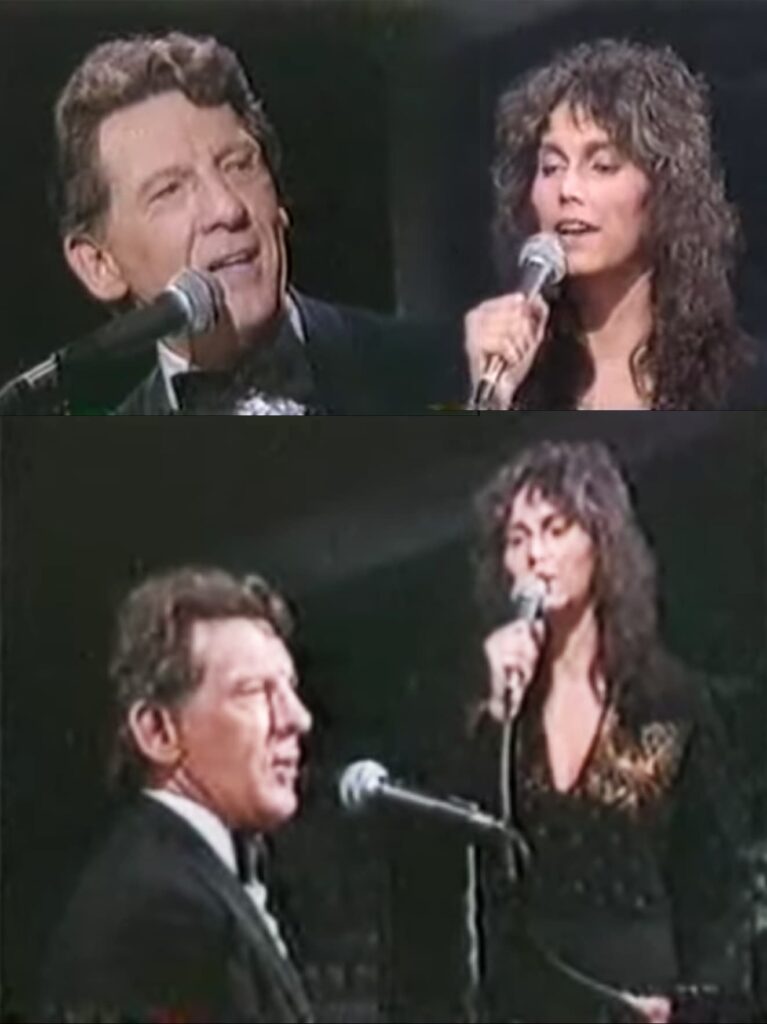
A Collision of Fire and Grace Between Two Artists Who Understood Heartbreak in Completely Different Ways
When Jerry Lee Lewis sat down at the piano beside Emmylou Harris for “Crazy Arms,” the performance carried far more meaning than a simple duet between two famous names. It felt like a meeting between two entirely different emotional worlds inside American music history: the reckless fire of early rock ’n’ roll and the quiet elegance of country-folk storytelling.
And somehow, against all expectations, the combination worked beautifully.
Originally written by Ralph Mooney and Charles Seals, “Crazy Arms” became a country milestone when Ray Price turned it into a massive hit in 1956. The song spent an astonishing 20 weeks at No. 1 on the Billboard country chart, helping establish the smooth “Ray Price shuffle” sound that would influence generations of country music. But for Jerry Lee Lewis, the song carried even deeper personal significance. Before he became rock music’s wildest piano-playing rebel with explosive hits like “Whole Lotta Shakin’ Goin’ On” and “Great Balls of Fire,” he had grown up immersed in country, gospel, and honky-tonk traditions deep in Louisiana.
That history matters when listening to this performance.
Many people remember Jerry Lee Lewis primarily as “The Killer” — the dangerous, untamed showman who attacked the piano like a man trying to outrun the Devil himself. His stage performances in the 1950s became legendary for their chaos and intensity. He kicked piano benches, pounded keys mercilessly, and sang with the ferocity of someone refusing to be forgotten. In the early rock era, nobody looked or sounded quite like him.
But beneath all that fire lived a deeply authentic country singer.
By the time of this collaboration with Emmylou Harris, Jerry Lee had already spent years reinventing himself within country music after the commercial decline of his rock career during the 1960s. Remarkably, he succeeded. Songs like “Another Place, Another Time,” “What’s Made Milwaukee Famous,” and “She Even Woke Me Up to Say Goodbye” proved he could channel heartbreak with as much conviction as rebellion.
Still, pairing him with Emmylou Harris created a fascinating emotional contrast few audiences expected.
Where Jerry Lee Lewis projected raw instinct and dangerous spontaneity, Emmylou Harris brought refinement, atmosphere, and emotional precision. Emerging in the 1970s after the tragic death of Gram Parsons, Emmylou became one of the defining voices of progressive country and Americana music. Her harmonies carried an almost ghostly beauty, capable of softening even the roughest edges of traditional country songs.
In “Crazy Arms,” that contrast becomes the performance’s greatest strength.
Jerry Lee attacks the piano with unmistakable confidence, his playing still carrying flashes of the wild young man who once terrified conservative America. Yet age adds something new to his voice here: weariness. Experience. The heartbreak inside the lyrics no longer sounds theatrical. It sounds lived-in. When he sings about arms that continue to hold someone else, there is resignation beneath the bravado.
Then Emmylou enters.
Her voice does not compete with Jerry Lee’s intensity. Instead, it surrounds it gently, almost like memory itself drifting through the song. The balance between them feels remarkably natural precisely because neither artist abandons their identity. Jerry Lee remains volatile and emotionally exposed. Emmylou remains poised and hauntingly elegant. Together, they create emotional depth neither could fully achieve alone.
What made this collaboration especially compelling to audiences was the symbolic bridge it represented inside American music history. Jerry Lee Lewis belonged to the first explosive generation of rock ’n’ roll rebels who shattered musical boundaries in the 1950s. Emmylou Harris emerged from the introspective singer-songwriter movement of the 1970s, where emotional subtlety and artistic authenticity became central values.
Yet both artists ultimately came from the same roots: country heartbreak songs built on loneliness, longing, and survival.
That shared foundation allows “Crazy Arms” to transcend nostalgia. This is not merely veteran musicians revisiting an old standard. It is two master interpreters uncovering different emotional dimensions within a familiar song. Jerry Lee emphasizes desperation. Emmylou reveals tenderness. Between them lies the full emotional complexity of country music itself.
There is also something deeply moving about hearing Jerry Lee Lewis later in life. Time softened neither his personality nor his musical instincts, but it did add vulnerability to his performances. The swagger remained, yet beneath it listeners could now hear traces of exhaustion, regret, and endurance. In many ways, aging transformed him into an even more convincing country singer because country music has always belonged to survivors.
And few artists survived more publicly than Jerry Lee Lewis.
Watching this performance now feels almost like witnessing two chapters of American music speaking directly to one another across generations. One artist forged in sweat, scandal, and rockabilly chaos. The other shaped by poetic introspection and luminous harmony. Together, they remind listeners that great country music has never truly been about style alone. It is about emotional truth.
That is why this version of “Crazy Arms” continues to resonate so powerfully. Beneath the flawless musicianship and legendary star power lies something far simpler and far more enduring: two extraordinary artists honoring the sadness at the center of an old country song — and making it feel heartbreakingly alive all over again.