
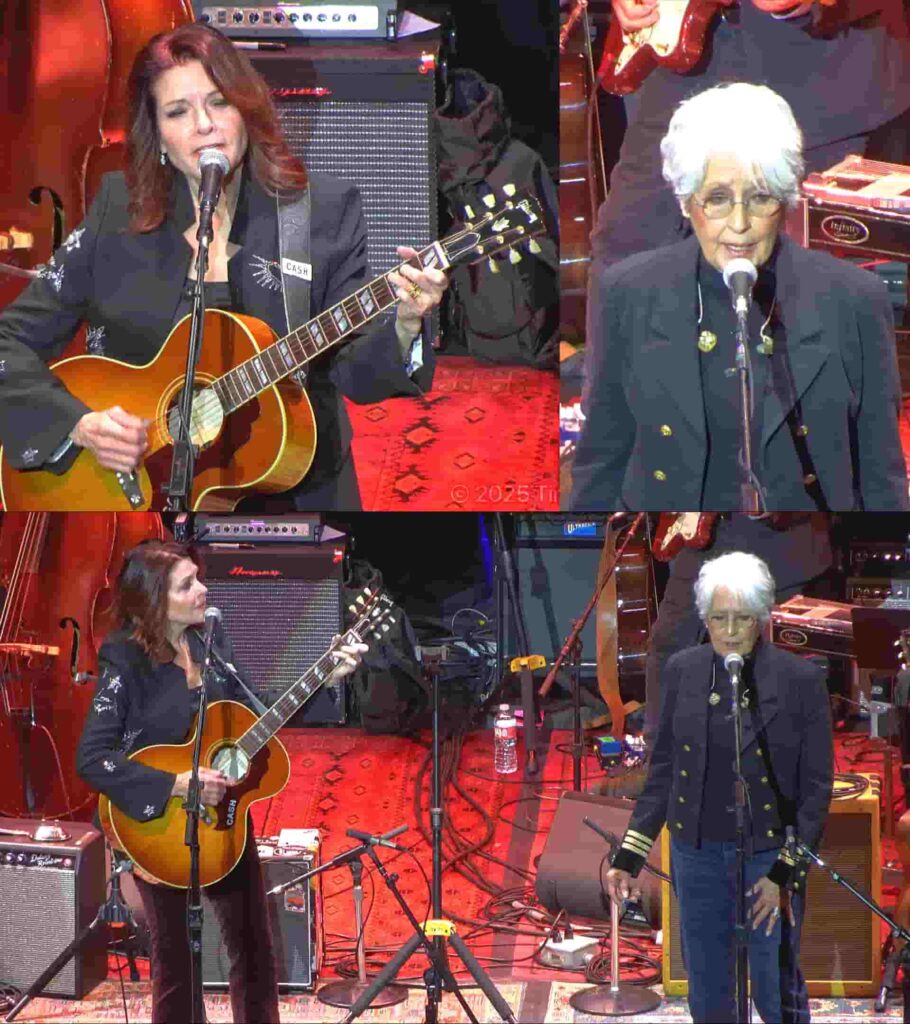
In “Farewell, Angelina,” Joan Baez and Rosanne Cash stood together not merely as performers, but as living bridges to the great American songwriting tradition that shaped generations.
On February 8, 2025, before a sold-out crowd at The Masonic Auditorium in San Francisco, Joan Baez returned to one of the songs forever tied to her artistic legacy: Bob Dylan’s “Farewell, Angelina.” But this performance carried a different emotional gravity than those from decades past. Time had softened nothing about the song’s mysterious power. If anything, age had deepened it.
Standing beside Baez was Rosanne Cash, herself one of America’s most respected songwriters and interpreters of emotional truth. Together, the two women transformed the concert hall into something closer to a gathering of memory, history, and reflection.
Originally written by Bob Dylan in the mid-1960s, “Farewell, Angelina” has long occupied a strange and haunting place in folk music history. Dylan himself never officially released his own studio version during that era, leaving the song to become deeply associated with Baez after she recorded it in 1965. Filled with surreal imagery, shifting landscapes, and cryptic emotional tension, the song has always felt less like a narrative and more like a dream slipping slowly out of reach.
Hearing Joan Baez sing it again in 2025 carried enormous emotional resonance.
Her voice, now weathered by time yet still unmistakably luminous, approached the lyrics with quiet authority. She no longer sang like a young folk activist standing at the center of the 1960s cultural storm. She sang like someone who had survived history itself. Every phrase carried decades of memory behind it.
Beside her, Rosanne Cash added warmth and grounding to the performance. Where Baez floated through Dylan’s surreal poetry with ethereal calm, Cash brought emotional earthiness and subtle strength. Their voices blended beautifully, not in perfect symmetry, but in the richer way two lived-in voices meet after long lives of joy, grief, activism, loss, and endurance.
The musicians surrounding them elevated the atmosphere without overwhelming it. Joe Henry’s restrained guitar work gave the song intimacy, while Greg Leisz painted the edges with mournful pedal steel lines that drifted through the auditorium like distant memories. Jason Crosby’s fiddle and keyboards added texture and melancholy, while the rhythm section of David Piltch and Gabe Harris kept the performance grounded and spacious.
Yet despite the remarkable ensemble, the emotional center remained fixed on Baez herself.
For many in the audience, watching her sing “Farewell, Angelina” in 2025 must have felt like witnessing an echo from another America. An America of folk clubs, protest songs, handwritten letters, and late-night records spinning beside dim living room lamps. The performance carried the weight of survival, not nostalgia alone.
What made the evening especially moving was the absence of grand gestures. There was no attempt to modernize the song or force relevance onto it. Baez and Cash trusted the material completely. They allowed the mystery inside Dylan’s writing to remain unresolved, just as it always has been.
And perhaps that is why the performance lingered so deeply after the final note faded.
Because “Farewell, Angelina” has never really been about understanding every lyric.
It is about feeling time pass.
Feeling people disappear.
Feeling history remain alive through voices that refuse to stop singing.
 Oldies Songs