
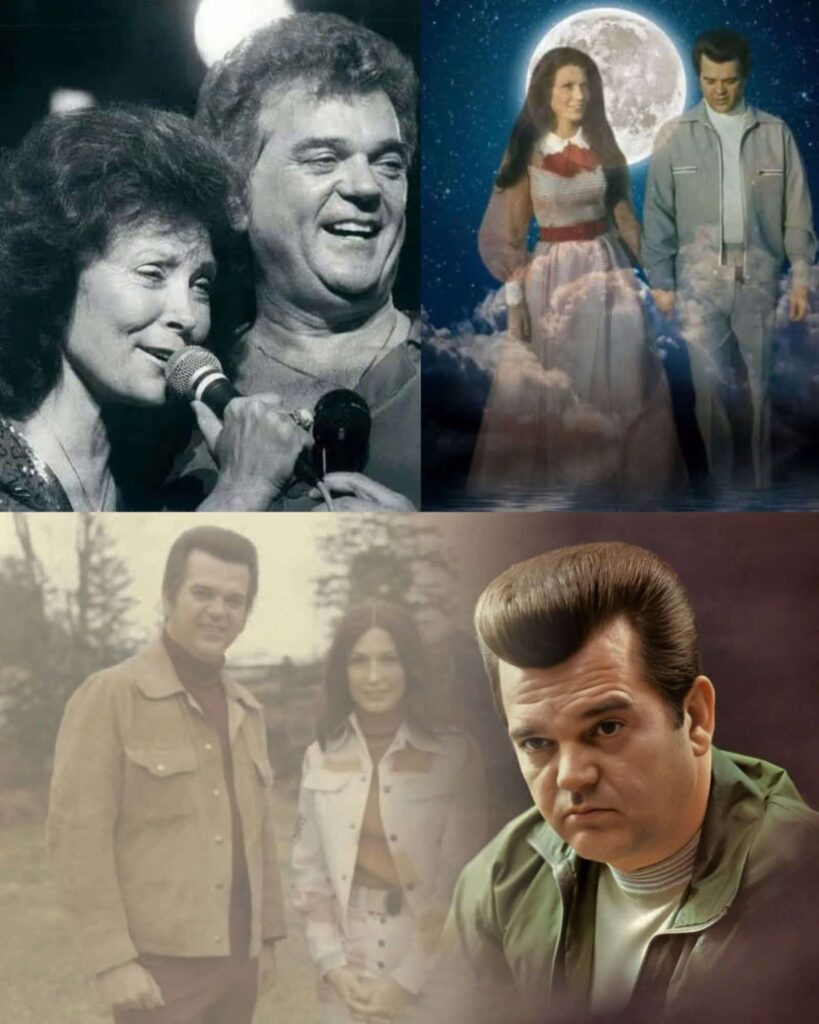
The Love Story America Imagined Was Never Real — But the Friendship Behind the Music Was Even More Beautiful
Few duet partnerships in country music history created more speculation, fascination, and emotional electricity than Conway Twitty and Loretta Lynn. When they stood together onstage, trading lines filled with longing, jealousy, desire, and heartbreak, audiences often believed they were witnessing something more than performance. Their chemistry felt too natural, too convincing, too emotionally alive to be entirely fictional.
And perhaps that is why so many people spent years convinced the two singers were romantically involved offstage.
But according to Loretta Lynn herself, nothing could have been further from the truth.
“Everybody thought me and Conway had a thing going,” she once explained with characteristic honesty. “But that’s the farthest from the truth. I loved Conway as a friend, and my husband did too.”
That statement reveals something profoundly important about their legacy. The emotional intensity listeners heard in their music did not come from scandal or hidden romance. It came from trust, artistic instinct, and a rare musical understanding between two performers who knew exactly how to communicate emotional truth inside a song.
Beginning in the early 1970s, Conway Twitty and Loretta Lynn became one of the most commercially successful duet acts country music had ever seen. At a time when duet recordings often felt temporary or novelty-driven, Conway and Loretta built something enduring. Their collaborations sounded lived-in. Authentic. Dangerous at times. Yet always emotionally believable.
Their first major duet success, “After the Fire Is Gone,” released in 1971, became an immediate sensation. The song reached No. 1 on the Billboard Hot Country Singles chart and won the Grammy Award for Best Country Vocal Performance by a Duo or Group in 1972. More importantly, it shattered expectations about what country duets could discuss openly. The song dealt unapologetically with infidelity, loneliness, and emotional desperation inside marriage — subjects country music understood deeply but often approached cautiously.
Conway and Loretta did not approach them cautiously at all.
That bold emotional realism became the defining feature of their partnership. Songs like “Lead Me On,” “As Soon As I Hang Up the Phone,” “Feelins’,” and especially “Louisiana Woman, Mississippi Man” transformed domestic tension and romantic conflict into thrilling musical drama. Released in 1973, “Louisiana Woman, Mississippi Man” became another No. 1 country hit, driven by fiery vocal interplay that sounded almost flirtatiously competitive.
Listeners believed every word because Conway and Loretta approached duet singing almost like acting.
Conway Twitty possessed one of the smoothest and most emotionally persuasive voices in country music history. His delivery carried intimacy effortlessly. He could make even simple lines sound dangerously personal. Loretta Lynn, by contrast, brought raw honesty and Appalachian toughness into every performance. Her voice was less polished than Conway’s, but perhaps more emotionally fearless. Together, those contrasting qualities created tension that audiences found irresistible.
Still, offstage, their relationship remained grounded in friendship and professional respect.
One of the most touching aspects of Loretta’s recollections about Conway involves her husband, Oliver Lynn — known affectionately as “Doolittle” or “Mooney.” Loretta often acknowledged that her husband could be suspicious of people in the entertainment business and protective of their marriage. Yet he genuinely liked Conway Twitty. The two men reportedly spent hours talking together comfortably, something Loretta always viewed as proof of the sincerity behind the friendship.
That detail matters because it dismantles the mythology audiences tried so hard to create around them.
In truth, Conway and Loretta did not need a secret romance to explain their chemistry. Great musical partnerships often emerge from emotional intelligence rather than romantic involvement. They understood timing, phrasing, humor, and emotional pacing instinctively. Each knew exactly how far to push a lyric, when to soften a line, when to tease, and when to let heartbreak linger.
Very few duet teams ever achieved that level of natural communication.
Their success also arrived during a transformative era in country music. The 1970s saw country become more emotionally candid and commercially expansive. Traditional themes of love and heartbreak remained central, but artists increasingly explored adult relationships with greater complexity and realism. Conway and Loretta stood at the center of that evolution. Their songs acknowledged temptation, frustration, passion, and emotional loneliness without moralizing.
For working-class listeners especially, their music often sounded startlingly familiar. These were not fantasy romances. These were songs about marriages under pressure, stubborn love, pride, desire, and survival
And perhaps that authenticity explains why the rumors surrounding them persisted for so long. Audiences sometimes struggle to believe emotional honesty can exist without personal entanglement behind it. But Conway Twitty and Loretta Lynn proved otherwise. They demonstrated that two artists could create deeply convincing romantic music while remaining simply loyal friends.
Watching their performances today feels almost bittersweet because modern country music rarely produces duet partnerships with such long-term emotional depth. Their collaborations unfolded across years rather than isolated singles. Listeners watched their musical relationship evolve over time, almost like characters inside an ongoing story.
By the time Conway Twitty passed away unexpectedly in 1993, Loretta Lynn spoke about him not merely as a collaborator, but as someone irreplaceable in her life. The grief in her voice during later interviews revealed how deeply she valued their friendship beyond the spotlight.
And perhaps that is the real story behind Conway and Loretta — not hidden romance, but something quieter and maybe even more meaningful: two artists who trusted each other completely, understood each other instinctively, and together created songs so emotionally believable that the world could not separate the music from reality itself.
 Oldies Songs