
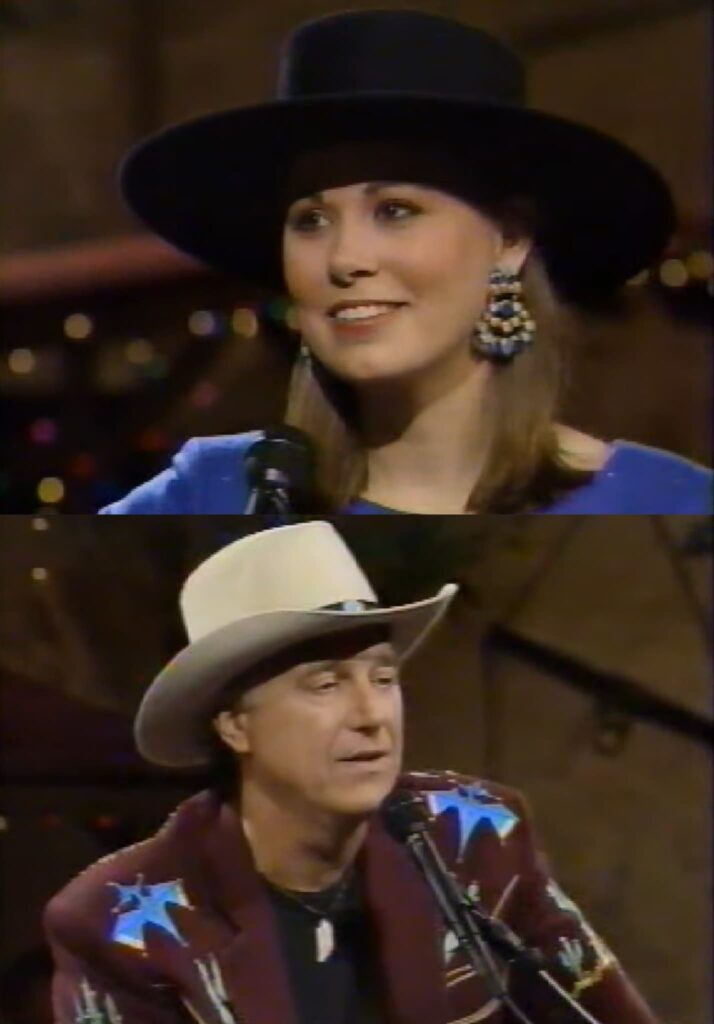
TWO WANDERING VOICES, ONE COWBOY SONG, AND THE OPEN WESTERN SKY
When Suzy Bogguss sat beside Jerry Jeff Walker to sing “Night Rider’s Lament,” the performance became more than music. It became a memory of dusty highways, late-night coffee houses, and the restless freedom of the American West.
There was something wonderfully unpolished about the evening. Before the music even began, the audience was treated to a long, easy conversation between Jerry Jeff Walker and Suzy Bogguss. It felt less like a television appearance and more like two old friends talking after midnight at a roadside café somewhere between Texas and Colorado. They laughed about low-paying gigs, free pizza, borrowed guitars, and the strange reality of trying to survive through folk music in the 1970s and 1980s.
Suzy Bogguss spoke with the warmth and honesty that made audiences love her long before she became a Grammy-winning country star. She recalled growing up in a small Illinois town where becoming a professional entertainer hardly seemed possible. Music, at first, was simply a way to earn a few dollars in college coffee houses. One of her earliest jobs paid only seven dollars plus “all the beer and pizza” she could consume. The audience roared with laughter when she admitted she used to take the leftover pizza home for her roommates.
But beneath the humor was the story of an artist discovering her calling.
After college, Bogguss traveled west to Colorado and Wyoming, where she encountered a very different musical culture. She described musicians teaching songs to one another on street corners, trading stories around guitars, and building a sense of fellowship through folk music. Listening to her speak, one could almost see the old Boulder sidewalks, crowded with wandering singers carrying guitar cases through mountain air.
That wandering spirit led naturally into “Night Rider’s Lament,” one of the most beloved cowboy songs written by Michael Burton and famously recorded by Jerry Jeff Walker on his 1975 album Ridin’ High. By the time Walker and Bogguss performed it together, the song had already become something sacred among lovers of Western music.
The performance itself carried a rare intimacy. Jerry Jeff’s weathered Texas voice sounded lived-in and honest, while Suzy’s gentle harmonies softened the rough edges like moonlight over prairie dust. She even joked about adapting the lyrics into a version she could sing from a woman’s perspective, though she laughed that it “still doesn’t make much sense.” The audience loved every second of it.
As the familiar lines unfolded about lonely riders, northern lights, hawks on the wing, and campfire songs echoing across the Divide, the room grew quieter. The song captured a kind of loneliness that older country music understood deeply. Not sadness exactly, but the ache of choosing freedom over comfort and knowing there is always a price attached to wandering too far from home.
When they sang:
“Why do they ride for their money?
Why do they rope for short pay?”
it no longer sounded like a simple cowboy lyric. It sounded like a question asked by every traveling musician, every drifter, and every soul who ever traded stability for the open road.
Jerry Jeff Walker knew that life better than most. A central figure in outlaw country and progressive folk, he spent decades turning rambling experiences into songs filled with humor, heartbreak, and humanity. Suzy Bogguss, though coming from a different musical generation, met him perfectly in that emotional space. Their chemistry felt natural because both artists understood storytelling first and celebrity second.
By the end of the performance, the applause felt deeply affectionate rather than explosive. The audience knew they had witnessed something genuine. No elaborate production. No grand spectacle. Just two musicians sharing stories and songs that carried the smell of campfire smoke and old leather saddles.
Even today, that performance survives as a beautiful reminder of a time when country and folk music still made room for wandering spirits, quiet conversations, and songs that sounded like real life.