
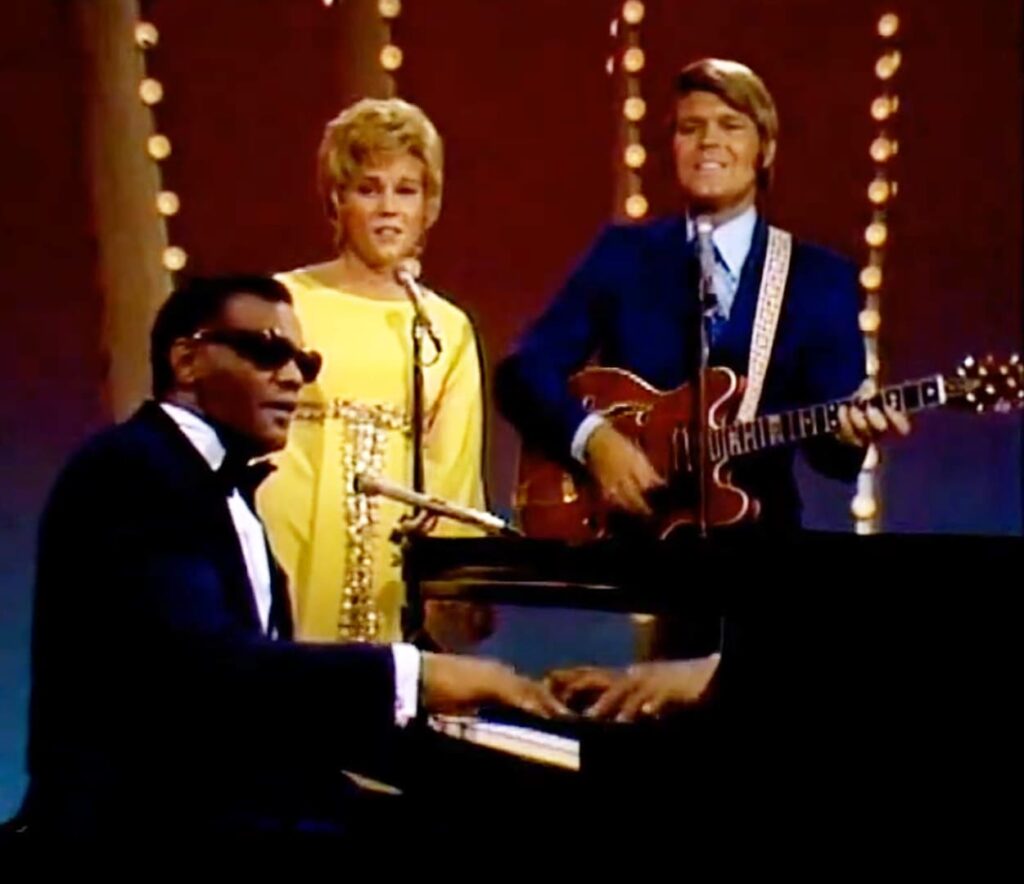
THREE LEGENDARY VOICES STOOD TOGETHER IN 1970 AND TURNED A TELEVISION STAGE INTO PURE AMERICAN MUSIC HISTORY
There are certain television performances that feel larger than entertainment. They become snapshots of an era when music still carried warmth, spontaneity, and human chemistry that could never be manufactured. The December 13, 1970 medley featuring Ray Charles, Anne Murray, and Glen Campbell is one of those rare moments.
Watching these three artists share the stage feels almost magical now. Each came from a completely different musical world, yet together they sounded effortless, as though country, soul, gospel, and pop had always belonged in the same room. There was no ego fighting for attention. No oversized production. Just musicians listening to one another and allowing the songs to breathe naturally.
The medley opens with “Blue Moon of Kentucky,” immediately setting a joyful, loose atmosphere. Glen Campbell’s easy charisma anchors the performance, while Anne Murray brings a calm elegance that balances the energy beautifully. Then comes Ray Charles, whose voice instantly changes the emotional gravity of the room. Few singers in history could bend a melody with such emotional authority. Even a familiar lyric suddenly sounded lived-in when Ray touched it.
But the emotional center of the performance arrives during “Born To Lose.” The song itself had already become a country standard long before this appearance, yet hearing Ray Charles and Glen Campbell move through it together creates something quietly devastating. Ray’s phrasing carries deep blues sorrow, while Campbell’s smoother country-pop delivery softens the edges just enough to make the heartbreak even more human.
Anne Murray’s presence throughout the medley is especially fascinating in hindsight. In 1970, she was still early in her rise to international fame after the massive success of “Snowbird.” Yet even standing beside giants like Ray Charles and Glen Campbell, she never looked intimidated. Her warmth and natural musical instincts allowed her to fit seamlessly into the performance. You can already see the calm professionalism that would later make her one of the most enduring crossover artists in modern music history.
What makes this performance so moving today is how unforced everything feels. Television variety shows of that era created spaces where artists genuinely interacted instead of merely appearing beside one another for publicity. The smiles were real. The musical exchanges were spontaneous. Even the imperfections added charm because audiences were witnessing living musicianship instead of carefully polished spectacle.
And then there is Glen Campbell himself, serving not just as performer but as gracious host. During those years, The Glen Campbell Goodtime Hour had become one of the last great homes for traditional musical collaboration on network television. Campbell possessed a rare ability to make guests feel relaxed, whether they came from country, soul, folk, or pop backgrounds.
The closing moments, including the brief reprise of “By the Time I Get To Phoenix,” now carry an especially nostalgic ache. Listening today, you realize you are hearing three voices from an America that no longer quite exists. An era when television audiences gathered together weekly around performances like this, when musical genres still crossed paths organically, and when artists were judged more by sincerity than image.
For older listeners especially, this medley feels like returning to a familiar living room from long ago. The lights are warm. The television glows softly in the corner. And for a few beautiful minutes, Ray Charles, Anne Murray, and Glen Campbell remind the world how timeless great music can truly be.