
By 2003, “Wake Up Little Susie” No Longer Sounded Like Teenage Trouble. It Sounded Like Two Brothers Remembering an Entire Lifetime Together
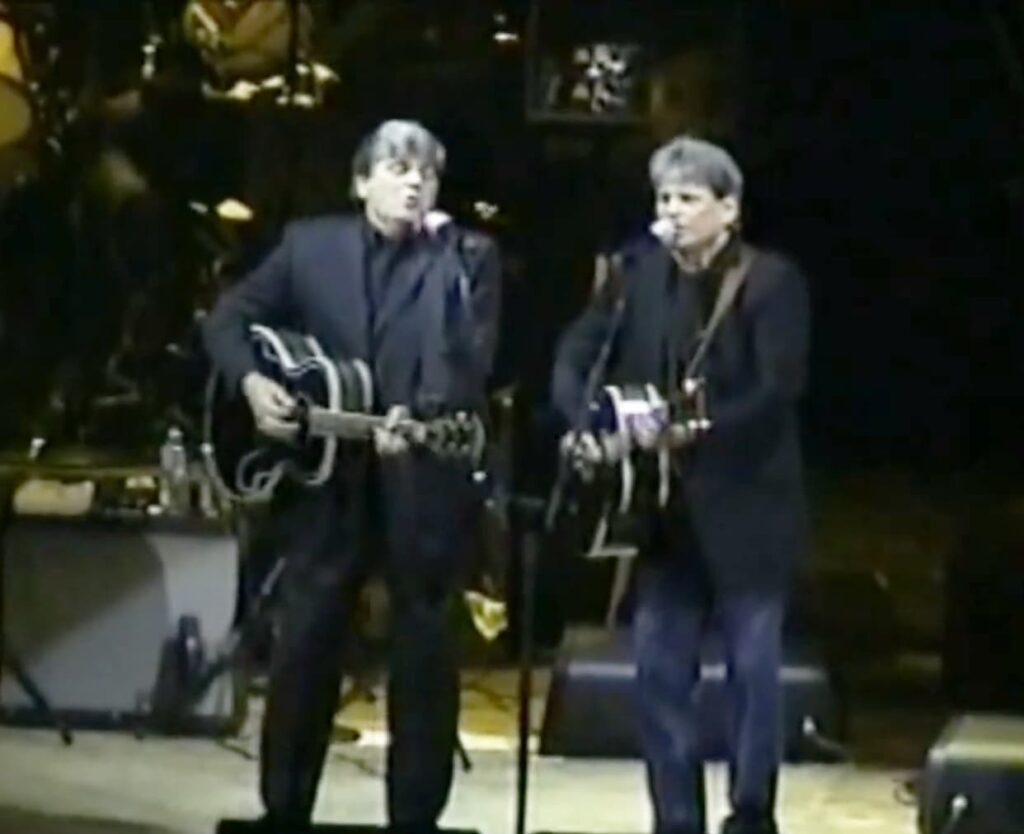
When The Everly Brothers walked onto the stage in Wilkes-Barre on October 16, 2003, the audience already knew they were witnessing something rare. Don and Phil Everly were no longer the impossibly young hitmakers who once shook American radio with “Wake Up Little Susie” in 1957. Time had changed everything around them. Rock and roll itself had changed. But the moment they began to sing, something extraordinary returned.
That harmony.
The famous Everly “blood harmony” still moved with almost supernatural instinct. Their voices no longer carried the youthful brightness of the 1950s, yet the connection between them remained untouched. One voice floated beneath the other so naturally that it felt less like two singers performing and more like memory itself becoming audible.
What makes the 2003 performance so emotional is the contrast between past and present.
Back in 1957, “Wake Up Little Susie” was playful teenage rebellion. It was nervous young love, late-night movie theaters, and the innocent panic of waking up too late. The original recording exploded with youthful energy and became one of the defining sounds of early rock and roll.
But in Wilkes-Barre nearly half a century later, the song carried an entirely different feeling.
There was no frantic excitement anymore.
No teenage urgency.
Instead, there were two older brothers standing side by side, singing a song that had followed them through almost every chapter of their lives. Every lyric seemed wrapped in decades of history: the fame, the exhaustion, the breakups, the reunions, and the complicated bond that only siblings can fully understand.
For longtime fans, that emotional weight is impossible to separate from the music.
Don Everly and Phil Everly famously endured years of tension and estrangement. Their split in the 1970s became one of the most painful stories in popular music history. Yet whenever they sang together again, it was as though the years of silence disappeared inside the harmony.
That is what makes this performance feel almost haunting today.
Watching it after Phil Everly’s death in 2014 transforms the concert into something far more profound than nostalgia. It feels like the final echo of an era that can never truly return. The brothers are calm, restrained, and completely unpretentious onstage. There is no attempt to modernize the song or turn it into spectacle. They simply trust the music that carried them through a lifetime.
And somehow, that restraint makes the performance even more moving.
Many fans describe late Everly Brothers performances this way: not as attempts to recreate youth, but as quiet conversations with it. By 2003, Don and Phil were not trying to prove they could still sing like young men. They were honoring the songs that had survived alongside them.
That is why the crowd reaction feels so warm and reverent throughout the performance. The audience is not merely hearing an old hit. They are hearing a living piece of American musical history. Without The Everly Brothers, the harmonies later perfected by bands like The Beatles, Simon & Garfunkel, and The Byrds might never have sounded the same.
But beyond influence and legacy, this performance endures for a simpler reason.
It shows two brothers who spent their lives drifting apart and coming back together again, standing beneath the lights one more time, still able to create something beautiful the instant they opened their mouths to sing.