
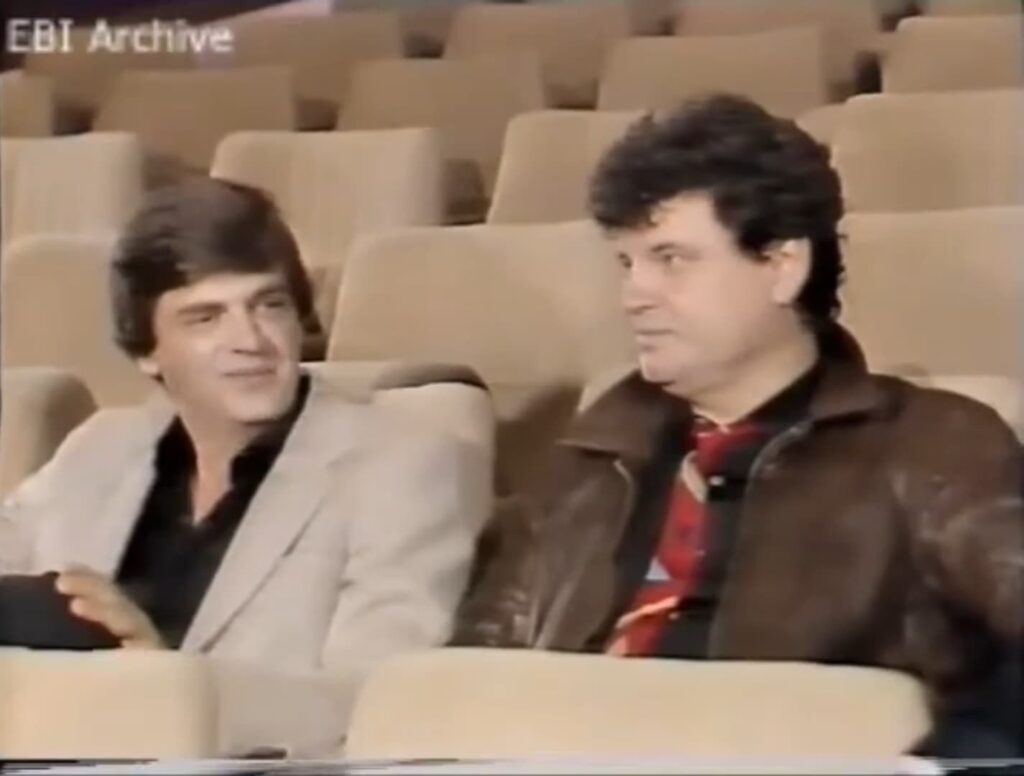
When The Everly Brothers Reunited at Royal Albert Hall in 1983, It Felt Like Rock and Roll Was Repairing an Old Wound in Public
In September 1983, London’s Royal Albert Hall became the setting for one of the most emotional reunions in popular music history. After ten years apart, The Everly Brothers walked back onto the stage together, and suddenly an entire generation was transported back to the late 1950s.
The British news clips covering the reunion captured something larger than nostalgia. They documented two brothers attempting to rediscover each other in real time.
By then, Don and Phil Everly were already legends. Between 1957 and the early 1960s, they had helped shape the very sound of modern pop music. Their mixture of rock and roll, country roots, and impossibly close harmonies produced classics like “Bye Bye Love,” “Wake Up Little Susie,” and “Cathy’s Clown.” Within only three years of their first hit, they had reportedly sold 15 million singles and became the first pop stars ever awarded a million dollar recording contract.
But behind the harmony was a relationship slowly collapsing under pressure.
The brothers split in 1973 after years of exhaustion, arguments, and personal strain. For a long time, they barely spoke to each other. That is what made the 1983 reunion so powerful. It was not simply a comeback concert. It was a reconciliation between two men who had spent almost their entire lives together and then suddenly learned how painful separation could be.
One of the most revealing moments from the interviews comes when the brothers are asked whether it was difficult to find their old sound again. Phil Everly laughs softly and admits they were surprised by how naturally it returned:
“It was really surprising… we just tuned up. Just like jumping in water.”
That line explains almost everything about the Everly Brothers.
The harmony was never manufactured. It was instinctive. Their voices moved together because their lives had moved together since childhood. Raised in a Kentucky musical family, Don and Phil were already singing on radio stations before they were even ten years old. In the clips, they speak openly about growing up under unusual circumstances, working at dawn before school while most children were still asleep.
By 1983, both men also seemed older in spirit than their years. There is a noticeable weariness in the interviews, but also relief. Don speaks honestly about needing time apart to discover who they were as individuals. Phil quietly acknowledges how unnatural it was to spend an entire lifetime living and working so closely together.
“It’s not really normal to spend your life completely that close,” he says.
That honesty gave the reunion emotional weight far beyond ordinary nostalgia.
The footage from rehearsals and press conferences is especially moving now because the brothers do not behave like untouchable icons. They joke nervously. They glance at each other for reassurance. They seem almost unsure how to explain why they finally came back together after so many refusals.
And perhaps the most touching answer is also the simplest.
“It was just time.”
When they finally stepped onto the stage at Royal Albert Hall, the audience reaction bordered on reverence. Fans were not merely applauding hit songs. They were witnessing two brothers rebuild something many people believed had been broken forever.
Looking back now, especially after Phil Everly passed away in 2014, the reunion feels even more emotional. The famous harmonies still sound miraculous, but the real story lies between the songs: two men who survived fame, resentment, distance, and time itself, only to discover that the music connecting them had never fully disappeared.
That is why the 1983 reunion still resonates so deeply decades later.
Not because it recreated the past perfectly.
But because it proved some harmonies are stronger than silence.