
More Than Fifty Years After Gram Parsons Dreamed of “Cosmic American Music,” Emmylou Harris Walked Onto a Rotterdam Stage Carrying the Last Living Echo of That Lost World
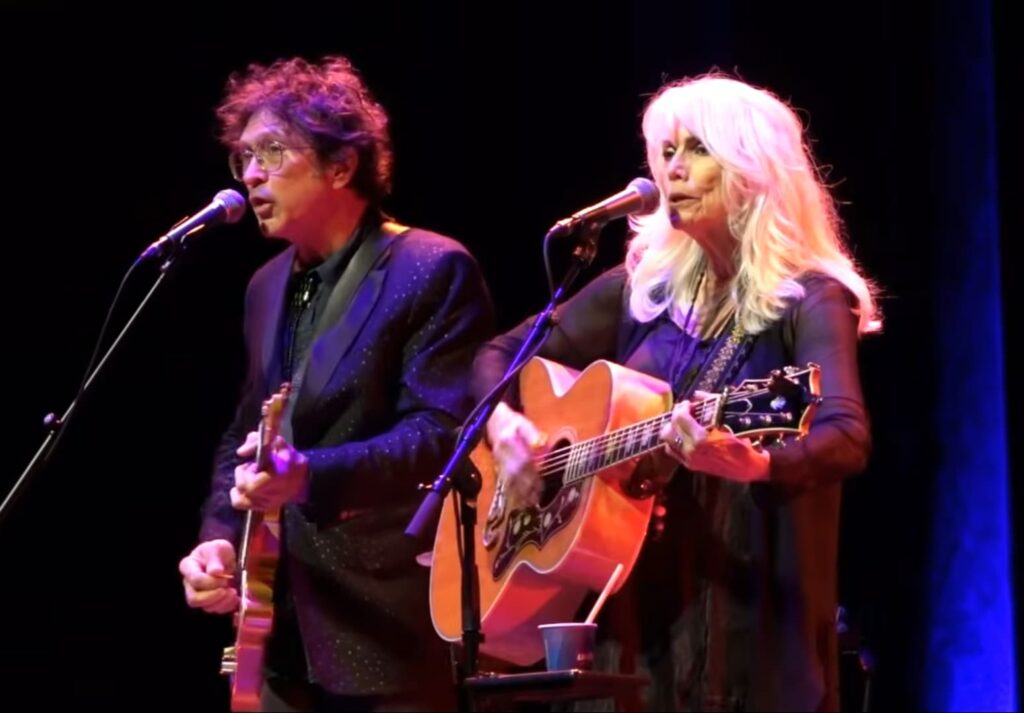
In 2026, inside a quiet concert hall in Rotterdam, Emmylou Harris sang “Return of the Grievous Angel” with the kind of grace that only time can give. The performance was beautiful, but it was also something heavier than beauty. It felt like memory itself had stepped onto the stage.
Back in 1974, when the song first appeared on Gram Parsons’ legendary album Grievous Angel, Emmylou was still a relatively unknown singer with a remarkable voice and uncertain future. Parsons, restless and visionary, was trying to build something entirely new through what he called “Cosmic American Music,” blending country, rock, folk, gospel, and desert poetry into one drifting American dream.
Few could have imagined that more than fifty years later, Emmylou Harris would become the last great keeper of that flame.
When she sang lines like “Won’t you scratch my itch sweet Annie Rich,” the lyrics no longer sounded playful or surreal. They sounded haunted. Every word opened a door back to the 1970s, back to Gram Parsons, back to the outlaw generation that once believed music could feel both earthly and spiritual at the same time.
That is what made the Rotterdam performance so emotional.
Many artists eventually leave their past behind. They stop performing the old songs or reshape themselves for newer audiences. But Emmylou Harris continues returning to “Return of the Grievous Angel” as if it were tied directly to her soul. The song no longer feels like catalog material. It feels like an artistic promise she never stopped keeping.
Her voice in 2026 carried none of the crystal brightness that once floated through recordings like “Luxury Liner” or “Boulder to Birmingham.” Age has softened and weathered it. There is more breath now, more fragility, more space between the notes.
Yet somehow, that makes the song hurt even more.
The older voice transforms the performance into something deeply human. It no longer sounds like a young woman singing about wandering highways and mystical America. It sounds like someone who has lived an entire lifetime remembering the dream she once saw up close.
That emotional weight was strengthened by the musicians surrounding her. Phil Madeira, Will Kimbrough, Bryan Owings, Chris Donahue, and Eamon McLoughlin played with remarkable restraint and tenderness. No one tried to modernize the arrangement or overpower the atmosphere. The mandolin, fiddle, accordion, and harmony vocals floated gently through the room like fading desert radio signals from another century.
The setting itself added another layer of melancholy.
There was something strangely beautiful about hearing one of the most American songs ever written echo through Rotterdam. The highways, deserts, motels, and California myths inside Gram Parsons’ music have traveled far beyond the United States now. European audiences hear these songs almost like folklore from a vanished world they somehow still miss.
And perhaps that is why performances like this resonate so deeply today.
By 2026, Emmylou Harris no longer simply performed “Return of the Grievous Angel.” In many ways, she had become part of the song itself.
Her silver hair, her quiet dignity, the fragile warmth still lingering inside her voice all gave her the same mysterious aura that once surrounded Gram Parsons. There was an almost spiritual feeling watching her stand beneath the lights, smiling softly between verses as if sadness, gratitude, survival, and memory had all learned to live together peacefully inside one heart.
For many in the audience, the performance seemed to ask a question larger than music itself:
Can songs keep ghosts alive?
For one evening in Rotterdam, the answer felt very close to yes.