
Two Months After Buck Owens Passed Away, His Friends Didn’t Hold a Memorial Service. They Gathered on a Stage and Played the Music He Loved.
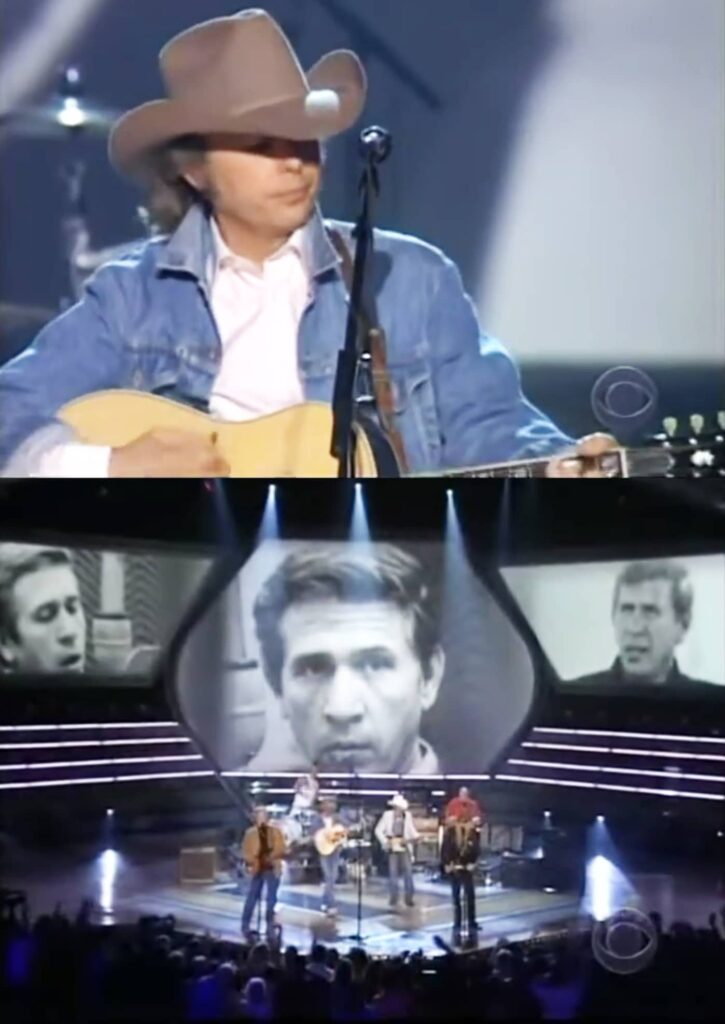
When Buck Owens died on March 25, 2006, country music lost more than a hitmaker. It lost one of the architects of a sound that changed the direction of American music. Just two months later, on May 23, 2006, a remarkable television tribute brought together an extraordinary collection of musicians to celebrate his life, his songs, and the enduring influence of the Bakersfield Sound.
At the center of the tribute stood Dwight Yoakam, perhaps the artist most closely associated with carrying Owens’ musical legacy into a new generation. Yet this was not simply another performance. From the moment Yoakam stepped onto the stage, it felt personal. During his introduction, he recalled that Buck had once given him the guitar he was holding that night. With a smile, he joked that nobody was allowed to touch it, except perhaps Brad Paisley. The audience laughed, but beneath the humor was a deeper truth. Buck Owens had been more than an inspiration to Dwight Yoakam. He had been a mentor, a friend, and one of the guiding forces behind Yoakam’s career.
The lineup assembled for the evening revealed just how far Owens’ influence extended beyond traditional country music. Alongside Yoakam were Brad Paisley, Billy Gibbons of ZZ Top, Chris Hillman, Travis Barker, original Buckaroos steel guitarist Tom Brumley, and later, Buddy Alan Owens, the son of Buck and Bonnie Owens. It was a gathering that crossed generations and genres, bringing together country, rock, country-rock, and alternative musicians under one roof.
Their presence illustrated something important. Buck Owens was often identified as a country star, but his impact reached far beyond the boundaries of Nashville. The bright, electric energy of the Bakersfield Sound influenced artists across the American musical landscape. The tribute served as living proof that Owens’ fingerprints could be found everywhere.
The opening choice of “Act Naturally” felt especially fitting. The song had helped establish Owens as a national star decades earlier, and hearing it again transported viewers back to the years when the red, white, and blue guitar became one of country music’s most recognizable symbols. It was both a celebration and a reminder of how much he had accomplished.
As joyful as the opening moments were, the emotional heart of the program arrived during “Together Again.” Long regarded as one of Owens’ most beautiful recordings, the song carried a different weight in 2006. The familiar lyrics suddenly sounded less like a love song and more like a farewell. For many viewers, it became the most moving moment of the entire tribute.
Another unforgettable chapter came when Yoakam welcomed Buddy Alan Owens to the stage. In introducing him, Yoakam honored not only Buck but also Bonnie Owens, who had recently passed away and whose contributions to the Bakersfield Sound were often overshadowed by those of her former husband. The moment transformed the show from a musical tribute into something much more intimate. It became a son honoring the legacy of both parents.
When Buddy Alan joined Yoakam for “Streets of Bakersfield,” the song seemed to take on an entirely new meaning. Originally a story about an outsider searching for opportunity, it now felt like an unofficial anthem for Buck Owens himself. No artist was more closely linked to Bakersfield than the man being honored that night.
Perhaps the most touching aspect of the performance is how it feels when viewed today. The musicians were not trying to recreate history. They were preserving it. The appearance of Tom Brumley, one of the original architects of the Bakersfield Sound, reminded audiences that they were hearing not a tribute band, but part of the very foundation of the music itself.
Looking back, the evening stands as far more than a memorial concert. It captured a community expressing gratitude through the language it knew best. Rather than mourning in silence, Buck Owens’ friends picked up their instruments and played. In doing so, they demonstrated that while legends may leave the stage, the songs they leave behind continue to echo long after the final applause has faded.
 Oldies Songs