
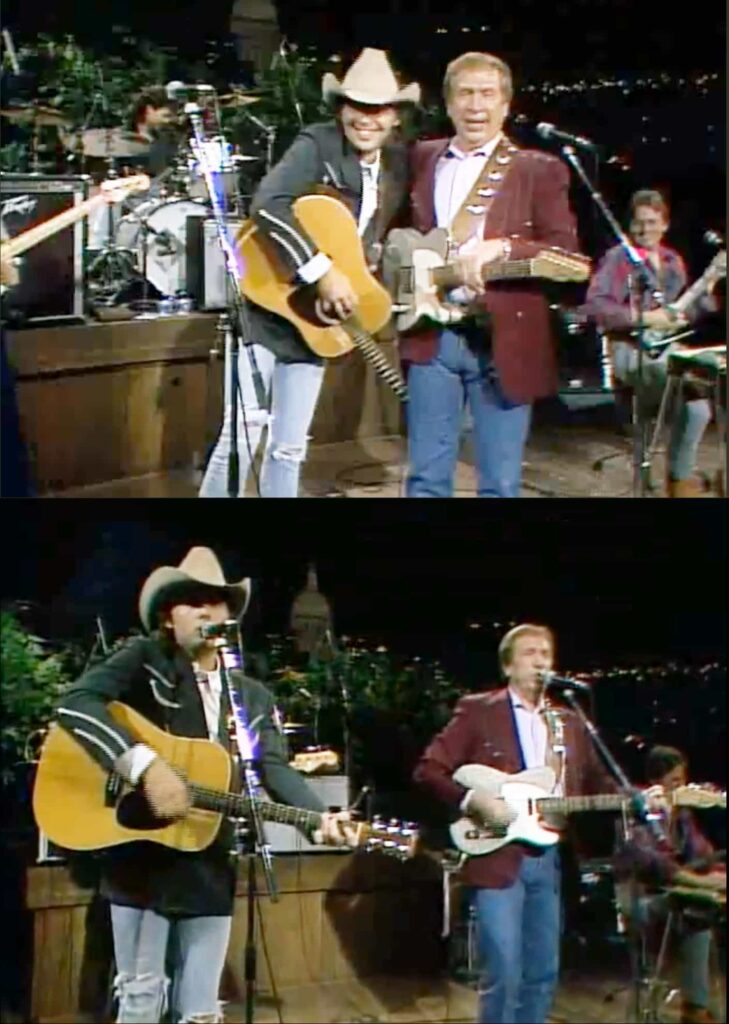
Twenty-Nine Years After Writing This Song, Buck Owens Stood Beside the Man Who Helped Bring Him Back to Country Music
When Buck Owens performed “Under Your Spell Again” during the historic Austin City Limits taping on October 23, 1988, it appeared to be a simple rendition of one of his classic hits. Yet beneath the familiar melody was a far more meaningful story. This was not merely a performance. It was a rare moment when a musical pioneer could see his influence living on through the artist standing beside him.
That artist was Dwight Yoakam.
By 1988, Yoakam had become one of country music’s brightest stars, earning acclaim for bringing traditional sounds back to the forefront at a time when Nashville was increasingly embracing polished production. For many fans, he was more than a successful performer. He was the most visible heir to the legacy of the Bakersfield Sound, the energetic, guitar-driven style that Buck Owens had helped create decades earlier.
The connection between the two men ran deeper than musical influence.
Only a few years before this Austin City Limits appearance, Owens had largely stepped away from the music business. Although he remained a respected legend, his days of chart dominance seemed firmly in the past. Then something unexpected happened. Dwight Yoakam openly celebrated Buck’s music, introduced a new generation to his work, and helped spark renewed interest in one of country music’s most important architects.
Many fans believe that without Yoakam’s admiration and persistence, Owens’ remarkable late-career revival might never have happened.
That reality gives “Under Your Spell Again” an entirely different meaning when viewed through the lens of history. Originally released in 1959 and co-written by Owens, the song became one of his earliest major successes, reaching the Top 5 on the country charts. Nearly three decades later, he returned to perform it with the artist most closely associated with carrying his musical vision into a new era.
The timing could not have been more significant.
Just months before this performance, Owens and Yoakam had stunned the country music world with “Streets of Bakersfield.” The duet became Buck’s first No. 1 country hit in sixteen years. Suddenly, a performer many had viewed as part of country music’s past was once again making headlines in the present.
As a result, the Austin City Limits appearance felt less like a nostalgic reunion and more like the beginning of a new chapter.
What makes the performance especially moving today is the chemistry between the two artists. Viewers often notice the smiles, the relaxed interaction, and the obvious mutual respect. Knowing the story behind the collaboration changes everything. Rather than watching two singers sharing a stage, audiences are witnessing a devoted admirer performing alongside one of his greatest heroes.
The performance also symbolizes a larger moment in country music history. Owens spent the 1960s challenging Nashville conventions with the Bakersfield Sound. Decades later, Yoakam was fighting his own battle to preserve traditional country influences during another period of change. In many ways, they were pursuing the same mission in different generations.
That is why this rendition of “Under Your Spell Again” feels so significant. It is not simply a duet. It is a conversation between two eras of country music. One artist built a movement. The other ensured that movement would not be forgotten.
The title itself seems strangely fitting. While the song was originally written about romantic attraction, history has added another layer of meaning. After years away from the spotlight, Buck Owens appeared to have fallen under the spell of music once again. The enthusiasm of a younger generation, led by Dwight Yoakam, helped draw him back to the stage he once ruled.
Today, the performance stands as one of the most heartwarming moments in classic country television. It captures a legend enjoying an unexpected resurgence, a devoted disciple honoring his inspiration, and a musical tradition being passed from one generation to the next.
Sometimes the most important performances are not the loudest or the most dramatic. Sometimes they are simply the moments when a pioneer realizes that his music will continue long after he is gone. On that Austin stage in 1988, Buck Owens received exactly that gift.