
The song that launched Dwight Yoakam’s career became a declaration of everything he would spend a lifetime defending
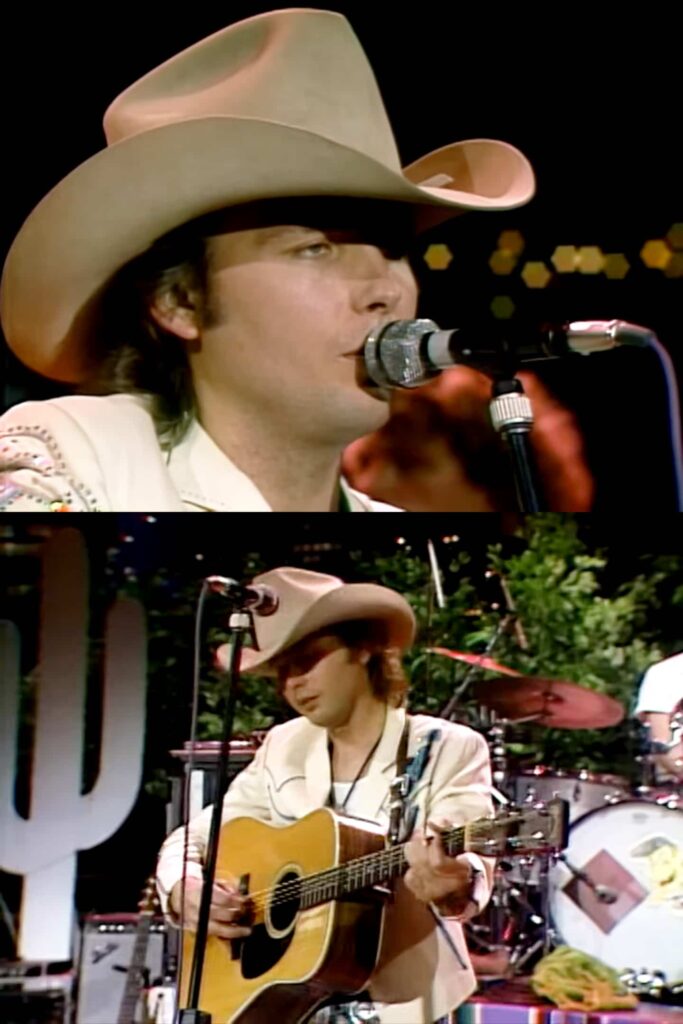
When Dwight Yoakam stepped onto the stage in Austin, Texas to perform “Honky Tonk Man,” he was singing far more than an old country hit. He was revisiting the very song that helped change the course of his life and, in many ways, helped restore traditional country music at a moment when many believed it was fading from the mainstream.
Released as the first single from his breakthrough 1986 debut album Guitars, Cadillacs, Etc., Etc., “Honky Tonk Man” introduced millions of listeners to a young artist who seemed determined to travel in the opposite direction of Nashville’s prevailing trends. While country radio was increasingly embracing polished production, pop influences, and contemporary sounds, Yoakam appeared wearing a cowboy hat, carrying the sharp twang of the Bakersfield Sound, and proudly embracing the spirit of classic honky-tonk music.
The gamble worked.
The song became his first major country hit and opened the door to a career that would eventually make him one of the most influential traditionalists of his generation. Looking back today, that success feels almost inevitable. Yet in 1986, it was anything but.
One of the most fascinating details surrounding “Honky Tonk Man” is that the song was not written by Yoakam at all. The tune was first recorded by Johnny Horton in 1956, becoming one of the defining recordings of the rockabilly and country era. Decades later, Yoakam discovered new life within the song and transformed it for a new generation. Some artists create hits. Others rescue great songs from history and remind listeners why they mattered in the first place. Yoakam belonged firmly in the second category.
What makes this Austin performance especially memorable is what happened after the final note. Rather than speaking about chart positions, awards, or commercial success, Yoakam immediately turned his attention to the people who helped shape his musical journey.
With genuine gratitude, he told the audience that one of the benefits of knowing Buck Owens was that Owens had introduced him to “Honky Tonk Man.” It was a brief comment, but one loaded with significance.
For country music historians, Owens was more than a star. He was the architect of the Bakersfield Sound, the musical movement that challenged Nashville’s smoother productions and inspired generations of artists seeking a rawer, more authentic approach. Without Buck Owens, there might never have been a Dwight Yoakam as the world came to know him. In that moment on stage, listeners were witnessing something touching and timeless: a student publicly thanking his mentor.
Yoakam also paused to praise Flaco Jiménez, the legendary Texas accordion player who contributed to the song’s distinctive Tex-Mex flavor. Calling Jiménez’s contribution “magic,” Yoakam made it clear that the recording’s success was not the work of one man alone. It was a reminder of an old country music truth that often gets overlooked. Behind every great artist stands a community of musicians, teachers, and friends whose influence echoes through every note.
Today, debates still continue among country fans about which version of “Honky Tonk Man” reigns supreme. Some remain loyal to Johnny Horton’s original 1950s recording with its rockabilly charm and youthful energy. Others prefer Yoakam’s harder-edged Bakersfield interpretation, driven by Telecaster guitars and an unmistakable sense of urgency. There may never be a final answer, and perhaps that is part of the song’s enduring appeal.
Viewed through the lens of history, this Austin performance feels like much more than a concert clip. It captures a pivotal artist celebrating the song that became his calling card. The lyrics speak of music, freedom, wandering, and life lived on one’s own terms. Those themes were not merely part of a song for Dwight Yoakam. They became the blueprint for an entire career.
Nearly four decades later, “Honky Tonk Man” remains a joyful reminder that sometimes the bravest thing an artist can do is refuse to follow the crowd. Dwight Yoakam chose the old road when everyone else seemed headed somewhere new. In doing so, he helped ensure that the sound of traditional country music would continue to echo far beyond the dance halls and honky-tonks where it was born.