
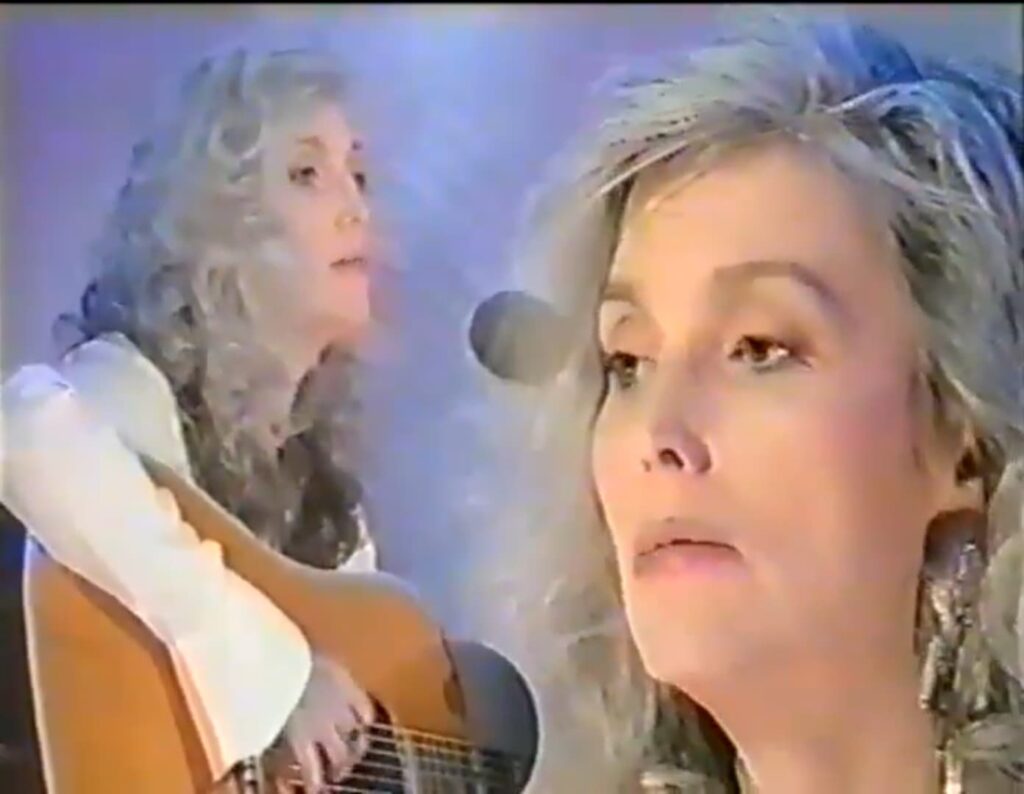
In a Quiet British Television Studio, Emmylou Harris Turned “Prayer in Open D” Into a Moment of Pure Reflection
In 1994, during a beautifully understated appearance on the British television program Pebble Mill, Emmylou Harris delivered a haunting live performance of “Prayer in Open D” that remains one of the most intimate moments of her later career. There were no grand stage effects, no dramatic production tricks, and no attempt to overwhelm the audience. Instead, Harris stood beneath soft studio lights and allowed the song itself to speak with gentle honesty.
Originally appearing on her acclaimed 1993 album Cowgirl’s Prayer, “Prayer in Open D” reflected a different side of Emmylou Harris than many listeners first discovered in the 1970s. By the early 1990s, Harris had already become one of the most respected voices in country and folk music through landmark collaborations with artists like Gram Parsons, Linda Ronstadt, and Dolly Parton. But this period of her career revealed something quieter and more introspective. She was no longer singing simply about heartbreak or romance. She was exploring memory, loneliness, faith, and emotional survival with remarkable maturity.
That emotional depth filled every second of the Pebble Mill performance.
From the opening lines, Harris sang with extraordinary restraint, her voice floating softly above the melody like a private confession. There was a calmness in the room that made the performance feel almost sacred. Rather than pushing for vocal power, she leaned into vulnerability, allowing tiny cracks of emotion to give the song its strength.
The lyrics of “Prayer in Open D” speak of longing, uncertainty, and spiritual searching. Harris delivers them not as dramatic poetry, but as lived experience. By 1994, her voice had gained an even deeper emotional texture, weathered gently by years of touring, recording, loss, and reinvention. That maturity transformed the song into something profoundly human.
What made Emmylou Harris so unique throughout her career was her ability to create intimacy without ever becoming sentimental. Even in television studios, she sang as though she were alone with the listener late at night after the world had gone quiet. The Pebble Mill broadcast captured that gift perfectly.
Watching the performance today feels almost like opening an old photograph album. The atmosphere of 1990s television still lingers in every frame: the warm lighting, the respectful silence of the audience, the absence of distraction. It was a time when music programs often allowed artists space to simply perform without interruption. Harris used that space masterfully.
There is also something deeply moving about revisiting this era of Emmylou’s career now. In the decades since, many artists have chased louder productions and faster attention spans, yet performances like this continue to endure because they rely on something timeless: sincerity. Harris never needed spectacle to hold a room. Her phrasing, her stillness, and the emotional truth inside her voice were enough.
By the song’s closing moments, “Prayer in Open D” no longer felt like a television performance at all. It felt like a conversation with memory itself. For listeners who grew up with Emmylou Harris, the performance carries an especially powerful resonance now, reminding them of long drives, quiet evenings, lost loves, and the comfort that certain songs continue to provide across an entire lifetime.
That is why this 1994 appearance still matters. It captured Emmylou Harris exactly as generations of listeners remember her: graceful, emotionally fearless, and able to turn even the quietest song into something unforgettable.