
Before At The Ryman Changed Country Music, Emmylou Harris Brought Hank Williams’ Story to Japan in a Remarkable Moment of Transition
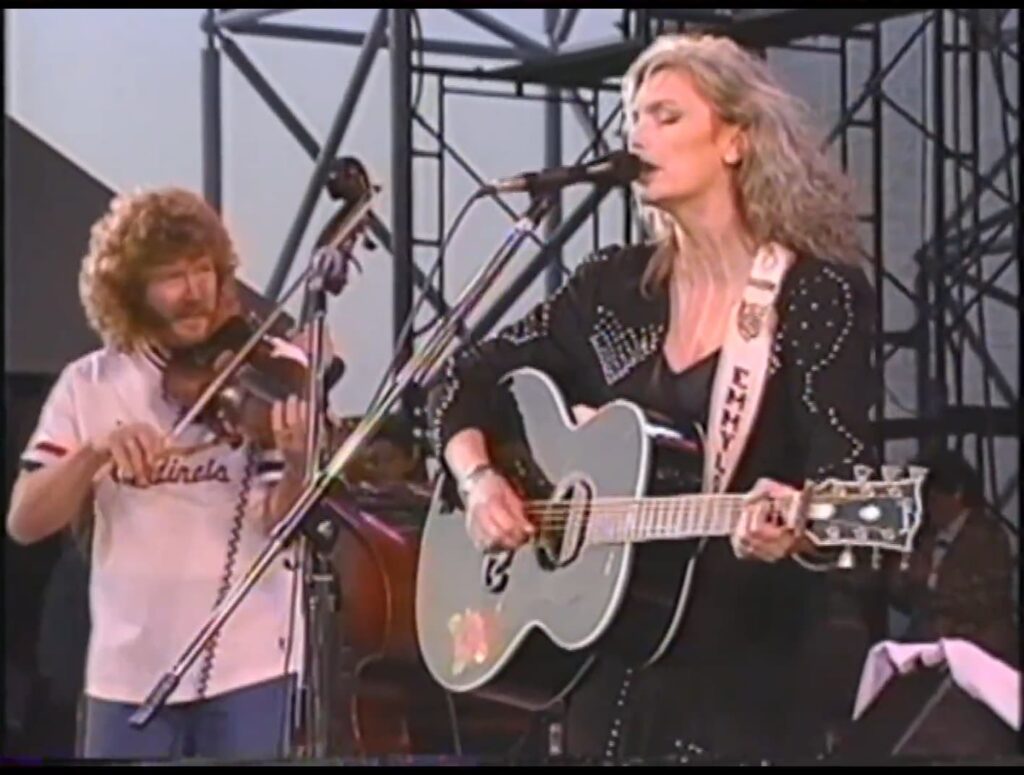
When Emmylou Harris performed “Rollin’ and Ramblin’ (The Death of Hank Williams)” on Country Gold in Japan in 1991, audiences saw a powerful tribute to one of country music’s greatest legends. Looking back more than three decades later, the performance reveals something even more fascinating. It captured Emmylou at one of the most important crossroads of her career, standing between a celebrated past and an artistic rebirth that would soon redefine her legacy.
At first glance, the performance appears to be a straightforward homage to Hank Williams, whose turbulent life and lonely death on New Year’s Day 1953 remain among country music’s most enduring stories. The song follows his restless travels, personal struggles, and final journey across America’s highways. Yet beneath that narrative lies another story, one that quietly reflects Emmylou’s own circumstances in 1991.
By this time, country music was changing rapidly. Commercial radio was increasingly embracing newer sounds, and many traditional artists found themselves pushed toward the margins. Emmylou remained deeply respected, but she was no longer at the center of Nashville’s commercial spotlight. In that sense, her performance carried an unexpected emotional resonance. She was singing about a legendary artist who felt misunderstood and isolated by the industry around him, while facing some of those same concerns herself.
The timing makes the performance especially significant.
The musicians appearing alongside Harris would soon become the foundation of the Nash Ramblers, the group that helped launch one of the most acclaimed chapters of her career. Featuring Sam Bush, Al Perkins, Jon Randall, and Roy Huskey Jr., this lineup represented a return to the acoustic roots and musical craftsmanship that had always been central to Harris’ artistic identity.
Viewed today, the performance feels like a preview of history in the making. Only a short time later, these musicians would help create the celebrated At The Ryman era, a project widely credited with rekindling interest in the historic Ryman Auditorium and helping spark a renewed appreciation for traditional acoustic country music.
One of the most intriguing aspects of the video is its setting. The song tells a deeply American story. Its imagery is filled with Southern highways, honky-tonks, loneliness, and the wandering spirit that defined Hank Williams’ life. Yet here it was being performed before an attentive audience in Japan.
That contrast highlights the remarkable reach of country music. The emotions embedded in Hank’s story proved capable of crossing cultures and languages. Thousands of miles from Alabama and Tennessee, listeners sat quietly absorbed in a tale rooted in the American South. It was evidence that great storytelling travels far beyond its birthplace.
For many longtime fans, another figure immediately stands out in the performance: Sam Bush. Already regarded as one of the most influential figures in progressive bluegrass, Bush brought an energy and musical intelligence that would become essential to the Nash Ramblers’ sound. His presence alone makes the video a valuable historical document for bluegrass and country enthusiasts.
The performance also benefits from a striking emotional contrast. The song deals with death, loneliness, and the final journey of a troubled legend. Yet the stage feels warm, vibrant, and alive. The musicians play with enthusiasm. The audience listens with admiration. The atmosphere is filled not with sadness, but with celebration.
That contrast creates the performance’s deepest message. Hank Williams had been gone for nearly four decades, but his music remained alive through artists willing to carry his stories forward.
Watching the video today adds another layer of nostalgia. Roy Huskey Jr. has since passed away. Several artists from that generation are no longer with us. The traditional country and acoustic music scene of 1991 has changed dramatically. What remains is this rare recording, preserving a moment when master musicians gathered on an international stage to honor their roots.
More than a tribute to Hank Williams, “Rollin’ and Ramblin'” now feels like a snapshot of a disappearing era. It captures Emmylou Harris just before a creative renaissance, a remarkable band just before making history, and a form of country music that still stood proudly before the world, carried by artists who believed its stories deserved to be heard.