
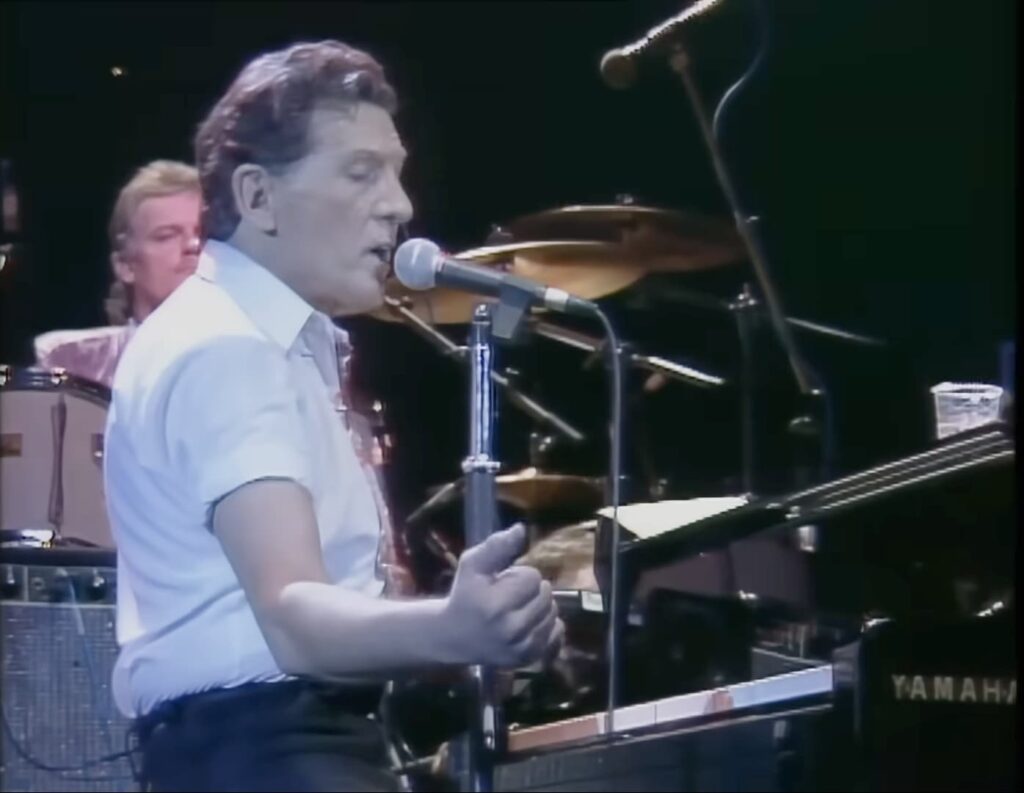
More Than Three Decades After “Great Balls of Fire” Changed Rock and Roll Forever, Jerry Lee Lewis Returned to the Song That Had Become the Story of His Own Life.
When Jerry Lee Lewis sat down at the piano to perform “Great Balls of Fire” during Jerry Lee Lewis and Friends in 1989, he was no longer the fearless 22-year-old who had shocked America in 1957. He was a man in his fifties who had survived extraordinary highs and devastating lows. By then, the song was no longer just a rock and roll classic. It had become a conversation between Lewis and the restless young man who had once set the music world ablaze.
More than thirty years had passed since “Great Balls of Fire” exploded onto the charts, becoming one of the defining records of the rock and roll era. Yet Lewis made no attempt to recreate the voice or swagger of his youth. Instead, he sang with the weathered conviction of an artist who had endured scandal, personal tragedy, addiction, multiple marriages, and decades of relentless touring. Every lyric carried the weight of experience rather than youthful rebellion.
The timing of the performance made it even more significant. The year 1989 marked a remarkable revival of public interest in Jerry Lee Lewis. The biographical film Great Balls of Fire!, starring Dennis Quaid, introduced his remarkable story to a new generation, while longtime fans rediscovered one of rock’s most complicated pioneers. This concert was not a comeback in the traditional sense. Lewis was not chasing another hit record. He was reclaiming his place in the history of American music.
Ironically, “Great Balls of Fire” had both launched and nearly destroyed his career. The record made him an international superstar, but only months later, his marriage to his 13-year-old cousin triggered one of the biggest scandals in rock history. Concerts were canceled, radio stations turned away from him, and the remarkable momentum of his career came to an abrupt halt. For years, many people associated the song with controversy as much as musical brilliance. Three decades later, that same song was once again greeted with standing ovations, completing one of the most remarkable circles in rock history.
Perhaps the most striking difference between this performance and those of the 1950s was what Lewis no longer needed to do. Gone were the outrageous stunts that once made headlines. He did not kick over the piano bench, pound the keys with his feet, or attempt to outdo every performer around him. He simply sat at the piano. The audience erupted anyway. Time had transformed spectacle into authority. His presence alone carried the power that youthful chaos once provided.
The concert itself felt less like an ordinary performance and more like a celebration of Lewis’ influence. Distinguished artists including Van Morrison, Brian May, Dave Davies, Dave Edmunds, and John Lodge gathered not because Lewis needed them, but because they wanted to honor the man whose music had inspired generations. Rather than joining their show, they had come to celebrate his legacy.
Listening to “Great Balls of Fire” in 1989 also changes the meaning of the song. While its lyrics remain a joyful celebration of romance, audiences often hear something much larger. Lewis’ voice evokes memories of the birth of rock and roll itself, a time when the music sounded dangerous enough to alarm parents and transform popular culture forever. The song becomes less about youthful infatuation than about the enduring fire of a generation that refused to follow the rules.
There is another fascinating layer beneath the performance. Throughout his life, Jerry Lee Lewis wrestled with the conflict between his deep religious upbringing and the music that made him famous. He often described rock and roll as something spiritually dangerous, yet “Great Balls of Fire,” with its fiery imagery and unstoppable energy, became the defining anthem of his career. That lifelong tension between faith and fame remained one of the most compelling aspects of his remarkable story.
Watching the performance today, the most unforgettable moment arrives before a single lyric is sung. Lewis walks to the piano, sits down, and places his hands on the keys. The audience immediately erupts in applause. It is a powerful reminder that some artists become legends through extraordinary performances. Jerry Lee Lewis reached the point where simply taking his place at the piano was enough to remind the world why they called him “The Killer.”
 Oldies Songs