
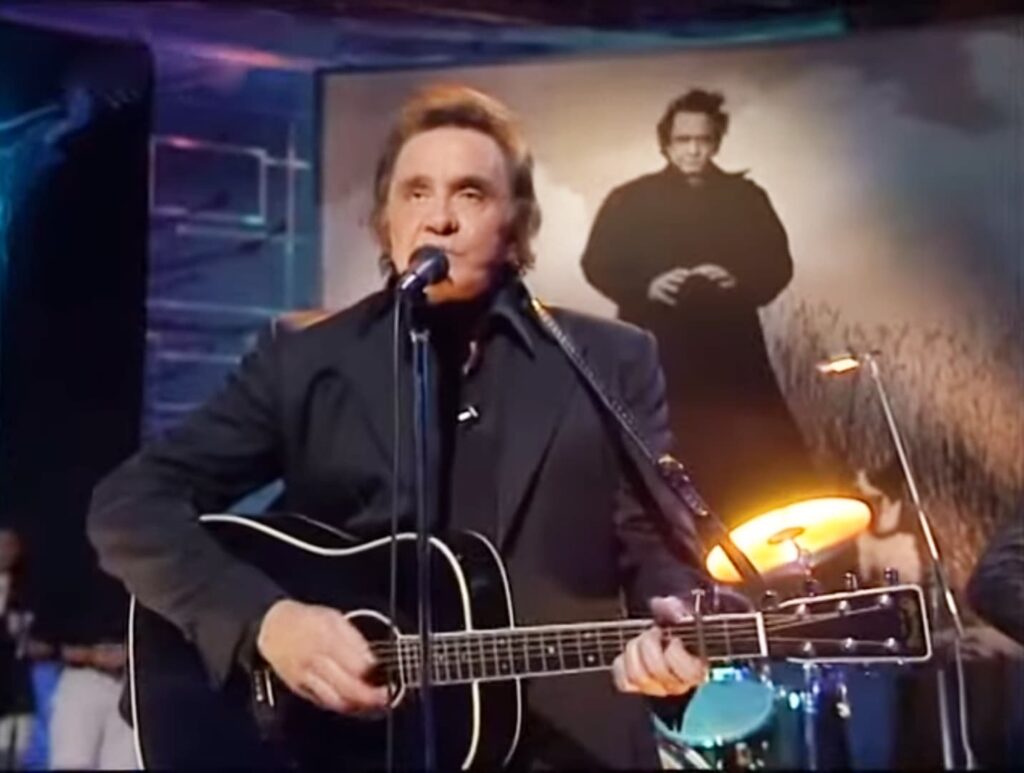
At 62, Johnny Cash Walked Onto a London Television Stage and Turned a Simple 1950s Rockabilly Tune Into a Lesson on How to Face Life’s Troubles.
When Johnny Cash appeared on Later… with Jools Holland on July 9, 1994, he was entering one of the most remarkable chapters of his career.
Commercial country radio had largely moved on.
A new generation of stars dominated the charts.
Many artists in Cash’s position might have spent their time celebrating past achievements.
Instead, Johnny Cash stepped onto a small television stage and reminded everyone why great songs never grow old.
The song was “Get Rhythm.”
Originally released in 1956 as the B-side to “I Walk the Line,” it was one of the earliest examples of Cash’s gift for finding profound truths inside seemingly ordinary stories. On paper, the song is simple. A shoe-shine boy works on a street corner and explains how he keeps from getting discouraged despite long hours and hard work.
His answer?
“Get rhythm when you get the blues.”
Nearly forty years after first recording the song, Cash delivered it with the same energy that had made him a star in the first place.
What makes this performance so fascinating is the contrast between the singer and the song.
By 1994, Johnny Cash had already lived through triumph, addiction, career setbacks, personal loss, and an extraordinary comeback. He was no longer the young rockabilly rebel from Sun Records.
Yet when he sang “Get Rhythm,” the message sounded more believable than ever.
The song was no longer youthful optimism.
It had become lived experience.
The audience could hear it in every line.
One of the great joys of watching this performance is seeing how effortlessly Cash commands the room. There are no elaborate stage effects. No dramatic production tricks. No attempt to compete with the flashy television performances of the era.
There is only Johnny Cash, his unmistakable voice, and a song built on pure rhythm.
That simplicity becomes the performance’s greatest strength.
The story itself remains one of the most charming in Cash’s catalog. The hardworking shoe-shine boy refuses to surrender to frustration. Instead, he finds dignity and happiness through effort, movement, and attitude. It is a working-class philosophy wrapped inside a catchy rock-and-roll groove.
That theme resonated deeply throughout Cash’s career.
He always had a special connection to ordinary people, laborers, outsiders, and those facing difficult circumstances. In many ways, the shoe-shine boy in “Get Rhythm” belongs to the same world as the prisoners of “Folsom Prison Blues” and the struggling characters who populated so many of Cash’s greatest songs.
What makes this 1994 appearance particularly moving today is knowing what came next.
Only a few months later, Cash would begin his legendary collaboration with producer Rick Rubin, launching the celebrated American Recordings era that introduced him to an entirely new generation of listeners.
Looking back, this performance feels like a bridge between two eras.
Part of it belongs to the young Johnny Cash who first recorded the song in the 1950s.
Part of it belongs to the elder statesman who was about to experience one of the most extraordinary late-career renaissances in music history.
And perhaps that is why “Get Rhythm” remains so enduring.
It is more than a catchy rockabilly tune.
It is a philosophy.
A reminder that life will always bring disappointment, setbacks, and difficult days. Yet sometimes the best response is the simplest one.
Keep moving.
Keep working.
Keep finding joy where you can.
On a London television stage in 1994, Johnny Cash delivered that message with a smile, a rhythm, and the unmistakable authority of someone who had spent a lifetime proving it was true.
 Oldies Songs