
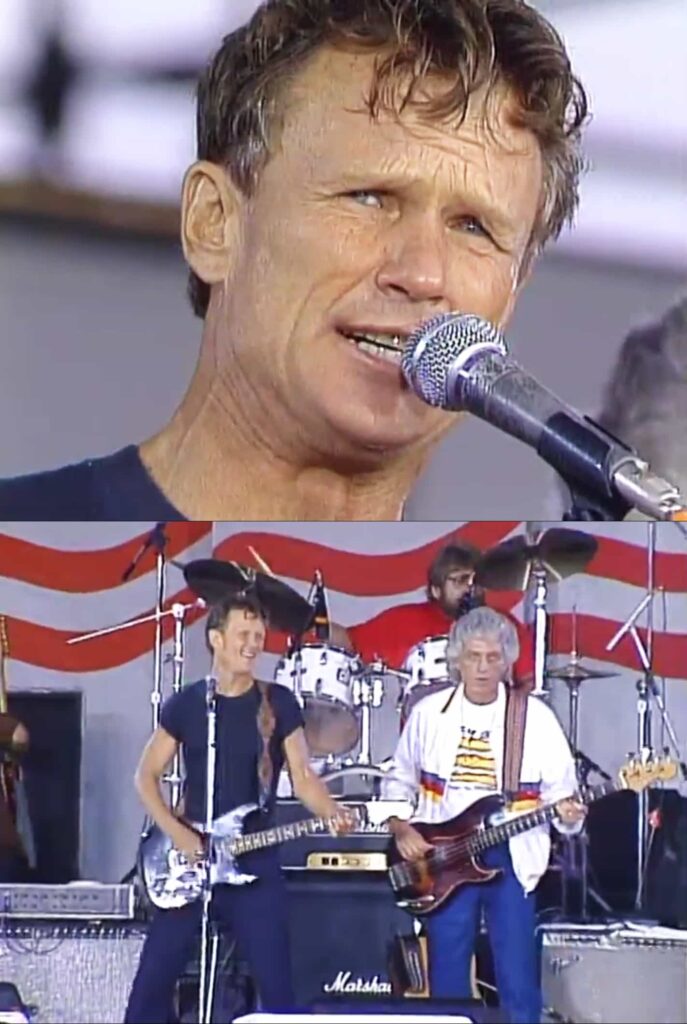
At the First Farm Aid, Kris Kristofferson Sang the Song That Changed His Life and Gave New Meaning to One of America’s Greatest Lyrics
CHAMPAIGN, Illinois, September 22, 1985 — There are moments when a songwriter sings a familiar song and somehow it becomes something entirely different.
That is what happened when Kris Kristofferson stepped onto the stage at the very first Farm Aid concert and performed “Me and Bobby McGee.”
The song was already a classic.
Millions knew it through the immortal recording by Janis Joplin, whose version became a posthumous No. 1 hit in 1971. For many listeners, Joplin’s voice was inseparable from the song itself.
Yet on this day, the audience was hearing something equally powerful.
They were hearing the man who wrote it.
Armed with little more than an acoustic guitar, Kristofferson stood before tens of thousands of people and delivered the song with the quiet confidence of someone who had lived every mile of the journey he was describing.
That simplicity was striking.
By 1985, Kristofferson was already much more than a songwriter. He was a celebrated actor, a cultural icon, and one of the most respected figures in American music. Yet there was nothing theatrical about this performance.
No elaborate production.
No cinematic image.
Just a storyteller and a song.
The setting made the moment even more meaningful.
Farm Aid was not simply another music festival. It was the birth of a movement. Organized to support American farmers facing severe economic hardship, the event brought together many of the biggest names in music to stand beside rural communities struggling to survive.
Against that backdrop, “Me and Bobby McGee” took on unexpected new dimensions.
The song had always been about freedom, movement, love, and loss. It celebrated life on the road while acknowledging the loneliness that often accompanies it. But when Kristofferson reached the line that generations of listeners know by heart, the words seemed to resonate differently.
“Freedom’s just another word for nothing left to lose.”
It is one of the most quoted lyrics in American songwriting history.
In the context of Farm Aid, however, it carried a deeper emotional weight.
Many people in the audience were confronting the loss of farms that had belonged to their families for generations. They were facing uncertain futures and difficult choices. For them, the lyric may have sounded less philosophical and more painfully real.
That tension between freedom and loss has always been at the heart of the song.
And few artists understood that better than Kristofferson himself.
Long before fame arrived, he had lived a life that seemed almost impossible to fit into a single biography. He was a Rhodes Scholar, a military officer, a helicopter pilot, and a struggling songwriter who worked countless jobs while pursuing music in Nashville.
He walked away from certainty in search of something less predictable.
In many ways, he lived the very freedom he wrote about.
That authenticity explains why performances like this continue to resonate decades later.
Kristofferson never sounded as though he were acting out a character. He sounded like a man sharing experiences he genuinely understood.
Watching the footage today adds another layer of emotion.
The audience in 1985 could not have known they were witnessing the beginning of an institution that would continue for decades. They could not have known how much Farm Aid would come to symbolize the preservation of rural America. Nor could they have imagined how precious these recordings would become.
Seen from the perspective of 2026, the performance feels like a snapshot of a remarkable era.
A younger Kris Kristofferson stands onstage, his voice steady, his guitar in hand, surrounded by a generation of artists who helped define American country, folk, and Americana music.
For four minutes, he revisits the song that made his name known around the world.
And in doing so, he reminds listeners why great songwriting never grows old.
The roads change.
The years pass.
The faces in the crowd grow older.
But a song built on truth continues to find new meaning with every generation that hears it.
 Oldies Songs