
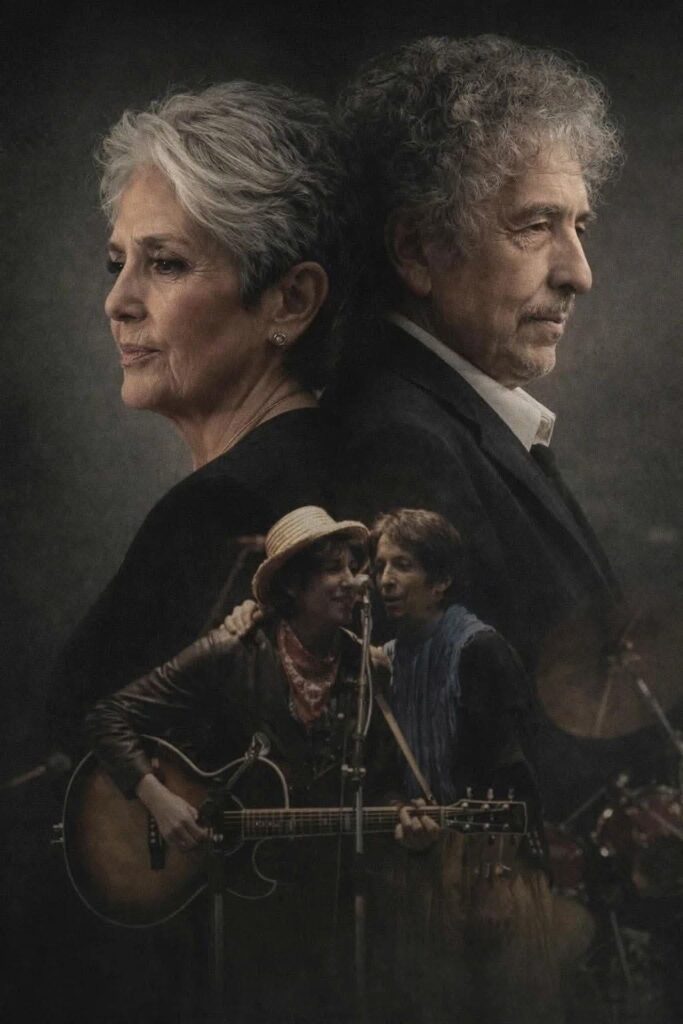
A Haunting Folk Lament of Love, Loss, and the Long Shadow of Separation
Few traditional songs carry the weight of memory and sorrow quite like “In the Pines”, and when interpreted through the voices of Joan Baez and Bob Dylan, it becomes something even more profound—a quiet dialogue between two defining figures of the 1960s folk revival. Unlike many of their better-known recordings, this song was never released as a major commercial single, and therefore did not chart in the conventional sense upon release. Instead, its significance lies in its deep roots and the intimate settings in which it was performed, particularly during the early 1960s folk circuit, including appearances at venues like the Newport Folk Festival.
“In the Pines” is not a modern composition but a traditional American folk song, sometimes known as “Where Did You Sleep Last Night.” Its origins trace back to the Appalachian region in the late 19th century, long before either Baez or Dylan brought their interpretive sensibilities to it. The song had been shaped by countless voices over generations, with earlier renditions by artists such as Lead Belly helping to preserve and popularize it. By the time Baez and Dylan encountered the song, it had already become a vessel for expressing grief, betrayal, and the quiet despair of lost love.
Their association with “In the Pines” reflects a particular moment in time—when the folk revival was less about commercial success and more about rediscovering the emotional truths embedded in traditional music. Joan Baez, with her crystal-clear soprano, approached the song with a sense of reverence, allowing its stark imagery to unfold gently yet hauntingly. Bob Dylan, still in the early stages of his career, brought a raw, almost restless energy, as though he were searching for something within the song itself. Together, even when not always performing simultaneously, their interpretations felt like two sides of the same emotional coin.
The story behind the song is as elusive as its melody. At its core, “In the Pines” tells of a troubled relationship, hinted at through fragmented lyrics—missing trains, decapitated bodies, and the chilling refrain of a lover left alone in the cold. These images are never fully explained, which only deepens their impact. In many ways, the song mirrors the uncertainties of life itself: unanswered questions, unresolved pain, and the lingering echo of things left unsaid.
For Baez and Dylan, the song also carries a subtle personal resonance. During the early 1960s, their artistic and personal relationship was both deeply intertwined and quietly complicated. While there is no definitive evidence that “In the Pines” was meant to reflect their own story, it is difficult not to hear a certain emotional undercurrent when listening to their versions—an unspoken tension, perhaps, or a shared understanding of loss that extended beyond the lyrics.
What gives “In the Pines” its enduring power is not just its melody or its history, but its ability to evoke a feeling that transcends time. It is a song that does not seek resolution; instead, it lingers, much like a memory that refuses to fade. In the hands of Joan Baez and Bob Dylan, it becomes a quiet meditation on absence—on the spaces left behind when someone or something is gone.
Even decades later, long after the height of the folk revival, the song continues to resonate. It reminds listeners of a time when music was not merely performed but lived—when each note carried the weight of lived experience, and each silence spoke just as loudly as the words themselves. In that sense, “In the Pines” is more than a song; it is a fragment of history, preserved in voice and memory, waiting patiently for each new listener to find their own meaning within its shadowed lines.