
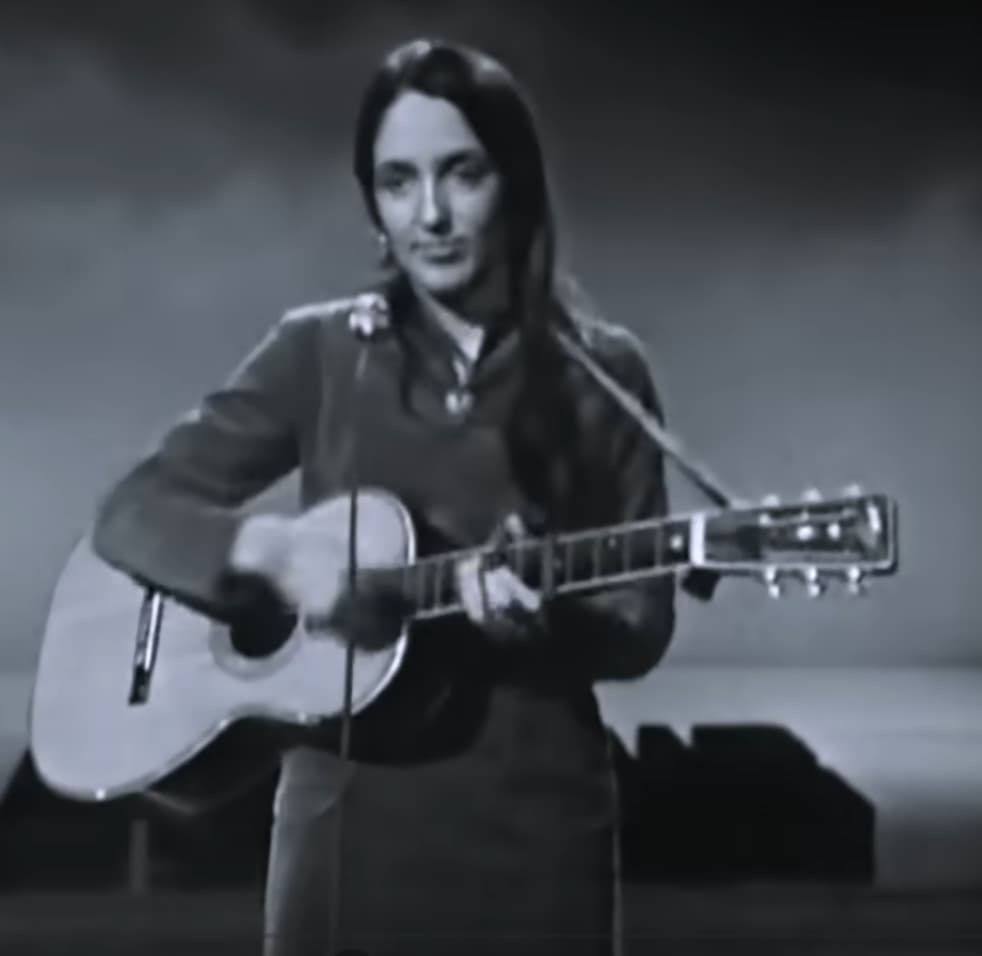
A Song About Distance, Loneliness, And The Quiet Ache Of A Restless Heart
“500 Miles” is more than a folk song — it is the sound of someone drifting farther from home, carrying regret, longing, and memory with every mile left behind.
There are songs that belong to a certain decade, and then there are songs that somehow escape time itself. “500 Miles”, immortalized by Joan Baez, is one of those rare recordings. It does not shout for attention. It does not rely on grand orchestration or dramatic production. Instead, it moves softly, almost like an old train disappearing into the horizon at dusk, leaving only echoes behind. And perhaps that is exactly why it has survived generation after generation.
Originally written in the early 1960s by folk singer Hedy West, the song became closely associated with the American folk revival movement, eventually finding one of its most haunting interpretations through Joan Baez. Her version appeared during a period when folk music was carrying the emotional weight of an uncertain world — a world filled with social unrest, changing values, and young people searching for meaning far from home. Baez had the rare ability to make a simple melody feel sacred, and in “500 Miles”, her voice seemed almost suspended between sorrow and acceptance.
Unlike many chart-driven hits of its era, “500 Miles” was never primarily about commercial success. It did not storm the pop charts the way louder songs did. Yet its cultural impact became far greater than many No. 1 singles that are now forgotten. The song gained enduring recognition through countless performances, radio broadcasts, and reinterpretations across decades. Versions by artists such as Peter, Paul and Mary, The Journeymen, and later even international adaptations helped turn it into a global folk standard. In many countries, listeners came to believe the song belonged to their own culture because its emotions felt so universal.
The beauty of the song lies in its devastating simplicity:
“If you miss the train I’m on,
You will know that I am gone…”
There is no elaborate storytelling. No complicated metaphor. Just distance. Shame. Separation. A traveler too far from home, perhaps emotionally even more than physically. The narrator cannot return because he has “not a shirt on my back, not a penny to my name.” Those lines carry the quiet humiliation of failure — something older listeners often understand more deeply than younger generations ever could. Life does not always unfold as planned. Dreams fade. Roads become longer than expected. And sometimes the hardest journey is the one back home.
When Joan Baez sang the song, she transformed that loneliness into something deeply intimate. Her crystal-clear soprano never sounded theatrical; instead, it felt painfully human. There was always a sense that she was not merely performing the song, but remembering something through it. That emotional honesty became one of the defining characteristics of Baez’s artistry throughout albums like “Joan Baez in Concert” and “Farewell, Angelina.”
Part of what keeps “500 Miles” alive is its refusal to age. The recording still sounds untouched by fashion or trend. It belongs to that precious category of music that should remain exactly as it was first heard — unpolished, unaltered, emotionally naked. The humorous Canadian joke that “in Canada, of course, this song is called 805 kilometres” always brings a gentle smile, but beneath the humor lies a truth: no matter the country, the feeling remains the same. Distance is distance. Homesickness sounds the same in every language.
And perhaps that is why many listeners feel protective of the song today. In an age obsessed with remixes, digital enhancement, and constant reinvention, “500 Miles” feels almost sacred in its purity. The silence between the notes matters. The fragility matters. The simplicity matters. To modern ears accustomed to overproduction, the song may seem almost too bare. But that bareness is precisely where its soul lives.
The line — “To the next generation: let this song remain untouched. No remix, no edit, no disguise” — carries enormous emotional weight because it speaks to something larger than music. It speaks to memory itself. Some songs are not meant to be modernized. They are meant to be preserved like old photographs tucked inside a family album, slightly faded but infinitely more valuable because of it.
Listening to Joan Baez sing “500 Miles” today feels like opening a window to another world — one where songs did not compete for attention but quietly accompanied people through heartbreak, loneliness, and reflection. It reminds us of train stations, empty highways, handwritten letters, and nights when music was not background noise but companionship.
And perhaps that is why the song still endures after all these years. Because somewhere, in every generation, there is always someone standing emotionally “500 miles away from home,” hoping a familiar voice might still guide them back.
 Oldies Songs