
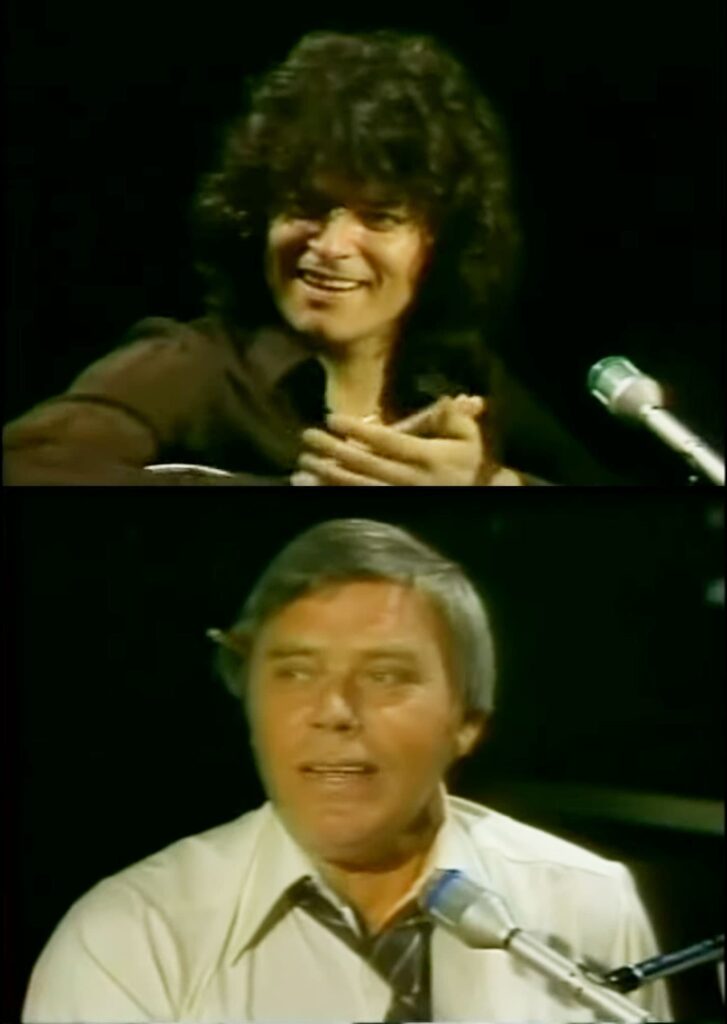
In 1979, Johnny Rodriguez and Tom T. Hall Turned a Simple Television Performance Into One of Country Music’s Most Charming Glimpses Inside the Songwriting Process
There is something beautifully unpolished about watching Johnny Rodriguez and Tom T. Hall perform “You Always Come Back To Hurting Me” on television in 1979.
The moment does not feel staged in the modern sense. It feels lived in.
Instead of presenting the song as a polished production number, the two men casually recreate the atmosphere of a real songwriting session, sitting together, trading lines, smiling through the lyrics, and allowing viewers to feel as though they are witnessing the birth of the song itself rather than merely hearing a finished performance.
That relaxed authenticity became the emotional center of classic country television.
By the late 1970s, country music still carried strong traces of front porch storytelling culture. Songs were not yet separated completely from the personalities and friendships that created them. Audiences wanted to hear not only the music, but also the conversations, humor, and everyday humanity behind it.
This performance captures that spirit perfectly.
Tom T. Hall, known for transforming ordinary life into unforgettable songs, approaches the performance with his signature conversational warmth. Few writers in country music history understood simplicity better than Hall. He could take emotions most people struggled to explain and reduce them to plain spoken truths that felt instantly recognizable.
And “You Always Come Back To Hurting Me” carries exactly that kind of emotional realism.
The title itself already sounds like something overheard late at night across a kitchen table after years of heartbreak and reconciliation. There is no dramatic poetry in it. No grand metaphor. Just emotional exhaustion distilled into one devastating sentence.
That honesty pairs beautifully with Johnny Rodriguez, whose voice always carried a mixture of smooth charm and quiet sadness. Rodriguez had one of the warmest voices in 1970s country music, capable of sounding relaxed and wounded at the same time. In performances like this, he sings heartbreak not with bitterness, but with weary acceptance.
That combination gives the song extraordinary emotional maturity.
Rather than presenting heartbreak as explosive drama, the performance treats it as something repetitive and deeply human. The pain is familiar now. Almost routine. The title itself suggests a cycle both men already understand too well.
And that emotional subtlety is what makes the performance linger.
There is also something deeply nostalgic today about the chemistry between Johnny Rodriguez and Tom T. Hall. Neither man appears interested in stealing attention from the other. The atmosphere is collaborative rather than competitive, reflecting a period when country television often felt more like musicians gathering together informally than carefully managed entertainment branding.
Modern performances rarely allow this kind of looseness anymore.
The pauses remain in place. The smiles stay unedited. Small imperfections survive. And because of that, the performance feels alive decades later.
For older audiences especially, moments like this bring back memories of a different era of country music television, one built around personality, songwriting, and human connection rather than spectacle. Viewers were invited into the room rather than overwhelmed by production.
That intimacy mattered.
Watching the performance now almost feels like sitting beside two old friends remembering how songs used to be written before everything became faster, louder, and more calculated.
And perhaps the most beautiful part is that neither Johnny Rodriguez nor Tom T. Hall appears to be trying very hard to create a “classic moment.”
They are simply talking, laughing, and singing together.
Which is often exactly how classic moments happen.
 Oldies Songs