
“L.A. Freeway” Was Never About Los Angeles. It Was About Finding the Courage to Leave a Life That No Longer Felt Like Home
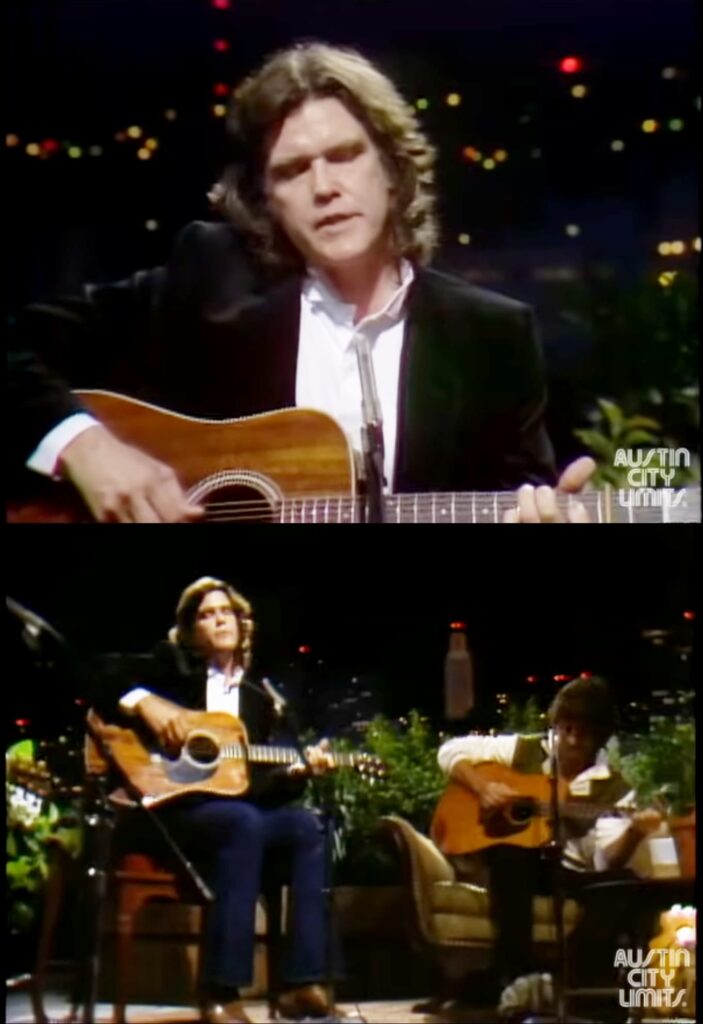
For many viewers, the 1983 performance of “L.A. Freeway” by Guy Clark on Austin City Limits’ Songwriters Special appears deceptively simple. A man sits on a stool with a guitar, singing a familiar tune. There are no elaborate stage effects, no dramatic gestures, and no attempt to command attention through spectacle. Yet for admirers of country and folk songwriting, the performance captures something far more enduring: one of the most powerful musical statements about freedom ever written.
The title has often misled first-time listeners. At a glance, “L.A. Freeway” sounds like a song about California highways and open roads. But the deeper one listens, the clearer it becomes that the freeway itself is merely a symbol. The song is not really about where the narrator wants to go. It is about where he desperately needs to leave behind.
Written during the early years of Guy Clark’s songwriting career, “L.A. Freeway” tells the story of a man suffocating beneath expectations, routine, and a life that no longer feels like his own. Rather than celebrating arrival, the song focuses on escape. Its emotional center rests in a universal realization that countless people experience at some point in life: waking up one morning and understanding that the path you are on is no longer the one you wish to follow.
The song also occupies a special place in Clark’s legacy. While many fans remember him for classics such as “Desperados Waiting for a Train,” “The Randall Knife,” and “Dublin Blues,” many songwriters consider “L.A. Freeway” the composition that first announced his remarkable talent. It helped establish his reputation in Nashville long before he became one of America’s most respected songwriter’s songwriters.
Ironically, the song became widely known through another artist before Clark himself achieved widespread recognition. Jerry Jeff Walker’s recording introduced the composition to a larger audience, and for many listeners, Walker’s version served as their first encounter with the song. Even today, country music fans continue to debate which interpretation captures its spirit most effectively: Walker’s relaxed charisma or Clark’s deeply personal delivery.
The 1983 Austin City Limits performance carries additional historical significance. During the early 1980s, artists such as Guy Clark, Townes Van Zandt, Steve Earle, and Jerry Jeff Walker were helping define what would later become known as the Texas songwriting tradition. Their influence extended far beyond record sales. They shaped an approach to songwriting rooted in honesty, vivid storytelling, and emotional truth.
What makes Clark’s performance especially moving is the contrast between the song’s upbeat melody and its underlying melancholy. Beneath the easy rhythm lies the voice of a man exhausted by his circumstances, searching for a chance to begin again. It is not loneliness born from lost romance. It is the quieter loneliness that comes from losing direction and wondering whether life might still hold another road ahead.
Many listeners have long viewed “L.A. Freeway” as a disguised autobiography. Clark himself spent time in California, struggled to establish his career, and searched for a place where his creative voice could flourish. While the song is not a literal retelling of his experiences, the emotions feel unmistakably authentic.
Watching the performance today adds another layer of meaning. In 1983, Clark was only in his early forties, with decades of songwriting still ahead of him. Now, following his passing in 2016, the recording feels like a preserved moment from a golden era. Many of the artists who helped shape that movement have also become part of history, transforming the video into a living photograph of a remarkable generation of storytellers.
Perhaps that is why “L.A. Freeway” continues to resonate more than fifty years after it was written. Its lasting power does not come from highways, destinations, or geography. It comes from a feeling nearly everyone understands. Guy Clark was not writing about running toward a better place. He was writing about the courage required to leave a life that no longer belongs to you. And that message remains as powerful today as it was when he first put pen to paper.