
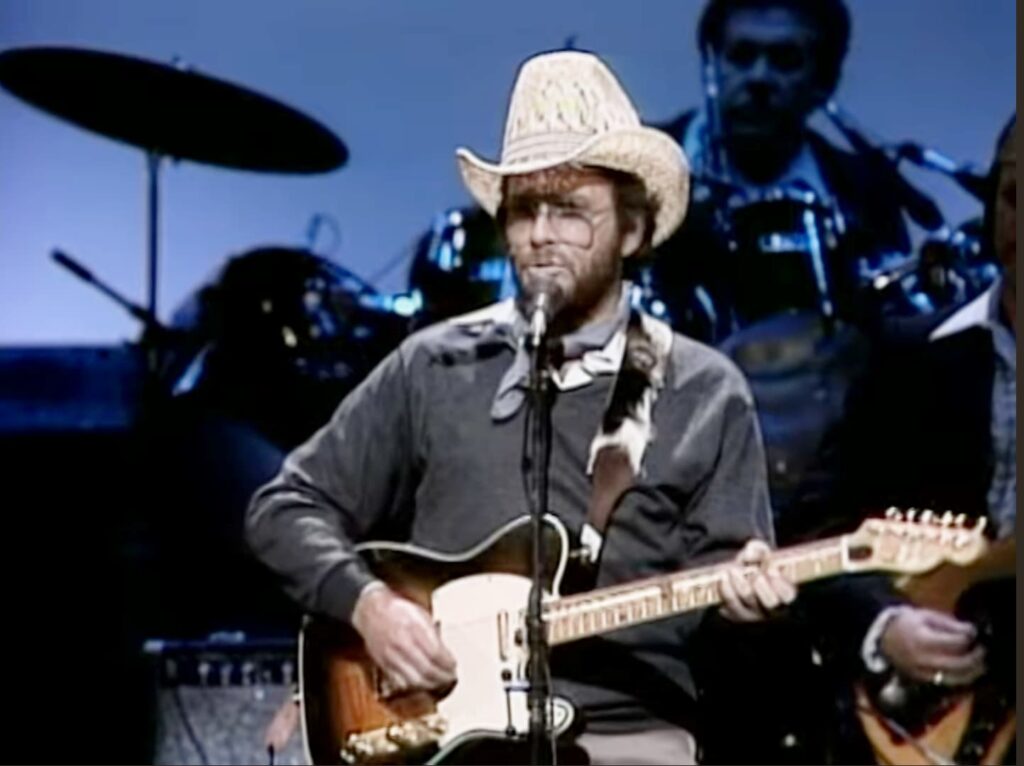
After the Prisons, the Freight Trains, and the Hard Luck Stories, Merle Haggard Came Back to a Simple Truth: “Honey, I Love You Too.”
There is something quietly remarkable about watching Merle Haggard perform “That’s the Way Love Goes.” Not because it is one of his loudest songs. Not because it tells the most dramatic story. Quite the opposite.
The power of the song comes from its simplicity.
For decades, Haggard built his reputation singing about the people often left standing at the edge of the American dream. He sang about prisoners, drifters, working men, broken hearts, late-night trains, and hard lessons learned the difficult way. His songs carried the dust of highways and the weight of lives that rarely found easy endings.
Yet in this gentle live performance of “That’s the Way Love Goes,” the legendary songwriter strips away all of that complexity and arrives at something surprisingly tender.
Released as a major hit in 1983, the song became one of the defining love ballads of Haggard’s career. Listening to it today, it feels less like a traditional country love song and more like a conversation between two people who have spent years weathering life’s disappointments together.
The opening lines paint a picture of a man chasing luck wherever he can find it.
He has thrown horseshoes over his shoulder.
He has searched for four-leaf clovers.
He has spent much of his life pursuing hopes that always seemed just out of reach.
The images are simple, but they reveal a familiar human experience. Everyone spends part of life looking for the next lucky break, the next opportunity, the next rainbow on the horizon. Haggard’s narrator is no different. He keeps reaching for something better, something brighter, something just beyond his grasp.
But then the song gently shifts direction.
Instead of focusing on what he never found, he begins reflecting on what was beside him all along.
A faithful companion.
A steady hand.
Someone willing to follow him through all those uncertain journeys.
The line that follows is one of the most heartfelt moments in Haggard’s catalog:
“Honey, I love you too.”
There is no poetry hidden behind it. No complicated metaphor. No dramatic declaration.
Just five words.
And somehow those five words carry the emotional weight of an entire lifetime.
What makes this live performance especially moving is the contrast between the song and the man singing it. By the time Haggard performs “That’s the Way Love Goes,” audiences already know him as the rugged voice behind classics about struggle, rebellion, and survival. He was the man who gave country music some of its most unforgettable portraits of outsiders and dreamers.
Yet here he stands before an audience, offering a reminder that beneath every great adventure, every heartbreak, and every hard-earned lesson, there is often a simple desire to be loved and understood.
The chorus deepens that message even further.
Haggard describes love as “the music God made for all the world to sing.”
It is a line that feels almost timeless. The song suggests that love is not something people invent. It is something they discover. It exists before them and continues long after them. It survives victories and failures, good years and bad years.
Looking back now, the performance feels like a reflection from a man who had seen nearly every corner of life. Haggard had experienced fame, hardship, redemption, success, and loss. Few artists possessed a deeper understanding of the complicated roads people travel.
Yet after all those stories, all those miles, and all those songs, he arrives at a conclusion that could not be simpler.
Luck comes and goes.
Rainbows fade.
Dreams change.
But when someone remains beside you through all of it, perhaps that is the real treasure people spend their lives searching for.
And perhaps that is why “That’s the Way Love Goes” still resonates so deeply today.
Because after the prisons, the night trains, the honky-tonks, and the restless wanderers, Merle Haggard returned to the most enduring truth he ever sang: Love stays.
 Oldies Songs