
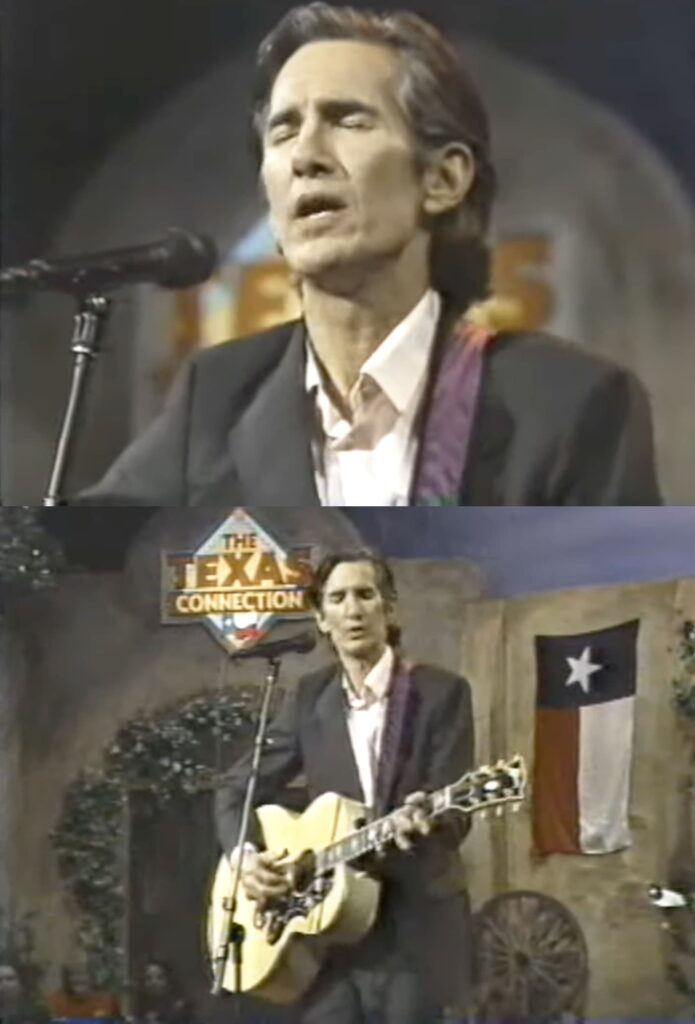
In 1990, Townes Van Zandt Sang “Pancho and Lefty” Like a Man Remembering Ghosts He Knew Personally
When Townes Van Zandt appeared on Texas Connection around 1990 to perform “Pancho and Lefty,” the song no longer felt like an ordinary outlaw ballad. In his hands, it sounded ancient, weary, and deeply personal, as though he were recalling the lives of two lost friends rather than singing one of the most celebrated folk songs ever written.
By then, “Pancho and Lefty” had already become legendary through recordings by Willie Nelson and Merle Haggard, whose 1983 version turned the song into a massive country hit. Yet hearing Townes himself perform it revealed something entirely different. The polished commercial success disappeared, leaving only the lonely soul of the story behind.
From the opening line, “Living on the road my friend,” Van Zandt’s voice carried the weight of experience. His singing was rough, restrained, almost fragile at times, but that vulnerability gave the performance extraordinary emotional power. Townes never tried to dramatize the song. He simply inhabited it.
That understated delivery became one of the reasons fellow songwriters revered him so deeply.
“Pancho and Lefty” tells the mysterious story of two outlaws drifting through betrayal, survival, and fading legend along the Texas-Mexico border. Pancho dies young and mythic, while Lefty survives quietly, disappearing into cheap hotels and anonymous northern cities. The contrast between the two men has fascinated listeners for decades, but Townes sang the story less like fiction and more like hard-earned truth.
As he moved through verses about dusty deserts, federales, and forgotten promises, the atmosphere in the room grew almost hypnotic. There was no rush in the performance. Every lyric unfolded slowly, allowing the sadness hidden inside the song to settle naturally over the audience.
What made Townes Van Zandt unique was his ability to make loneliness feel enormous without ever raising his voice.
By 1990, his own life had become inseparable from the wandering characters inside his songs. Years spent traveling endlessly between clubs, bars, and small stages had given him the same drifting quality carried by Pancho and Lefty themselves. Listening to him sing about men growing old, running out of places to hide, and carrying regret through empty towns felt painfully autobiographical at times.
The performance also revealed Townes’ extraordinary songwriting craftsmanship. The lyrics are filled with cinematic imagery, but they never explain too much. Questions remain unanswered. Did Lefty betray Pancho? Did the authorities truly “let him go so wrong”? Townes understood that mystery often makes stories more emotionally haunting than certainty ever could.
Watching the 1990 performance today feels almost eerie because Townes himself already seemed half mythological by that point. Thin, soft-spoken, visibly worn by life, he stood before the audience like the last surviving storyteller from another era of American songwriting.
And yet there was warmth too.
Near the end, after delivering the devastating final verses, he simply muttered “thanks everybody” with characteristic humility, almost shrugging off the emotional storm he had just created. That contrast between genius and understatement defined him throughout his career.
After Townes Van Zandt passed away in 1997, performances like this took on even deeper resonance. They preserved not only the songs, but the man himself: vulnerable, brilliant, haunted, and profoundly human.
That is why “Pancho and Lefty” continues to endure across generations. Beneath the outlaw imagery and borderland mythology lives something universal: the sadness of survival, the cost of freedom, and the lonely silence waiting after the legends fade away.