
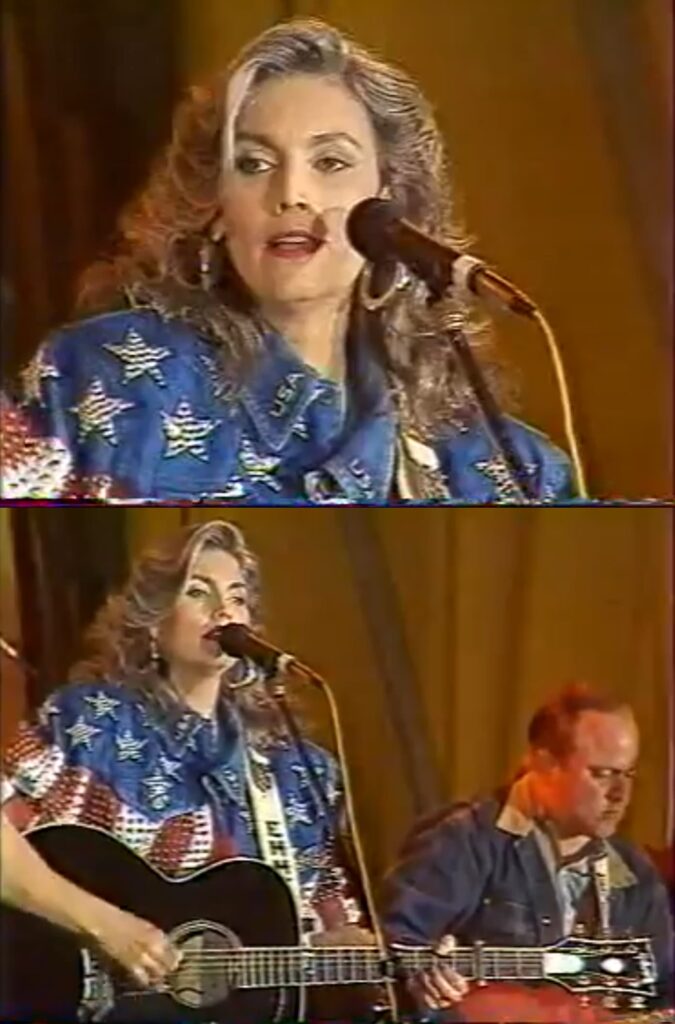
In 1988, Emmylou Harris Walked Onto a Stage in Budapest and Proved That Heartbreak Needs No Translation
When Emmylou Harris arrived in Budapest in 1988 to perform “Heaven Only Knows,” she stood before an audience separated from Nashville not only by geography, but by history itself. The Cold War era was still fading slowly from Eastern Europe, and American country music remained something distant and almost mythical to many listeners there. Yet the moment Emmylou began to sing, those distances seemed to disappear entirely.
Before the song starts, she speaks to the crowd with warm humility, introducing it as one from her “brand new album” and joking that since it was their first time in Budapest, they might as well “play a long time.” There is something deeply charming about the way she says it. No grand entrance. No rock-star ego. Just a touring musician genuinely grateful to stand before a room full of strangers in a city she may never see again.
That sincerity shaped the entire performance.
By 1988, Emmylou Harris had already become one of the most respected voices in country and Americana music, known for her ethereal harmonies, emotional intelligence, and restless musical curiosity. But performances like this revealed something even more important about her artistry: she could make deeply American music feel universal.
When she sings:
“I don’t know who’s right or wrong, but all we had is gone…”
the lyric no longer sounds tied to one relationship or one country song. Inside that Budapest hall, it becomes something broader. Regret. Distance. Love slipping away before either person understands why.
And perhaps that is why the audience responds so warmly throughout the performance.
Even listeners who may not have fully understood every word could understand the feeling.
That was always one of Emmylou’s greatest gifts.
Unlike many performers of the era, she never relied on vocal theatrics or oversized stage production. Her power came from restraint. She sang heartbreak softly, almost conversationally, allowing the sadness to settle slowly over the room instead of forcing it onto the audience. In “Heaven Only Knows,” that approach becomes almost devastating.
There is also a quiet loneliness surrounding the performance that becomes more noticeable with time.
When Emmylou says, “Who knows when we’ll be back again,” it sounds casual in the moment. Looking back now, it feels strangely poignant. Touring musicians of that generation often spent their lives moving from city to city, carrying songs across borders while living in a constant state of departure. The stage became home for a few hours, then disappeared again the next morning.
That transient feeling lives inside this performance.
The lighting is simple. The stage modest. The applause warm but restrained. Nothing distracts from the voice itself. And what a voice it was in 1988: silver, weary, elegant, and impossibly human.
For many longtime fans, this Budapest appearance captures Emmylou Harris at a fascinating point in her career. She was no longer the young cosmic-country muse of the 1970s, but not yet the elder stateswoman she would later become. She stood somewhere in between, carrying enough life experience to deepen every lyric while still possessing the clarity and beauty that first made audiences fall in love with her music.
Today, the performance feels like more than a concert recording.
It feels like evidence that great songs can cross oceans, languages, and political borders without losing their emotional truth. In Budapest, far from Tennessee, Emmylou Harris reminded an audience that loneliness sounds the same in every part of the world.