
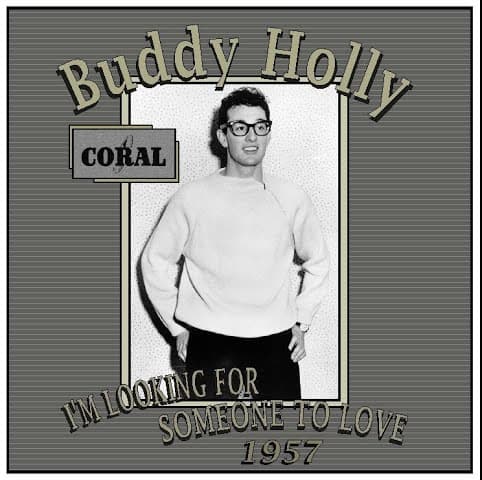
An earnest, youthful plea for a fresh start in love, riding the wave of rock and roll’s first great surge.
There are certain records, certain sounds, that instantly transport you back to a simpler time, when the promise of a Saturday night felt boundless and the future stretched out like an open highway. Buddy Holly’s “I’m Looking for Someone to Love,” the energetic B-side to the breakout single “That’ll Be the Day,” is one of those timeless touchstones. Released in July 1957, credited to The Crickets (a clever workaround due to a previous record contract), this track quickly became a cornerstone of the burgeoning rock and roll movement. Though it was technically the flip side, it rode the massive success of its A-side, which soared all the way to Number 1 on the Billboard Hot 100 chart and reached Number 1 on the UK Singles Chart later that year. This single wasn’t just a hit; it was a cultural flashpoint, and “I’m Looking for Someone to Love” contributed its distinct flavor to that success.
The story behind this seminal track is woven into the very fabric of rock and roll history. It was recorded in the crucible of Norman Petty’s studio in Clovis, New Mexico, during the same legendary late-February 1957 session that produced the chart-topper. While “That’ll Be the Day” was nailed in just two takes, the band spent a bit more time getting the groove right on its companion track, with Buddy Holly (lead singer and guitarist), Jerry Allison (drums), Larry Welborn (stand-in bass), and Niki Sullivan (rhythm guitar), joined by backing vocalists Ramona and Gary Tollett. This was the moment the distinct, tight, and professional sound of The Crickets truly coalesced, transforming Holly from a talented but struggling artist into a defining voice of his generation. The song later appeared on the group’s only album released during Buddy Holly’s lifetime, The “Chirping” Crickets.
Lyrically, “I’m Looking for Someone to Love” is a wonderfully candid and slightly bruised expression of a young man back on the market. It tells a simple, relatable tale: the singer has been wronged—his baby has left him for another—and instead of wallowing, he’s deciding, with a burst of defiant energy, to move on. Lines like, “Stayin’ at home, waitin’ for you / Just won’t get it ’cause you say we’re thru,” and the repeated, straightforward declaration, “I’m lookin’ for someone to love,” are pure, unvarnished 1950s romantic angst, quickly overcome by hopeful resolve.
There’s a beautiful, understated emotional honesty here. It’s not a ballad of brokenhearted despair, but a spirited rockabilly shuffle of determined resilience. The meaning is clear: life is too short to mourn a lost love, and there’s always a new chance just around the corner. The music perfectly captures this mood—the driving, simple drum beat, Holly’s signature hiccuping vocal delivery, and the crisp guitar work make the song an irresistible, foot-tapping invitation to get back out there. It’s a sound that brings back memories of drive-in diners, slow dances that turned fast, and the sheer, exhilarating thrill of being young and unburdened. The raw, live-in-the-studio feel of the recording, complete with the charming backing vocals, gives it an authenticity that subsequent generations have tried—and often failed—to replicate. It’s a foundational piece, a piece of the magic that made the music of Buddy Holly eternal.