
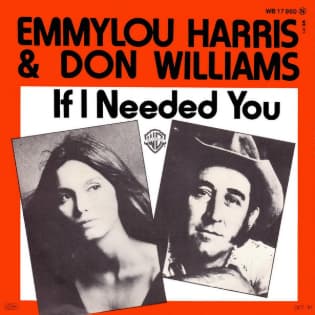
A quiet confession of devotion carried on two of country music’s most unmistakable voices
When Don Williams and Emmylou Harris released their duet If I Needed You in 1981, the song settled gently—but decisively—into the American country consciousness. Issued as part of Williams’ album Especially for You, the single rose to the Top 5 on the Billboard Hot Country Songs chart, its ascent driven not by bombast or marketing spectacle, but by the magnetism of two artists whose interpretive restraint had long commanded deep respect. From the opening measure, one senses a meeting of sensibilities: Williams’ warm, unhurried baritone and Harris’ crystalline, feather-light soprano entwine in a dialogue that feels less like performance and more like a private truth suddenly overheard.
The song itself, originally written by Townes Van Zandt, possesses a rare structural simplicity—two short verses, a gentle melodic curve, and a lyrical clarity that resists ornamentation. Williams and Harris do not attempt to reshape it; instead, they inhabit it, bringing to its modest frame a kind of emotional geometry that only fully realized artists can supply. What emerges is a portrait of devotion rendered with exquisite understatement. The refrain carries the song’s quiet thesis: love expressed not through sweeping declarations, but through the steady, dependable promise of presence—if I needed you, would you come to me? In their hands, the question becomes both universal and achingly intimate.
The deeper power of this recording lies in the way their voices communicate across the spaces the lyrics leave unstated. Williams sings like a man who trusts silence; Harris answers like someone who has made peace with longing. Together they create a harmonic tension that feels almost architectural—an interlocking of timbres and emotional timbres, each supporting the other without overshadowing it. This is the kind of duet in which two artists do not merely share a microphone; they share a worldview. Their interpretation suggests a love rooted not in drama, but in constancy—a partnership measured by its steadiness rather than its storms.
The instrumental arrangement reinforces this ethos. Light acoustic picking, understated percussion, and a melody that seems to drift forward on its own breath. Nothing strains, nothing accelerates. The music remains as patient as the love it describes. This is the essence of Williams’ artistic philosophy and one of Harris’ greatest interpretive virtues: the courage to let a song be rather than to force it into spectacle.
Over four decades later, If I Needed You endures not because it attempts to dazzle, but because it understands something far more enduring: that the most profound declarations of love often arrive quietly, carried on the calm assurance of two voices that know the weight—and the wonder—of simply being there for one another.