
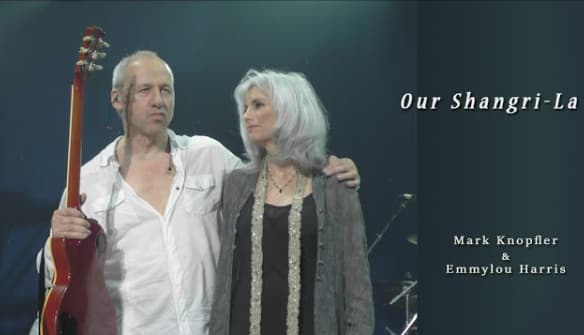
A quiet hymn to the places we carry in our hearts, Our Shangri-La stands as one of Mark Knopfler’s most tender meditations on memory, belonging, and the search for peace.
When Mark Knopfler released Our Shangri-La on his 2004 album Shangri-La, the song was never pushed as a commercial single, and therefore it did not appear on major singles charts at its debut. Instead, it lived a quieter life, carried by word of mouth, late-night listening sessions, and the affection of longtime fans who recognized in it one of Knopfler’s most reflective works. The album itself reached the Top 10 in several countries, including the UK, where it peaked at No. 8, but Our Shangri-La became beloved not for numbers, rather for the stillness and wisdom woven into its melodies.
Although the studio recording is a solo Knopfler creation, the song gained renewed resonance when he performed it with Emmylou Harris during their collaborative period around the albums All the Roadrunning (2006) and the live set Real Live Roadrunning. Harris’s gentle, aching harmony brought a new emotional hue to the piece. Her voice moved like a soft lantern light through Knopfler’s storytelling, illuminating the song’s sense of longing and the almost spiritual calm at its center. For many listeners, this shared performance became the definitive version, the one that lingers in memory long after the music fades.
At its heart, Our Shangri-La is a song about the places we return to when life has pushed us too hard and too far. Not physical destinations, but inner landscapes that hold our earliest joys, our softest wounds, our deepest roots. Knopfler’s songwriting here is unhurried, almost conversational, as if he were sitting across from the listener, recalling the small truths one only learns after many years of living. The gentle guitar lines, warm and understated, allow the words to breathe, giving the song a quiet dignity that resonates strongly with those who have watched time pass and felt its weight.
The title itself evokes the mythical “Shangri-La” from James Hilton’s Lost Horizon, a place untouched by the world’s chaos, suspended in perpetual peace. For Knopfler, though, Shangri-La is not a faraway utopia but something personal and earthly. It might be a childhood street corner, a shared moment with someone who is now gone, or a place you once stood that changed you forever. The song suggests that everyone carries such a sanctuary, even if they rarely speak of it.
The collaboration with Emmylou Harris deepened this message. Her presence added a layer of shared memory, two seasoned musicians looking back with affection, gratitude, and a hint of sorrow for the roads traveled and the ones left behind. Their performance felt less like a duet and more like two storytellers gently shaping a single reminiscence.
In an age of restless noise, Our Shangri-La remains a quiet reminder of how precious it is to have a place of emotional refuge. Knopfler’s lyrics invite listeners to pause, breathe, and remember the moments that formed them. The song does not demand attention; it earns it. And for those who have lived long enough to understand the value of peace, of stillness, of looking back without regret, it becomes something almost sacred.