
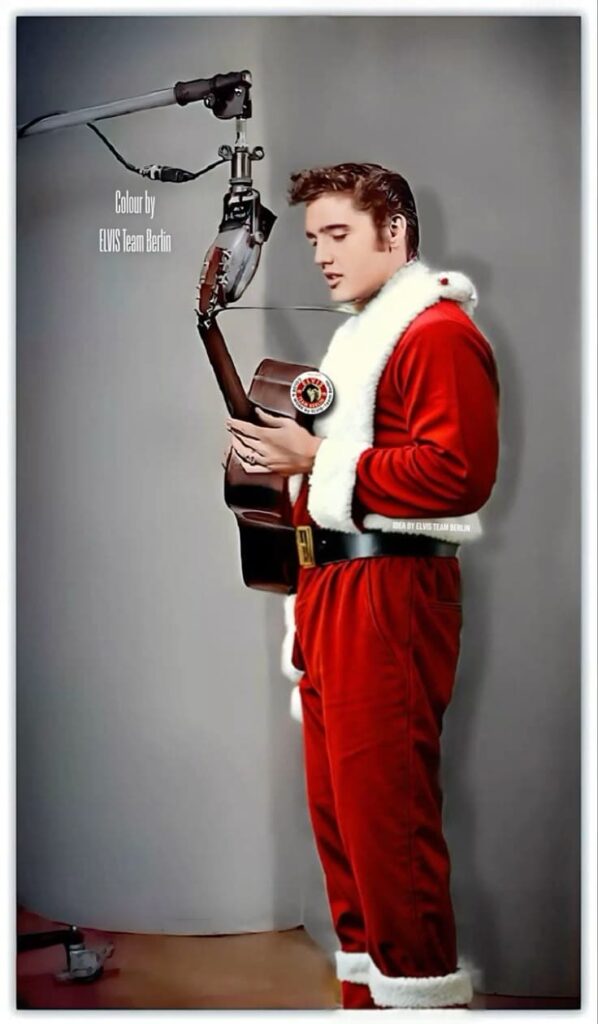
Santa Claus Is Back in Town — a smoky, swaggering Christmas classic that blends desire, blues, and the unmistakable soul of Elvis Presley
From the very first growl of “Santa Claus Is Back in Town,” you can feel Elvis Presley stepping into the holiday season not with bells and sugar, but with a confident, blues-soaked swagger. Released in 1957 as the opening track of his album Elvis’ Christmas Album, the song immediately stood apart from the gentle carols and traditional hymns of its time. Instead of soft snow and warm fireplaces, Elvis delivered Christmas with a sly grin, a blues rhythm, and a voice that curled like smoke in a dim December room.
It’s hard to overstate how bold this was in the late ’50s. While most Christmas releases followed safe, wholesome formulas, Elvis — along with songwriters Jerry Leiber and Mike Stoller — crafted something daringly modern. With its sensual undertones and playful innuendo, the song surprised listeners who expected the polite charm of “White Christmas.” And yet, it worked. It worked brilliantly.
Elvis’ Christmas Album debuted on the charts in the U.S. soon after release, eventually becoming the bestselling Christmas album of all time in the United States. Though “Santa Claus Is Back in Town” was not released as a standalone single at the time, it quickly became one of the album’s defining tracks — the one people remembered because it didn’t sound like any Christmas song they’d heard before.
But beyond the music industry significance, there is a deeper story wrapped inside this track.
It captures Elvis at the height of his early power — that moment when he was rewriting the rules of popular music with every note he sang. Here, he transforms Santa from a jolly, round-bellied figure into a mysterious traveler rolling up in a big black Cadillac, knocking on a lover’s door with unmistakable intention. It was playful, yes, but also electrifying. For many listeners, especially those who were young adults in the 1950s, this song marked a turning point: the moment when holiday music stopped being purely sentimental and gained a pulse, a spark, a little trouble.
The performance itself is unforgettable. Elvis leans low into the blues, stretching out the words like he’s savoring each one. His voice dips, growls, and glides with the confidence of a man who knows exactly the effect he has on his audience. Behind him, the Jordanaires echo like ghosts of rock ’n’ roll Christmas future, their harmonies smooth but never overwhelming. Every element is carefully balanced, yet it all feels effortless — as if Elvis walked into the studio, winked at the microphone, and the song simply fell into place.
For listeners today, the magic of the track lies in that mix of nostalgia and electricity. It takes us back to a time when music was changing quickly, when young voices were shaking old traditions, and when something as simple as a Christmas song could feel rebellious. The sound of early rock ’n’ roll is all there — raw, lively, full of motion — but wrapped in a holiday ribbon that makes it both familiar and thrilling.
And for those who lived through the era, hearing “Santa Claus Is Back in Town” now is like stepping into a warm memory: a Christmas night long ago, when the world seemed bigger, possibilities wider, and Elvis Presley’s voice felt like a doorway into something new.
It remains a holiday classic not because it is sweet, but because it is honest — unapologetically full of personality, rhythm, and the youthful fire that defined a generation.
All these years later, Elvis Presley still brings Christmas alive not with snowflakes, but with swagger. And perhaps that is why the song endures: it reminds us of a time when even winter seemed warmed by the sound of his voice.
 Oldies Songs