
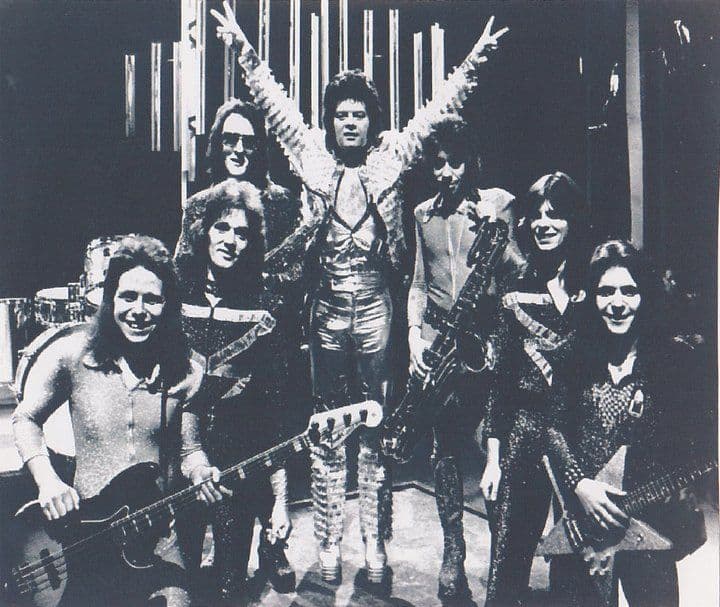
Angel Face — a glittering smile masking the thrill, danger, and illusion of young love
When “Angel Face” by The Glitter Band burst onto the airwaves in 1974, it carried all the sparkle, swagger, and seductive tension that defined the height of British glam rock. Released as a single in the summer of that year, the song climbed rapidly to No. 2 on the UK Singles Chart, becoming one of the band’s biggest and most enduring hits. It arrived at a moment when pop music was loud with color, confidence, and fantasy — yet beneath its infectious stomp and glossy hooks lay a knowing wink about desire, temptation, and appearances that can deceive.
The Glitter Band were already a familiar name by then, having emerged from the powerful backing group behind Gary Glitter. By the early 1970s, they had stepped confidently into their own spotlight, crafting records that were rhythm-heavy, chant-ready, and tailor-made for radio and dance halls alike. “Angel Face” came from this period of independence and success, cementing their identity as more than a supporting act. It was glam rock distilled to its essence: big drums, sharp guitar lines, and a chorus that practically demanded to be shouted back.
Yet what gives “Angel Face” its lasting appeal is not only its irresistible groove, but its subtle narrative. The song tells the story of being captivated by someone whose beauty and charm promise heaven, while quietly hinting at danger beneath the surface. The “angel face” is not purely innocent — it is alluring, powerful, and slightly dangerous. In this way, the song reflects the glam rock era itself: dazzling on the outside, but often playing games with image, identity, and desire.
There is a playful cynicism in the lyrics, a recognition that attraction can be both intoxicating and risky. This was not the wide-eyed romance of early pop love songs, but something more streetwise. By the mid-1970s, audiences had grown older, and so had the stories in their music. “Angel Face” speaks to that moment — when admiration turns into obsession, and when surface beauty hides emotional complexity. It never moralizes, never judges. It simply observes, with a grin and a stomp.
Musically, the track is classic glam rock: driving percussion that feels almost tribal, layered vocals that invite participation, and a chorus built for repetition. There is a physicality to the song — it doesn’t just play in the background; it moves through the body. This made it perfect for crowded dance floors, lively radio shows, and the shared experience of youth. It was music meant to be felt as much as heard.
For listeners who lived through that era, “Angel Face” carries more than nostalgia — it recalls a time when music felt bold and unapologetic, when three minutes of sound could turn an ordinary evening into something electric. The song is inseparable from memories of flared trousers, bright lights, and the sense that pop music belonged to everyone in the room, not just the performer on stage.
Despite its chart success, The Glitter Band were never about grand statements or epic ballads. Their strength lay in capturing a moment — the energy of a night out, the pulse of desire, the thrill of attraction. “Angel Face” remains a perfect example of that talent. It doesn’t try to be timeless; instead, it proudly belongs to its time, and that honesty is exactly why it endures.
Today, listening again, the song feels like opening an old photograph: the colors slightly faded, but the emotion intact. The beat still hits, the chorus still lifts the spirit, and the story still rings true. Beauty still dazzles, temptation still beckons, and behind every angelic smile, there is always more than meets the eye.
In the end, “Angel Face” stands as a joyful, knowing relic of glam rock’s golden age — a reminder that sometimes music doesn’t need depth to be meaningful. Sometimes, it only needs rhythm, attitude, and the courage to shine.