
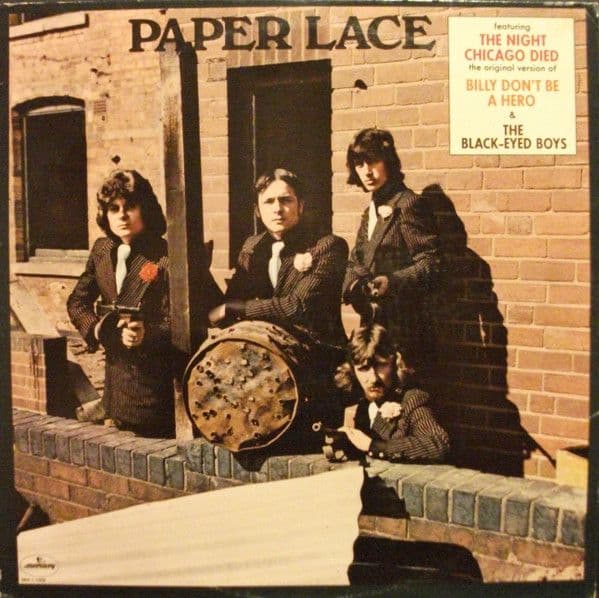
The Night Chicago Died — when a British band turned American myth into a haunting pop elegy
Few songs capture the feeling of collective shock and shared memory quite like “The Night Chicago Died” by Paper Lace. From its first spoken lines to its solemn, marching chorus, the song unfolds like a newspaper headline frozen in time — not merely telling a story, but inviting the listener to remember it, even if it never truly happened. Released in late 1973 and rising to prominence in early 1974, the song became one of the most distinctive pop narratives of its era, blending nostalgia, fear, and innocence into a surprisingly emotional package.
Right at the outset, its historical impact is clear. “The Night Chicago Died” reached No. 1 on the UK Singles Chart in February 1974 and soon after climbed to No. 1 on the US Billboard Hot 100 in March 1974. For a British band from Nottingham, this was an extraordinary achievement — especially with a song so deeply rooted in American imagery. It also topped charts in several other countries, making Paper Lace briefly but memorably part of global pop history.
The story behind the song is as fascinating as the song itself. Written by songwriters Peter Callander and Mitch Murray, it was inspired not by a real historical event, but by the myth of Chicago during the Prohibition era — a city imagined through gangster films, newsreels, and whispered legends. Al Capone is mentioned by name, yet the events described in the song are entirely fictional. No such shootout between police and Capone’s men ever took place. And yet, the song feels emotionally true, which is perhaps why it resonated so deeply.
At the heart of the narrative is a child waiting anxiously at home, listening to the radio, fearing that their father — a policeman — may not come back alive. This choice of perspective is crucial. Rather than glorifying violence or gangland bravado, the song filters danger through innocence. The tension comes not from gunfire, but from waiting. From imagining footsteps at the door. From the unbearable silence between news bulletins.
Musically, Paper Lace approached the song with restraint. There is no excess drama, no bombast. The arrangement moves steadily, almost solemnly, like a slow procession. The melody is simple, nearly hymn-like, which gives the story a sense of inevitability. When the chorus arrives — “And the night Chicago died” — it feels less like a statement and more like a sigh. A collective exhale after holding one’s breath too long.
For listeners who lived through the 1970s, the song carries an added layer of meaning. This was a time when radio still felt intimate, when families gathered around shared sounds, and when pop music often told complete stories in under four minutes. “The Night Chicago Died” belongs to that tradition — a reminder of when songs didn’t just accompany life, but narrated it.
There is also something quietly universal in its theme. Strip away the gangster setting, and what remains is fear for a loved one’s safety, the vulnerability of waiting, and the relief — or heartbreak — that comes with the news. Many listeners recognized that feeling immediately, regardless of geography. Chicago became every city. The father became every protector. The night became every moment of uncertainty we carry with us.
Though Paper Lace would not sustain the same level of success long-term, this song ensured their place in pop memory. It stands today not as a historical document, but as a beautifully crafted illusion — proof that a song doesn’t have to be factual to feel deeply real.
Listening now, decades later, “The Night Chicago Died” still feels like a radio voice drifting out of the past, carrying a story we somehow already know. And perhaps that is its greatest achievement: turning imagined history into shared remembrance, and reminding us how powerful a simple song can be when it speaks to the quiet fears of the human heart.