
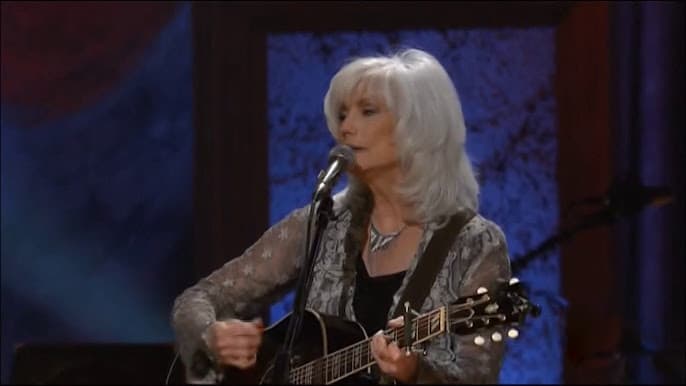
A Song of Longing and Light, Where Faith, Poverty, and Hope Quietly Meet
When Emmylou Harris stepped onto the stage of the Ryman Auditorium in 2017 to sing “Mansion on the Hill”, she was not merely revisiting a classic song. She was reopening a shared emotional archive of American music, one shaped by hardship, dignity, and the quiet promise of something better beyond this life. For listeners who grew up with country music as a companion rather than a novelty, this performance felt less like a concert moment and more like a late evening conversation with an old friend.
Originally written and recorded by Hank Williams in 1948, “Mansion on the Hill” was released as a single on MGM Records and climbed to No. 12 on the Billboard Best Selling Folk Records chart. That chart position matters, not for bragging rights, but because it marked a moment when deeply personal, spiritually rooted storytelling could still find its way into the commercial bloodstream of American music. Hank Williams was never writing to impress. He was writing to survive, and that honesty carried his songs far beyond their modest origins.
The song itself is deceptively simple. Over a gently rolling melody, the narrator speaks of earthly poverty while dreaming of a heavenly home, a mansion on a hill where sorrow and struggle no longer apply. This was not abstract theology. It was lived reality. Hank Williams knew financial instability, chronic pain, and emotional turmoil intimately. Raised in rural Alabama during the Great Depression, he understood what it meant to look at the world from the outside and still hold on to faith. The mansion in the song is not about wealth. It is about dignity restored.
When Emmylou Harris sings “Mansion on the Hill”, especially in a sacred space like the Ryman Auditorium, the song takes on additional layers of meaning. Harris has long been one of the most trusted interpreters of classic country and Americana, not because she reshapes songs aggressively, but because she approaches them with humility and deep understanding. Her voice, weathered yet luminous, carries the weight of decades spent honoring tradition while gently expanding its emotional range.
By 2017, Emmylou Harris had already lived several musical lifetimes. She had championed the legacies of Gram Parsons, The Louvin Brothers, and The Carter Family, always acting as a bridge between generations. Singing “Mansion on the Hill” at the Ryman was a deliberate choice. The venue itself, often called the Mother Church of Country Music, has absorbed countless stories of faith, doubt, sorrow, and redemption. Harris did not perform the song as nostalgia. She performed it as testimony.
What makes this song endure, especially for older listeners, is its refusal to rush toward comfort. The lyrics do not deny hardship. They acknowledge it plainly. There is hunger, loneliness, and exclusion here. Yet there is also patience, the belief that life’s injustices are not the final word. In a world that increasingly celebrates immediacy and abundance, “Mansion on the Hill” speaks to those who learned early that meaning often arrives slowly.
Musically, the song remains restrained. That restraint is its power. In Harris’s hands, the melody breathes. Each line feels considered, almost prayerful. She allows silence to do part of the work, trusting the listener to bring their own memories into the space the song creates. This is not performance as spectacle. It is performance as remembrance.
For those who have walked long roads, loved deeply, and endured quiet losses, “Mansion on the Hill” remains a companion piece. It does not promise easy answers, but it offers something rarer: understanding. Through Emmylou Harris, the song becomes a gentle reminder that music can still speak softly and be heard clearly, even after many years.