
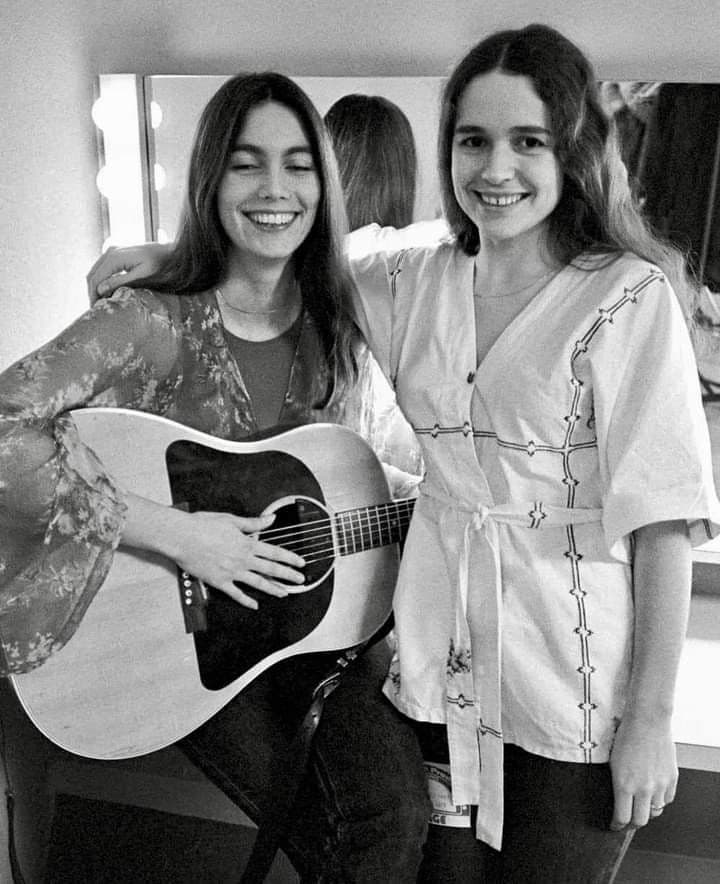
The First Noel — a fragile light of faith, memory, and grace carried by a timeless voice
When Emmylou Harris sings “The First Noel,” the song does not arrive with grandeur or theatrical power. Instead, it comes quietly — like candlelight in a darkened room — gentle, reverent, and deeply human. Her recording appears on the 1979 album Light of the Stable: The Christmas Album, a work that remains one of the most beloved and enduring Christmas records in American roots music. Upon its release, the album reached No. 5 on the Billboard Top Country Albums chart and crossed over to No. 21 on the Billboard 200, an impressive achievement for a seasonal, traditionally rooted collection. The song itself was not released as a charting single, yet its legacy has grown steadily with time.
What makes “The First Noel” so moving in Emmylou Harris’s hands is not reinvention, but restraint. This is one of the oldest English Christmas carols, passed down through centuries, sung in countless churches and homes. Harris does not attempt to modernize it or reshape its melody. Instead, she steps aside and allows the song’s ancient soul to speak, guided by her unmistakable voice — clear, silvery, and tinged with quiet sorrow.
By 1979, Emmylou Harris was already a revered figure in music. She had emerged from personal tragedy and artistic uncertainty to become one of the defining voices of country, folk, and Americana. Her work carried the influence of Gram Parsons, traditional ballads, and the emotional honesty of lived experience. Light of the Stable came at a moment when her career was flourishing, yet the album feels deliberately humble, almost private — as if it were meant for living rooms rather than concert halls.
“The First Noel” sits near the emotional heart of the album. The arrangement is sparse and respectful, often supported by acoustic instruments and harmonies that feel closer to prayer than performance. Harris sings not at the listener, but with them, as though joining a familiar carol already humming softly in the room. There is no rush in her phrasing. Each line unfolds patiently, allowing the weight of the story — the shepherds, the star, the fragile beginning of hope — to settle gently in the air.
The meaning of the song itself has never changed: it tells of a humble birth, witnessed first not by kings or scholars, but by shepherds keeping watch through the night. In Emmylou Harris’s interpretation, this humility becomes central. Her voice carries a sense of quiet wonder, but also reflection — as if she understands that faith, like music, often survives not through certainty, but through trust and memory.
What resonates so deeply with listeners over time is the way her voice bridges past and present. There is something timeless in her tone, something that feels rooted in old hymns, winter evenings, and family traditions carried across generations. You don’t simply hear this version of “The First Noel”; you remember it. It recalls moments when the world slowed down, when silence mattered, when the simplest melodies carried the greatest meaning.
Unlike many Christmas recordings that sparkle brightly and then fade with the season, this song lingers. It invites contemplation rather than celebration, stillness rather than noise. It feels especially powerful in later years, when memories grow richer and time feels more fragile. Harris sings with a tenderness that suggests she knows how easily moments pass — and how important it is to hold them gently.
In the larger arc of Emmylou Harris’s career, “The First Noel” stands as a reminder of her greatest strength: emotional truth. She never overwhelms a song. She listens to it, honors it, and then lets it breathe. That approach transforms a centuries-old carol into something intimate and personal, without losing its sacred core.
So when this song returns each winter, it does not feel like repetition. It feels like reunion. A familiar voice, a familiar melody, and a quiet assurance that even in a world shaped by loss and change, there is still room for light — softly sung, patiently remembered, and carried forward, one season at a time.
 Oldies Songs