
A Collective Salute to a Voice That Defined Strength, Vulnerability, and American Songcraft
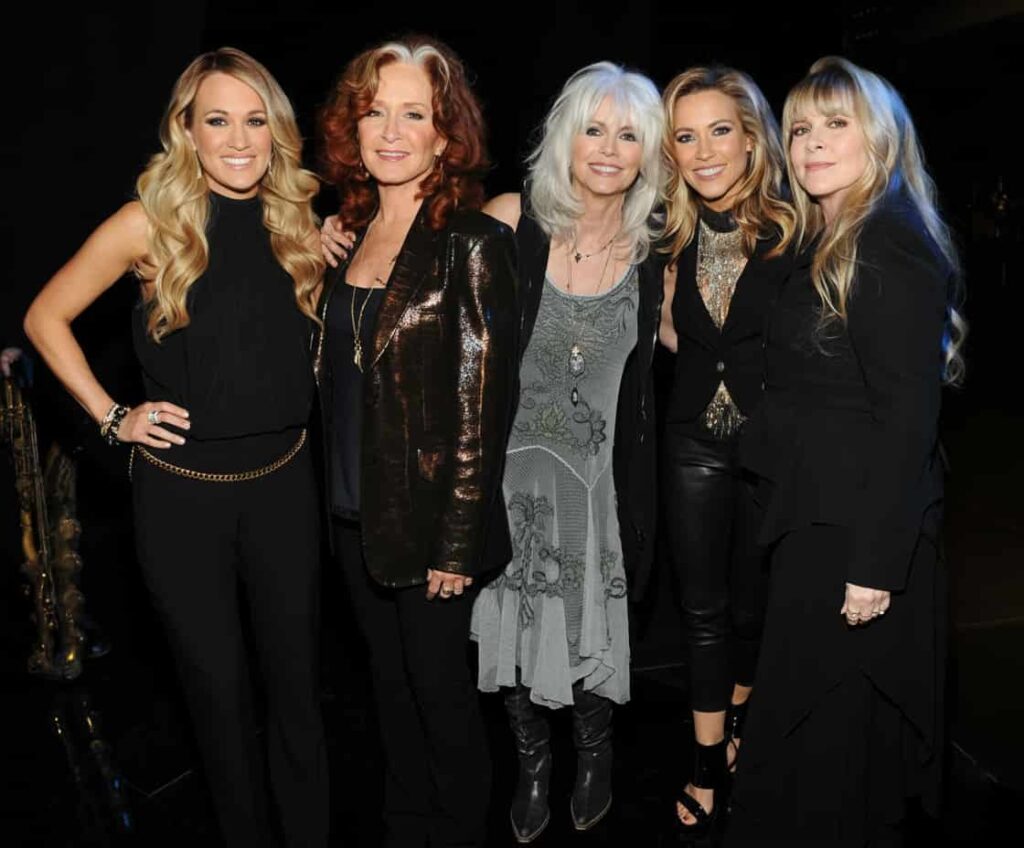
Few moments in recent music history have felt as quietly powerful as the tribute to Linda Ronstadt at the 29th Annual Rock and Roll Hall of Fame Induction Ceremony on April 10, 2014. Before an audience deeply aware of the weight of legacy, Emmylou Harris, Stevie Nicks, Bonnie Raitt, Carrie Underwood, and Sheryl Crow came together to honor a woman whose voice had shaped multiple generations and crossed stylistic borders with rare authority. Their medley, centered on “You’re No Good” and “When Will I Be Loved”, was not simply a performance. It was a recognition of lineage, influence, and artistic courage.
The choice of songs was deliberate and historically grounded. “You’re No Good”, released in late 1974 as the lead single from Linda Ronstadt’s landmark album Heart Like a Wheel, reached No. 1 on the Billboard Hot 100 in February 1975. It became the defining hit of her career, announcing her arrival as a dominant solo artist after years of steady work in folk rock and country circles. The song itself was not new. It had been recorded before by Betty Everett and others. Yet Ronstadt transformed it. Her version was sharper, more resolute, and emotionally direct, framed by a restrained groove that allowed her voice to carry both defiance and release. It was the sound of a woman claiming authority in a pop landscape still uneasy with female strength.
“When Will I Be Loved”, also from Heart Like a Wheel, followed closely behind, climbing to No. 2 on the Billboard Hot 100 in 1975. Originally written and recorded by Phil Everly of The Everly Brothers in 1960, the song took on new meaning in Ronstadt’s hands. Where the original carried youthful impatience, her interpretation conveyed emotional fatigue and self awareness. It spoke to longing shaped by experience rather than innocence. In pairing these two songs, the medley traced a quiet emotional arc from resolve to reflection, mirroring much of Ronstadt’s recorded legacy.
What made the 2014 tribute especially resonant was the personal and artistic connection each performer brought to the stage. Emmylou Harris shared a deep musical bond with Ronstadt dating back to the 1970s, including their work together with Dolly Parton on the Trio albums. Bonnie Raitt, long admired for her blend of blues, rock, and emotional honesty, had often cited Ronstadt as proof that commercial success need not dilute artistic integrity. Stevie Nicks represented the rock mysticism and vulnerability Ronstadt helped normalize for women in arena scale music. Sheryl Crow and Carrie Underwood, from different generations, stood as living evidence of Ronstadt’s enduring influence across genres.
By 2014, Linda Ronstadt herself was no longer able to sing publicly due to Parkinson’s disease, a reality that lent the evening a profound sense of gravity. Her induction into the Rock and Roll Hall of Fame was both a celebration and an acknowledgment of absence. Yet her presence was unmistakable. It lived in phrasing choices, vocal restraint, and the collective humility of artists who understood they were standing inside a tradition larger than themselves.
Ronstadt’s significance lies not only in chart success, though that record is formidable, but in her refusal to be contained. She moved effortlessly between rock, country, pop, folk, standards, and later Spanish language albums, often at moments when such shifts carried real professional risk. Heart Like a Wheel remains a turning point in American popular music because it demonstrated that emotional truth could coexist with mass appeal, and that a female artist could lead without apology.
The 2014 tribute did not attempt to recreate Ronstadt’s voice. It did something far more respectful. It allowed multiple voices to converge around her songs, illustrating how deeply they had entered the shared musical memory. In that convergence, the audience was reminded that great songs do not age. They accumulate meaning. And great artists, even when silent, continue to sing through those who follow.