
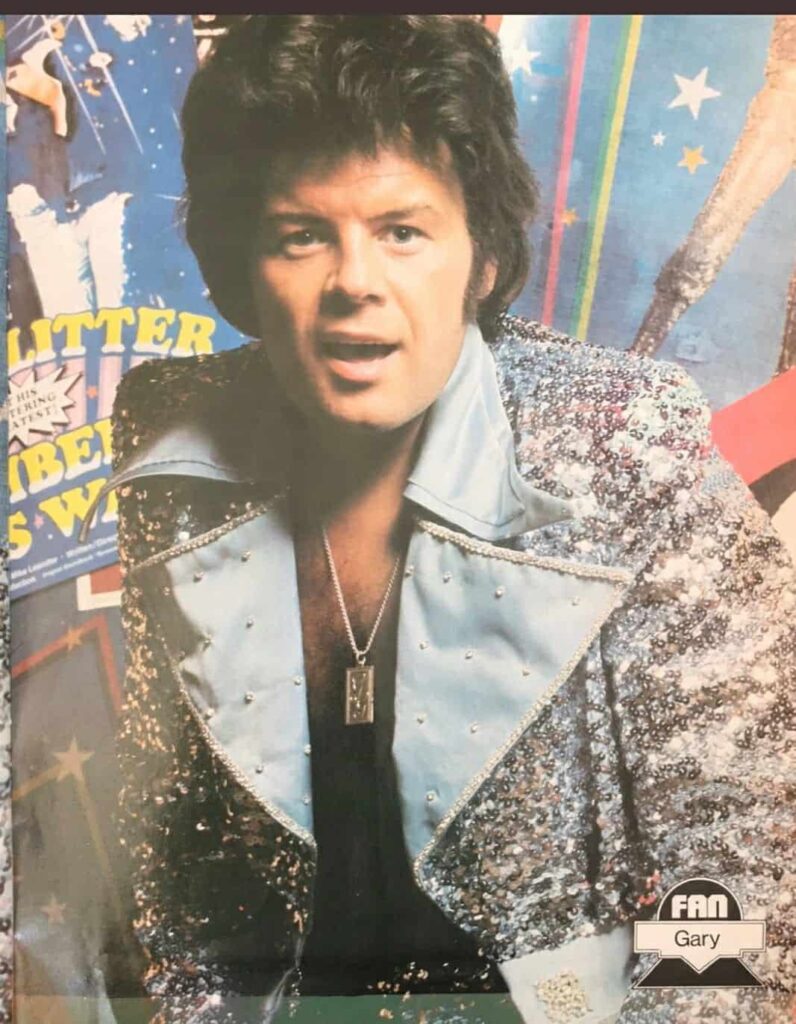
I’m the Leader of the Gang (I Am!) — a thunderous chant of youth, rebellion, and a moment when pop music ruled the streets
Few songs capture the raw, stomping spirit of early-1970s British pop quite like “I’m the Leader of the Gang (I Am!)” by Gary Glitter. From its opening drum beat to its shouted chorus, the song feels less like a traditional pop single and more like a rallying cry — loud, uncomplicated, and impossible to ignore. Released in 1973, it arrived at a time when pop music was beginning to flirt boldly with glam rock’s glittering defiance, and it made its mark instantly.
Right at the outset, the historical facts are clear and important. “I’m the Leader of the Gang (I Am!)” was released as a single in mid-1973 and quickly climbed to No. 1 on the UK Singles Chart, holding the top position for four consecutive weeks. It became one of the defining hits of the glam rock era in Britain and cemented Gary Glitter as one of the most recognizable — and controversial — pop figures of the decade. The song was also a significant international success, charting in several countries and becoming closely associated with the larger-than-life image Glitter cultivated during his commercial peak.
Musically, the song is deceptively simple. Built around a pounding, tribal drum rhythm and a call-and-response chorus, it borrows as much from football chants and street bravado as it does from rock ‘n’ roll. That simplicity is precisely where its power lies. This is not a song that asks to be analyzed; it asks to be shouted, stomped, and shared. The repeated declaration — “I’m the leader of the gang, I am!” — feels like a statement of identity, confidence, and belonging, especially for a young audience eager to feel part of something larger than themselves.
Behind the scenes, the song was co-written by Gary Glitter and producer Mike Leander, a partnership that defined Glitter’s biggest hits. Leander’s production gave the track its unmistakable sound: heavy drums pushed to the front of the mix, handclaps, and a chant-like vocal style that blurred the line between performer and crowd. This approach would become a blueprint for many glam rock singles that followed — bold, theatrical, and designed to command attention in a noisy world.
Lyrically, the song does not tell a complex story. Instead, it captures a mood. The “gang” in the title is less about criminality and more about youth culture — the desire to stand out, to lead, to be seen and heard. In the early 1970s, when traditional social structures were being questioned and young people were asserting their own identities through music, fashion, and attitude, this kind of anthem struck a powerful chord. It was loud confidence in a three-minute burst.
For listeners who remember that era, the song carries a strong sense of place and time. It evokes packed dance halls, transistor radios, bold stage outfits, and a moment when pop music felt physical — something you didn’t just listen to, but felt in your chest. The glam rock movement, with its platform shoes, glitter, and theatrical swagger, offered an escape from everyday routines, and “I’m the Leader of the Gang (I Am!)” stood at the center of that spectacle.
Over the years, the song’s legacy has become complicated by the later life and actions of its performer — a reality that has led many to reassess how they engage with the music. Yet, as a historical artifact, the song remains a clear reflection of its moment. It represents a time when pop singles could dominate public space, when choruses spilled out of radios into streets and stadiums, and when music offered a sense of shared energy and release.
Separated from biography and viewed purely through the lens of musical history, “I’m the Leader of the Gang (I Am!)” endures as one of the most unmistakable sounds of early-1970s British pop. It is loud, brash, unapologetic — and deeply rooted in the collective memory of an era when music didn’t whisper its intentions. It shouted them, proudly, and invited the world to shout back.