
A Quiet Portrait of Love and Longing in the World of Gram Parsons
Few songs capture the fragile poetry of country rock quite like “Juanita.” In the hands of Sheryl Crow and Emmylou Harris, this gentle composition becomes more than a tribute. It turns into a conversation across generations, voices joined in reverence for a songwriter who reshaped American music from the margins.
“Juanita” was written by Gram Parsons together with Chris Hillman, both central figures in The Flying Burrito Brothers. The song first appeared on the band’s second album, Burrito Deluxe, released in 1970. At the time of its original release, the song was never issued as a single and therefore did not enter the major Billboard singles charts. Like much of Parsons’ work, its influence traveled quietly rather than loudly, finding its audience slowly, through attentive listening rather than commercial force.
Nearly three decades later, the song was reborn on Return of the Grievous Angel: A Tribute to Gram Parsons in 1999. The album itself reached number 64 on the Billboard 200, a respectable showing for a tribute record devoted to an artist who had never been a mainstream star in his lifetime. That placement mattered, not for bragging rights, but as a reminder that Parsons’ vision continued to resonate long after his early death in 1973.
The pairing of Sheryl Crow and Emmylou Harris on “Juanita” was inspired and deeply symbolic. Harris had been Parsons’ closest musical partner during his final years, singing with him on GP and Grievous Angel, and carrying his musical philosophy forward throughout her own storied career. Crow, on the other hand, came from a later generation, shaped by rock radio and modern songwriting, yet deeply respectful of roots music and its emotional honesty. Together, they formed a bridge between eras.
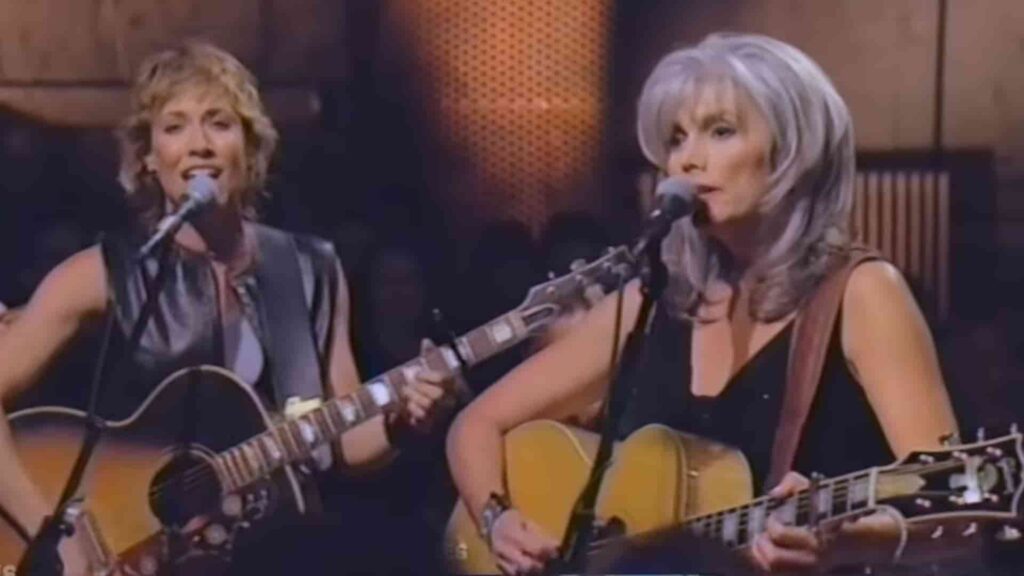
Their performance strips the song down to its emotional essentials. Crow’s voice brings a weathered warmth, grounded and human, while Harris’ high, luminous harmony floats above it, almost like memory itself. There is no excess here, no attempt to modernize or dramatize the song. The arrangement remains faithful to the spirit of Parsons’ original vision, understated, patient, and sincere.
Lyrically, “Juanita” is a study in devotion and vulnerability. The narrator speaks not in grand declarations, but in quiet assurances. It is a song about staying, about choosing love without illusions, and about accepting the weight that comes with commitment. There is a tenderness in the way the name Juanita is repeated, as if speaking it aloud is an act of reassurance in itself. This simplicity is deceptive. Beneath it lies a profound understanding of human longing and emotional risk.
When Crow and Harris performed “Juanita” live on Sessions at West 54th in 1999, the moment carried added resonance. It was not merely a television performance, but a living testament to continuity. The song moved from the late 1960s countercultural country rock scene into a new century, still intact, still meaningful. That is a rare achievement.
For listeners who have lived long enough to see musical fashions rise and fall, “Juanita” offers something enduring. It does not chase trends or nostalgia for its own sake. Instead, it invites reflection. It reminds us that the most lasting songs are often the quiet ones, the ones that speak gently but truthfully about love, loyalty, and the passage of time.
In the end, this rendition of “Juanita” stands as a graceful homage, not only to Gram Parsons, but to a way of making music that values honesty over spectacle. Through Sheryl Crow and Emmylou Harris, the song continues to live, not as a relic, but as a companion, walking softly alongside those willing to listen.