
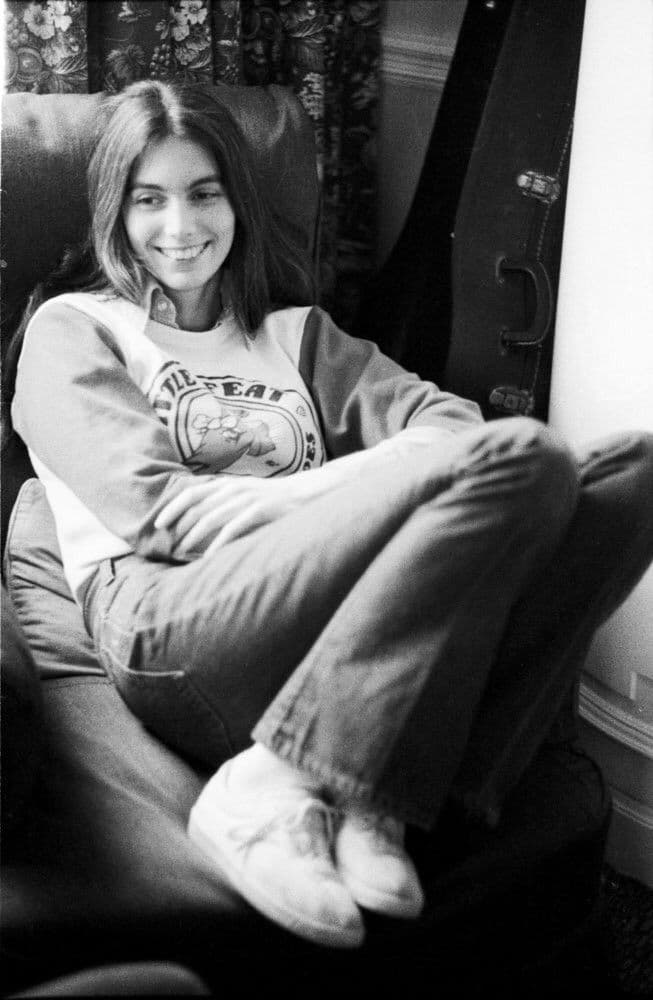
Emmylou Harris: The Silver Thread of Americana and the Price of a Song
Based on the poignant narrative of her life, this essay explores the profound intersection of artistry, sacrifice, and the search for self-identity in the life of Emmylou Harris.
The Architect of a Lonesome Sound
To hear the voice of Emmylou Harris is to listen to the wind blowing through an empty cathedral—it is ethereal, slightly fractured, and deeply holy. While she is celebrated as the “Queen of Americana,” the transcript of her life reveals that her legendary status was not bought with glitter and gold, but with the currency of solitude. For a woman who spent decades singing about the endurance of love, her personal reality was often defined by the “hollow spaces” left behind when the stage lights dimmed.
Harris’s journey is a masterclass in the quiet tragedy of talent. It is the story of an artist who chose—or perhaps was chosen by—a path that demanded the systematic dismantling of a conventional domestic life to preserve the integrity of a musical one.
Foundations in Silence and Steel
The roots of Emmylou’s stoicism can be traced back to her childhood as a “military brat.” Born in 1947 to a Marine Corps officer who endured the horrors of being a prisoner of war, she learned early that resilience was an obligation, not a choice. In a household where emotions were secondary to discipline, music became her only “safe space.”
When she eventually traded her aspirations in drama for the folk scenes of Greenwich Village, she wasn’t just looking for a career; she was looking for a language to define herself. However, the initial “stumble” of her debut album, Gliding Bird (1969), and the swift collapse of her first marriage to Tom Slocum, forced her into a brutal confrontation with the reality of being a touring musician and a mother. The heartbreaking choice to send her daughter, Hallie, to live with grandparents so she could pursue music in Washington D.C. became the first of many “unspoken farewells” that would haunt the timbre of her voice.
The Anchor and the Aftermath: Gram Parsons
The most pivotal chapter of her life—and perhaps the most enduring ghost—was her collaboration with Gram Parsons. Their voices together were described as “two breaths meant to move together.” In albums like GP and Grievous Angel, they redefined country rock. Yet, Parsons was a self-destructive flame. His death in 1973 didn’t just end a partnership; it left Harris as the custodian of a legacy.
She did not retreat. Instead, she channeled her grief into Pieces of the Sky (1975) and the iconic “Boulder to Birmingham.” This period cemented her as a solo powerhouse, yet it also established a pattern: her greatest creative heights were often tethered to her deepest personal losses.
The Paradox of the Trio and Final Liberation
As the years progressed, Emmylou navigated two more marriages—to producer Brian Ahern and songwriter Paul Kennerly. Both followed a similar arc: love born in the studio, eventually eroded by the relentless “machinery of success.” She famously noted she was a “really good ex-wife,” a bittersweet acknowledgment that her absolute loyalty belonged to the music, not the hearth.
In 1987, she found a different kind of kinship with Dolly Parton and Linda Ronstadt. The Trio project was a defiance of industry logic, proving that female solidarity could outsell the male-dominated status quo. This success provided a transition into her later, more experimental years, such as the haunting, atmospheric Wrecking Ball (1995) and the deeply personal Red Dirt Girl (2000).
Today, Emmylou Harris stands alone, but she is far from empty. Her life is a testament to the fact that one can find balance outside the traditional framework of marriage. Through her devotion to social causes and her “Bonaparte’s Retreat” animal rescue, she has replaced the turbulence of romance with the steady rhythm of purpose. She remains the silver thread of Americana—a voice that tells the truth because it ha
 Oldies Songs