
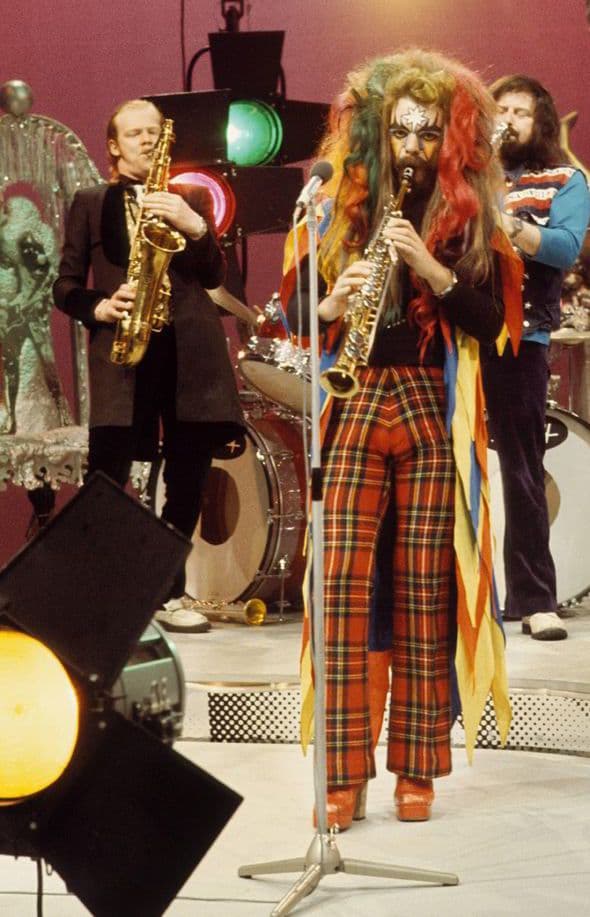
A joyful throwback to lost innocence and teenage love, wrapped in the bright echoes of 1950s rock ’n’ roll nostalgia
Released in May 1973, “See My Baby Jive” by Wizzard arrived like a burst of Technicolor joy in a decade that was rapidly becoming more cynical and fragmented. At a time when glam rock was strutting, prog rock was stretching, and singer-songwriters were turning inward, this song did something deceptively simple: it smiled. That smile carried it all the way to No. 1 on the UK Singles Chart, where it stayed for four consecutive weeks, becoming Wizzard’s biggest and most enduring hit. From the moment it entered the charts, it felt less like a new single and more like a memory rediscovered.
Fronted and masterminded by Roy Wood, already celebrated for his work with The Move and as a founding member of Electric Light Orchestra, Wizzard was never intended to be a conventional band. It was a vehicle for Wood’s deep love of classic pop forms—particularly the exuberant, harmony-rich sound of 1950s American rock ’n’ roll. “See My Baby Jive” is perhaps the purest expression of that affection. Clocking in at barely two minutes, it wastes no time on complexity or irony. Instead, it dives straight into handclaps, buoyant piano, layered vocals, and a rhythm that feels designed for sock hops and transistor radios.
The song was later included on Wizzard’s debut album, Wizzard Brew (1973), but it stands apart from the album’s heavier, more eccentric moments. Here, Wood deliberately stripped things down—not in instrumentation, but in emotional intent. The lyrics are famously simple, almost childlike: a boy, a girl, a dance, a feeling that words can’t quite explain. There is no grand narrative, no heartbreak, no bitterness. That simplicity is not naïveté; it is a conscious artistic choice. Wood once made it clear that he wanted to recapture the feeling of early rock records rather than imitate them note for note. In “See My Baby Jive,” that feeling is one of first love, of evenings when the world felt smaller and kinder, and music was something you shared face to face.
Musically, the song is a loving collage of influences. One can hear echoes of Buddy Holly, The Everly Brothers, and early Elvis Presley, filtered through the glossy production values of the early 1970s. The handclaps recall school gym dances; the backing vocals sound like friends crowded around a single microphone. Even the slightly rough, almost rushed ending feels intentional, as if the band didn’t want the moment to last too long—because moments like this never do.
Its success on the charts was not driven by controversy or reinvention, but by recognition. Listeners recognized themselves in it—not as they were in 1973, but as they once had been. That is the quiet power of “See My Baby Jive.” It doesn’t ask the listener to move forward; it gently invites them to look back. In doing so, it became a defining single of the glam era while standing slightly apart from it—less theatrical, less knowing, more sincere.
Today, more than five decades on, “See My Baby Jive” remains a reminder that popular music does not always need to be profound to be meaningful. Sometimes, meaning lies in warmth, in rhythm, in a chorus that feels like an old friend tapping you on the shoulder. Roy Wood understood that memory itself can be a form of melody—and with Wizzard, he gave those memories a beat you could dance to.