
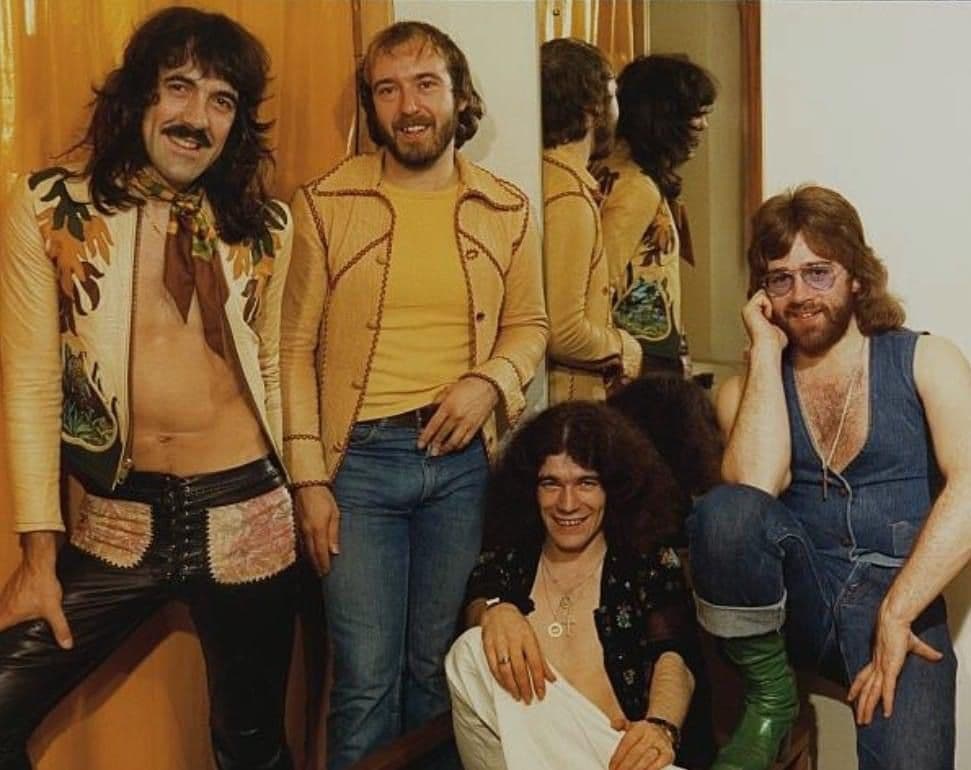
A tender teenage love song that blends 1950s innocence with 1970s pop craftsmanship, capturing the fragile beauty of first love and longing.
Released in late 1973, “Angel Fingers (A Teen Ballad)” by Wizzard arrived at a moment when British pop music was joyfully looking both forward and backward. Written and produced by Roy Wood, the song was issued as a single and later included on the album Wizzard Brew (1973). Upon its release, it climbed steadily to No. 1 on the UK Singles Chart, holding the top position during the Christmas season of 1973. This achievement marked Wizzard’s second UK No. 1 hit, following the exuberant success of “See My Baby Jive,” and confirmed Roy Wood’s remarkable ability to shape popular taste while honoring musical tradition.
From the very first notes, “Angel Fingers” announces itself not as a loud declaration, but as a gentle confession. The arrangement is rich yet restrained, built around warm piano lines, soft harmonies, and subtle orchestration that recalls the classic teen ballads of the late 1950s and early 1960s. Roy Wood was never shy about his love for early rock ’n’ roll and pre-Beatles pop, and here he channels that affection into a song that feels timeless rather than nostalgic for its own sake. The production deliberately avoids contemporary glam-rock excess, choosing intimacy over spectacle.
The story behind “Angel Fingers” is deeply tied to Roy Wood’s artistic philosophy. After leaving The Move and briefly co-founding Electric Light Orchestra, Wood formed Wizzard as a vehicle to explore the sounds that first made him fall in love with music. While many glam-era hits leaned on irony or flamboyance, Wood approached the past with sincerity. This song, subtitled “A Teen Ballad,” is his loving reconstruction of an era when pop songs spoke plainly about young love, vulnerability, and emotional uncertainty.
Lyrically, “Angel Fingers” is disarmingly simple. The narrator describes the feeling of being touched—both physically and emotionally—by someone who seems almost unreal in their purity and tenderness. The phrase “angel fingers” becomes a metaphor for innocence, for the way first love feels almost sacred. There is no cynicism here, no knowing wink. Instead, the song dwells in the fragile space between hope and fear, where affection is new and the future still unwritten. That emotional honesty is precisely what gives the song its enduring power.
Musically, the track stands out for its careful balance of sentiment and craftsmanship. The chord progression is classic, almost doo-wop in spirit, but Wood’s arrangement adds layers of sophistication. Background vocals echo like memories, while the rhythm section remains unobtrusive, allowing the melody to breathe. Roy Wood’s vocal performance is particularly noteworthy—gentle, slightly aching, and deliberately unpolished, as if any technical perfection might break the spell.
Although “Angel Fingers” did not achieve the same chart success outside the UK, its cultural impact within Britain was significant. Reaching No. 1 during the Christmas period, traditionally dominated by novelty songs or grand anthems, it stood out as something quieter and more reflective. It suggested that there was still room in popular music for tenderness, for songs that trusted listeners to slow down and feel.
Over time, “Angel Fingers” has come to be regarded as one of Roy Wood’s most heartfelt compositions. It represents the softer side of Wizzard, contrasting with the band’s more energetic singles while revealing the emotional depth beneath the surface. For many listeners, the song now feels like a preserved moment—an echo of youth, of handwritten letters, of emotions felt more intensely because they were new.
In the broader landscape of 1970s music, “Angel Fingers (A Teen Ballad)” stands as a reminder that progress does not always mean abandoning the past. Sometimes, it means listening carefully to what once moved us and finding a way to let it speak again, gently, honestly, and without irony.