
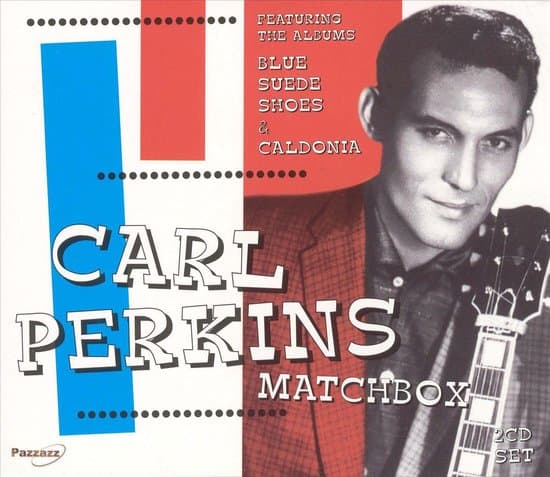
“Matchbox” and the Restless Spirit of Early Rockabilly: A Song About Pride, Poverty, and Defiance
When Carl Perkins recorded “Matchbox” in December 1956 at Sun Records, it arrived quietly, almost modestly, as the B-side to “Your True Love.” Yet history has a way of favoring the songs that speak plainly and honestly. Released in early 1957, “Your True Love” went on to become a major hit, reaching No. 13 on the Billboard Hot 100 and No. 1 on the Billboard Country chart. “Matchbox” did not chart at the time. Still, over the decades, it has endured as one of Carl Perkins’ most recognizable and influential recordings, a raw statement of character that captures the soul of early rockabilly better than many chart-toppers ever could.
“Matchbox” was written and recorded by Carl Perkins, though its lyrical roots reach further back into American blues history. In 1927, Blind Lemon Jefferson recorded “Match Box Blues,” a song that is musically different but shares several striking lyrical phrases. Perkins never denied the connection. Like many Southern musicians of his generation, he absorbed blues lines and imagery from records, radios, and front-porch listening, reshaping them through his own rural experience. What Perkins created was not imitation, but transformation. He took a blues lament and reimagined it through the clipped rhythms and nervous energy of rockabilly.
Musically, “Matchbox” is spare and urgent. The track features Perkins on vocals and guitar, backed by a young Jerry Lee Lewis on piano, whose pounding, barrelhouse style adds tension and drive beneath the song’s lean structure. Recorded at Sun Studio under the watchful ear of Sam Phillips, the performance feels almost confrontational. There is no polish here, no attempt to smooth rough edges. Phillips understood that authenticity was the product, and Carl Perkins delivered it with instinctive precision.
Lyrically, “Matchbox” is deceptively simple. The famous line, “I’m sittin’ here wonderin’, will a matchbox hold my clothes,” is not merely a clever turn of phrase. It is a stark image of poverty, displacement, and wounded pride. The narrator is a man pushed to the margins, abandoned, yet unwilling to beg for sympathy. There is humor in the exaggeration, but also quiet bitterness. The song speaks of being left behind, of having one’s life reduced to something that could fit inside a matchbox, and still standing upright in the face of it.
This emotional duality is where “Matchbox” finds its lasting meaning. Unlike many rock songs that celebrate youth and freedom, this one acknowledges hardship without surrender. Perkins sings not with self-pity, but with defiance. His voice carries the weight of lived experience, shaped by years of poverty in rural Tennessee. That authenticity resonated deeply with musicians who followed.
Over time, “Matchbox” became a cornerstone of rock and roll’s shared language. Jerry Lee Lewis recorded his own version in 1958, leaning more heavily into the piano-driven chaos that would define his style. Years later, The Beatles revived the song for a new generation. Sung by Ringo Starr, their 1964 recording brought “Matchbox” into the British Invasion era, where it charted in the UK and introduced Perkins’ work to listeners far removed from the cotton fields and highways that inspired it.
Yet for all its covers and reinterpretations, the original Carl Perkins recording remains definitive. It captures a moment when American popular music was still being invented in real time, shaped by musicians who blended blues, country, and rhythm with no concern for categories. “Matchbox” stands as a reminder that not every important song arrives with fanfare. Some arrive quietly, on the back of a hit single, and wait patiently for history to catch up.
For listeners who lived through those early years of rock and roll, “Matchbox” evokes a world where music was raw, personal, and deeply human. It is not just a song from the past. It is a document of resilience, of humor in hard times, and of a voice that refused to be smoothed down or forgotten. In that sense, Carl Perkins did more than record a memorable track. He left behind a small, sturdy box of truth, one that still holds more than it appears.