
The Wry Charm of Everybody’s Trying to Be My Baby — A Rockabilly Twist on Fame, Desire, and Musical Legacy
When you lay a vintage vinyl groove into the groove of Everybody’s Trying to Be My Baby, you’re hearing more than just a catchy rockabilly tune you’re hearing a musical conversation between eras. First given life in the 1930s by country singer Rex Griffin, the song found its enduring voice in the hands of Carl Perkins, who transformed its lyrical kernel into a rock and roll anthem in the mid-1950s and created a bridge over time that would lead it straight into the British Invasion of the 1960s.
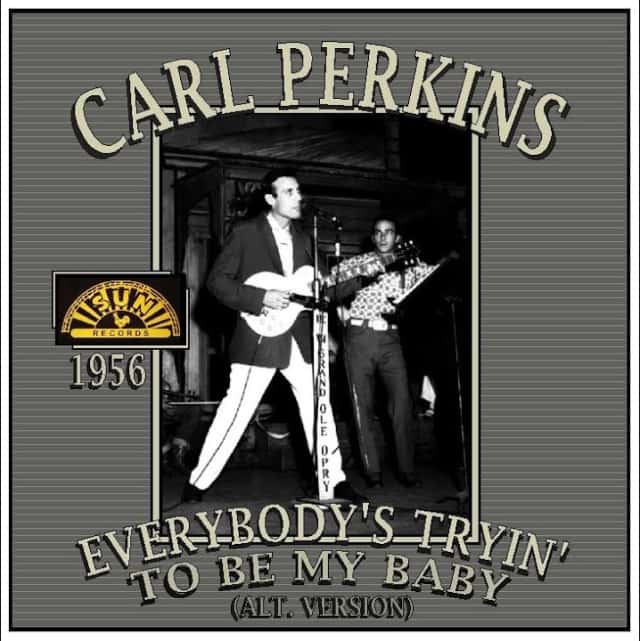
Recorded in 1956 and released in 1957 on Dance Album of Carl Perkins, the song sits amidst the earliest and most influential rockabilly music ever pressed at Sun Records in Memphis. While it never made a splash on the singles charts in the way that his monumental Blue Suede Shoes did, the track was part of the package that sealed Perkins’s reputation as a pioneer. Its sheer style and swagger carried a playful boast “everybody’s trying to be my baby” that spoke to both romantic bravado and the competitive theatricality of early rock and roll. It was as if Perkins was winking at an audience learning to dance on the febrile edge between country tradition and the electric urgency of rock.
Perkins’s version owes its roots to Griffin’s 1936 recording, but the rockabilly arrangement, brisk rhythmic bounce, and lyrical embellishments most notably the additional verse Perkins contributed transport the song far from its hillbilly origin. Where Griffin’s original is steeped in solo acoustic plaintiveness, Perkins’s interpretation is electric, rhythmic, and slyly jocular hinting at the loosened social codes of a postwar America discovering rhythm and blues, country twang, and back-porch swing in a single, thrilling mix.
The song’s afterlife was ensured when The Beatles reached across the Atlantic and made it the closing track on their 1964 LP Beatles for Sale, sung with lighthearted bravado by George Harrison. In their hands, the tune became a transatlantic artifact of rock history: an American rockabilly gem embraced, rearranged, and reborn by a generation captivated by the raw power of what had come before. The Beatles’ performance, complete with studio echo effects and a false ending that jolts listeners with a sense of playful uncertainty, speaks to the hybrid vigor of 1960s pop British enthusiasm filtered through the grit of American roots music.
The lyrical conceit standing firm amidst a sudden swarm of suitors, whether literal or metaphorical took on a fresh shade of meaning in the Beatles’ rendition. Suddenly it was not just about romantic competition but about musical emulation: every young band trying, in their own way, to stake a claim on a sound that Perkins had helped define. In this sense, the line between personal charm and artistic influence blurs “everybody’s trying to be my baby” becomes a wry meta-commentary on musical lineage itself.
Over the decades, the song’s spirit has endured in live performances, covers, and tribute sessions—most poignantly when Harrison shared the stage with Perkins himself in later years, a testament to mutual admiration between generations. For listeners today, the track offers a portal into a time when rock and roll was still finding its voice, when a wink and a double entendre in a two-minute song could evoke an entire cultural shift, and when the joyous collision of styles became the soundtrack to a new collective imagination.
In the heart of every note and every refrain, Everybody’s Trying to Be My Baby remains a celebration of rhythm’s promise: that music can be both a confession and a challenge, a memory and a dare, inviting each new generation to make it their own.