
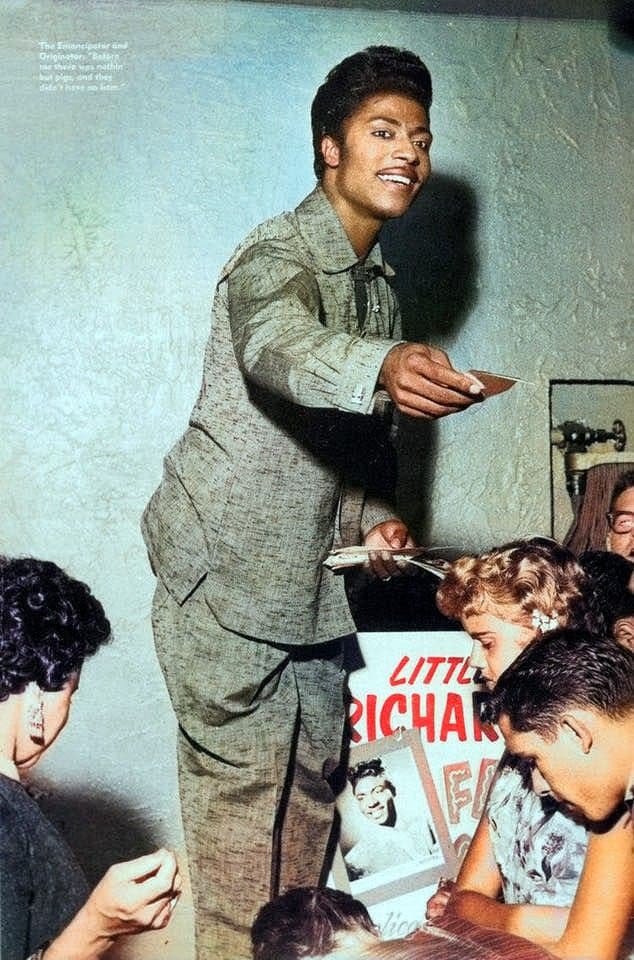
A wild cry of desire and devotion, “Lucille” captures the moment when rock ’n’ roll stopped knocking politely and kicked the door wide open.
When Little Richard released “Lucille” in 1957, popular music was already changing—but this record made it feel irreversible. It was not simply another hit single; it was a declaration. Coming at the height of his explosive early career, “Lucille” reached No. 1 on the Billboard R&B chart and No. 21 on the Billboard pop singles chart shortly after its release on Specialty Records. Those numbers matter, but they only hint at the deeper impact of the song. What truly counted was the sound: urgent, reckless, and emotionally naked, as if the singer had poured his entire being into two and a half minutes of vinyl.
By 1957, Little Richard—born Richard Wayne Penniman—had already shaken America with “Tutti Frutti” and “Long Tall Sally.” Yet “Lucille” feels different. Where earlier hits reveled in rhythmic nonsense and ecstatic abandon, this song leans heavily into obsession and longing. The repeated cry of the name Lucille is not playful; it is pleading, almost desperate. It sounds like someone chasing love down a dark street, knowing full well that it may never turn back.
The story behind the song adds another layer to its myth. The name Lucille was not chosen at random. Richard often used it as a symbolic stand-in for temptation, desire, and romantic chaos. In later interviews, he spoke of real women who inspired the name, but also of how “Lucille” became a recurring figure in his songwriting—a woman who represents trouble as much as attraction. There is also the famous touring anecdote from earlier in his career, when a fire broke out at a venue during one of his shows, and he later blamed it on his own indulgent behavior. From that moment on, Lucille became a name associated with both passion and warning, pleasure and consequence.
Musically, “Lucille” is a masterclass in controlled chaos. The pounding piano—played by Richard himself—drives the song forward like a runaway train. The saxophone solos scream and snarl, while the rhythm section locks into a relentless groove that refuses to let go. Above it all is Little Richard’s voice: raw, piercing, and emotionally unfiltered. He does not sing so much as testify. Each shout of “Lucille!” feels like it could tear his throat apart, and that sense of danger is precisely what made the record unforgettable.
Lyrically, the song is simple, almost stark. There are no poetic metaphors or elaborate narratives. Instead, repetition becomes meaning. By calling her name again and again, Richard conveys fixation, devotion, and loss all at once. It mirrors real emotional experience—the way love, when it overwhelms us, reduces language to a single name, a single thought we cannot escape. This directness is one reason the song still resonates decades later. It speaks to anyone who has ever loved too hard, or stayed too long.
Within the broader landscape of 1950s music, “Lucille” stands at a crossroads. It bridges rhythm and blues with the emerging force of rock ’n’ roll, helping carry Black musical expression into the mainstream—often without proper credit at the time, but with undeniable influence. Artists who came later, from Paul McCartney to Elton John, openly acknowledged their debt to Little Richard, and songs like “Lucille” are the reason why. The pounding piano style, the uninhibited vocals, the sense that music could be both joyful and dangerous—these became cornerstones of rock history.
Today, listening to “Lucille” feels like opening an old photograph that still pulses with life. The sound may belong to another era, but the emotion is timeless. It reminds us of a moment when music was raw enough to scandalize parents, thrill teenagers, and permanently alter the cultural landscape. More than a chart success, “Lucille” is a memory set to rhythm—a reminder of when voices were louder, nights were longer, and love felt like something worth shouting into the void.
 Oldies Songs
  Oldies Songs