
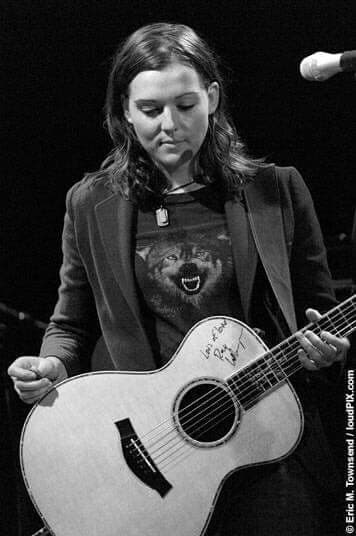
A defiant anthem of survival, “Broken Horses” turns scars into strength and memory into music.
Released in October 2021 as the lead single from the album In These Silent Days, “Broken Horses” marked a bold and unapologetic chapter in Brandi Carlile’s artistic journey. The song went on to win the Grammy Award for Best Rock Performance at the 65th Annual Grammy Awards, reaffirming Carlile’s place not just as a folk storyteller but as a commanding rock voice of her generation. Though it did not dominate the pop charts in the traditional sense, it resonated deeply across Adult Alternative and Americana audiences, becoming one of the defining tracks of her late-career renaissance.
From the very first thunderous guitar riff—driven by longtime collaborators Tim Hanseroth and Phil Hanseroth—the song announces itself with grit and urgency. This is not the gentle, pastoral Carlile of earlier favorites like “The Story.” Instead, “Broken Horses” charges forward with distorted guitars and pounding drums, evoking the spirit of heartland rock while carrying the emotional weight of confessional folk. It feels like a reckoning. And in many ways, it is.
The story behind the song is as compelling as the music itself. Carlile has spoken openly about growing up feeling different—about hardship, faith, identity, and the quiet struggles of coming of age in small-town America. The title, “Broken Horses,” is drawn from the imagery of animals that have been trained, tested, and bruised, yet remain strong and unbowed. It becomes a metaphor for resilience—for those who have been underestimated or misunderstood, yet refuse to be broken.
One of the song’s most striking lines, “I have been to the well and back again,” feels like a lifetime compressed into a single breath. There is no bitterness here, only clarity. Carlile sings not as a victim of circumstance but as someone who has wrestled with doubt and emerged stronger. The song’s lyrical themes—self-acceptance, faith challenged and reclaimed, generational memory—are delivered with a conviction that only comes from lived experience.
Musically, the production is expansive yet controlled. The electric guitars carry a sharp edge reminiscent of classic 1970s rock, while Carlile’s vocal performance moves between hushed introspection and full-throated declaration. Her voice, always expressive, sounds particularly weathered here—in the best possible way. It carries the grain of experience, the timbre of someone who has sung through both joy and heartbreak.
The album In These Silent Days, produced by Dave Cobb, was recorded largely in Nashville and conceived during a period of global uncertainty. Yet instead of retreating inward, Carlile chose confrontation. “Broken Horses” stands as the album’s emotional and thematic cornerstone. It is a declaration that silence can no longer contain the truth.
There is also a broader cultural resonance to the song. At a time when many artists chase fleeting trends, Carlile rooted herself firmly in authenticity. She did not soften her edges to fit contemporary radio formulas. Instead, she leaned into her influences—classic rock, gospel, Americana—and allowed them to collide with modern urgency. In doing so, she created a song that feels timeless rather than trendy.
For those who have followed her career since the mid-2000s, “Broken Horses” feels like a culmination. It carries echoes of her earlier vulnerability, yet it stands taller, more assured. It is the sound of an artist who has endured criticism, industry shifts, and personal trials—and who now sings with the authority of someone who has nothing left to prove.
In the end, “Broken Horses” is not merely a rock song. It is a testament. It reminds us that scars are not signs of weakness but of survival. And in Carlile’s hands, that message becomes something larger than music—it becomes memory, defiance, and, ultimately, grace.
 Oldies Songs