
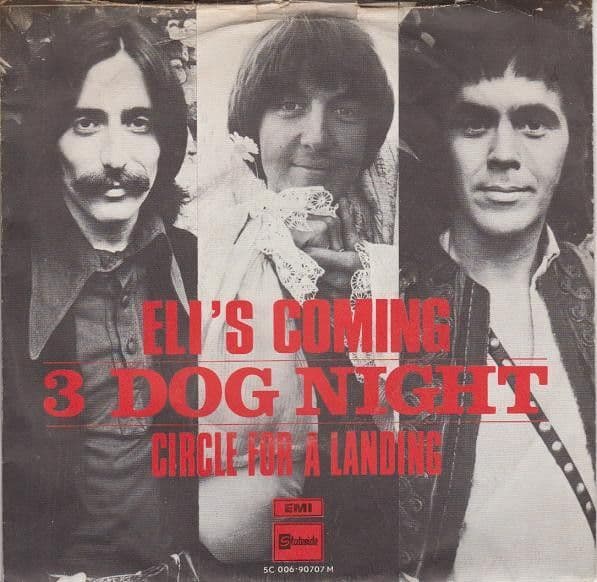
A thunderous warning about a charming destroyer — “Eli’s Coming” captures the thrill and danger of love rushing in like a storm you cannot outrun.
Few singles in the late 1960s carried the same urgent electricity as “Eli’s Coming” by Three Dog Night. Released in 1969 as the lead single from their second studio album, Suitable for Framing, the song quickly climbed to No. 10 on the Billboard Hot 100 in the United States. It became one of the band’s defining early hits, further establishing their reputation as one of the most successful American vocal groups of the era. At a time when rock music was splintering into psychedelia, folk-rock confessionals, and heavier blues influences, Three Dog Night carved out their own identity: dramatic, harmony-driven, radio-ready — yet never emotionally hollow.
What many listeners may not immediately recall is that “Eli’s Coming” was written by the inimitable Laura Nyro, one of the most influential and quietly revolutionary songwriters of her generation. Nyro first recorded the song for her 1968 album Eli and the Thirteenth Confession. Her version is moody, layered, almost mystical — but it was Three Dog Night’s more muscular, high-impact arrangement that brought the song into the mainstream. The group’s producer, Gabriel Mekler, recognized the theatrical tension in Nyro’s writing and amplified it with dramatic tempo shifts, bold horn accents, and tightly wound harmonies.
The vocal spotlight here falls on Chuck Negron, whose impassioned delivery gives the song its spine. When he sings, “Eli’s comin’, hide your heart, girl,” there is both warning and fascination in his voice. The phrasing is almost breathless, as if he himself has seen the damage and yet cannot look away. That duality — attraction and alarm — is what gives the song its enduring power.
Lyrically, “Eli’s Coming” is built around a simple but compelling premise: a charismatic, dangerous figure is on his way, and someone’s heart is at risk. But who is Eli? Nyro never spelled it out. Some have speculated that Eli represents an archetype — the seductive lover who leaves emotional wreckage behind. Others hear it as a metaphor for temptation itself, or even as a coded commentary on volatile relationships in the turbulent late 1960s. The ambiguity works in the song’s favor. Eli is whoever we once feared — and perhaps desired — despite knowing better.
Musically, the structure is unusually dynamic. The song opens with a brooding piano figure before erupting into a driving rhythm section. The verses build tension through syncopation and minor-key urgency, only to explode into that unforgettable chorus. The arrangement pulls back and surges forward again, mimicking emotional instability. This was not formulaic pop. It was controlled drama — a kind of miniature rock opera compressed into just under three minutes.
In the broader arc of Three Dog Night’s career, “Eli’s Coming” helped solidify a pattern: they were masters at interpreting songs written by others and transforming them into definitive radio classics. The band would go on to score a remarkable string of hits between 1969 and 1975 — 21 Top 40 singles in total — but this track remains one of their most theatrical statements.
Listening to it today, one can almost feel the atmosphere of 1969 — a year thick with change, uncertainty, and emotional intensity. There is something timeless in the warning embedded within the song. We have all known an “Eli.” We have all watched someone ignore the signs. And perhaps, in quieter moments, we have been the one arriving like a storm ourselves.
That is why “Eli’s Coming” still resonates. Not merely as a Top 10 hit, not merely as a showcase for powerful harmony singing, but as a vivid emotional snapshot — a reminder that love, especially the kind that dazzles at first sight, can carry both heat and hazard. The song does not judge. It simply warns. And in that warning, it finds its lasting echo.