
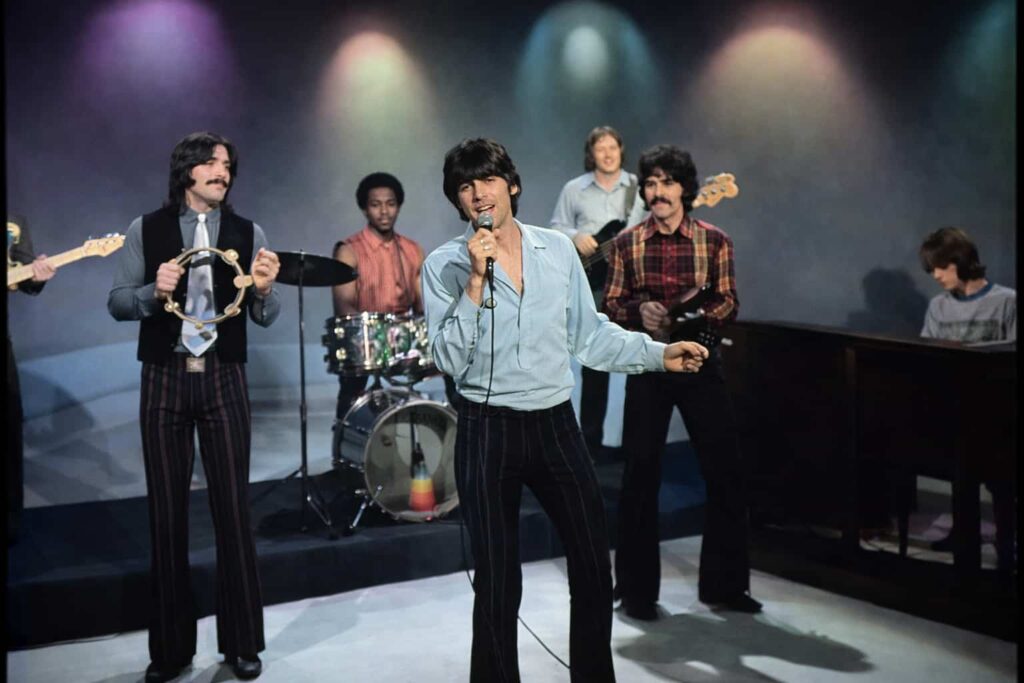
A defiant anthem about resilience, performance, and the quiet dignity of carrying on when the curtain refuses to fall
When “The Show Must Go On” by Three Dog Night was released in 1974, it arrived at a pivotal moment—not only for the band but for the entire era of early-’70s rock transitioning from idealism to introspection. The single climbed to No. 4 on the Billboard Hot 100 in the United States and reached No. 2 in Canada, reaffirming the group’s formidable presence on the charts at a time when musical tastes were rapidly shifting. It was featured on their album Hard Labor (1974), a record that itself reflected mounting tensions within the band and the pressures of relentless success.
Originally written and recorded in 1973 by British singer-songwriter Leo Sayer, whose theatrical persona and mime-inspired stage presence gave the song a literal circus flavor, the version by Three Dog Night transformed it into something altogether different. Where Sayer’s rendition leaned into vaudeville melancholy, Three Dog Night’s interpretation sharpened the edges, adding muscular rock instrumentation and the unmistakable lead vocal of Danny Hutton, whose slightly raspy tone carried both irony and ache. The band stripped away some of the theatrical whimsy and replaced it with urgency—turning the song from cabaret commentary into a rock statement of perseverance.
The opening lines—“Baby, although I chose this lonely life…”—introduce a narrator who appears to address a child, explaining the burdens of a life lived in the spotlight. On the surface, the song borrows imagery from the circus: painted clowns, costumes, spotlights. But beneath that imagery lies something far more intimate. It is a meditation on performance—not just on stage, but in life. The painted smile becomes a metaphor for the masks we wear; the spotlight becomes the unblinking gaze of expectation. And the repeated refrain, “I won’t let the show go on,” delivered with increasing emotional tension, suggests both resistance and inevitability. Eventually, the chorus turns toward acceptance: the show must go on.
For Three Dog Night, the song resonated with uncomfortable accuracy. By 1974, they had already placed 21 consecutive Top 40 hits on the Billboard chart between 1969 and 1975, including three No. 1 singles—“Mama Told Me (Not to Come),” “Joy to the World,” and “Black and White.” Few American bands of the period matched their commercial consistency. Yet behind the scenes, fatigue, internal disagreements, and the strains of fame were beginning to show. Listening to “The Show Must Go On” in that context, one hears not just a cover song, but a reflection of a band staring at its own reflection in the dressing-room mirror.
Musically, the arrangement is classic mid-’70s arena rock: bold piano lines, emphatic percussion, and layered harmonies that had always been Three Dog Night’s signature strength. But there is also restraint. The verses feel measured, almost conversational, before the chorus bursts forward with theatrical insistence. It is this push and pull—between vulnerability and bravado—that gives the track its enduring emotional weight.
Over time, the song has become more than a chart success. It has evolved into a cultural phrase, shorthand for endurance in the face of hardship. But in this particular recording, there is a subtle melancholy that lingers. It acknowledges that perseverance is not always triumphant; sometimes it is simply necessary. There is dignity in that necessity.
Looking back, “The Show Must Go On” stands as one of the final major hits in Three Dog Night’s golden run before their initial breakup in 1976. In hindsight, it feels almost prophetic—a curtain call disguised as a hit single. Yet it also serves as a reminder of why the band mattered: their ability to interpret outside material and make it feel personal, immediate, and emotionally honest.
In the echo of that chorus, one hears more than a rock refrain. One hears a generation learning that applause fades, spotlights dim, and yet life—like music—demands that we step forward once more.