
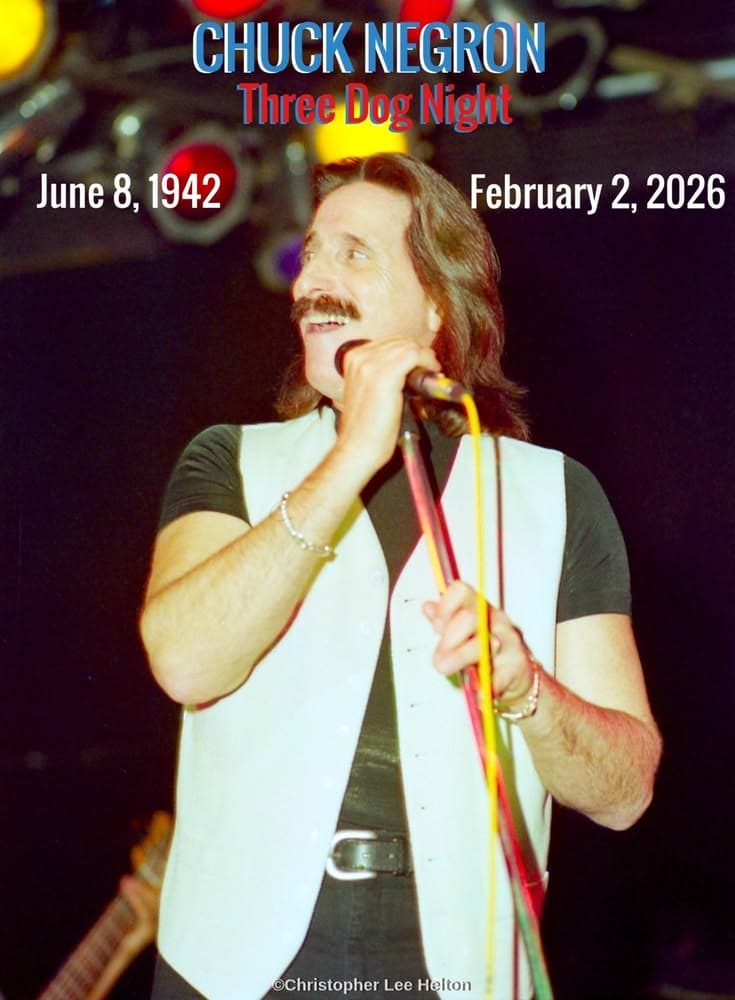
A tender hymn of hope and redemption, where a once-troubled voice finds grace in a timeless Disney melody
Few songs in the American popular canon carry the emotional weight and intergenerational tenderness of “When You Wish Upon a Star.” Written by Leigh Harline and Ned Washington for the 1940 Disney film Pinocchio, and first sung by Cliff Edwards, the song won the Academy Award for Best Original Song and eventually became the musical signature of Walt Disney itself. Though it was not a traditional pop chart hit in the modern Billboard sense at the time of its release, it became a standard—recorded by countless artists across decades, a melody woven deeply into the cultural memory of the 20th century.
When Chuck Negron, best known as one of the three lead vocalists of Three Dog Night, chose to record “When You Wish Upon a Star” in his solo years, he was not simply revisiting a beloved standard—he was, in many ways, reclaiming a part of himself. Negron’s voice had once soared through arena anthems like “Joy to the World” and “One,” helping propel Three Dog Night to multiple Top 10 hits on the Billboard Hot 100 throughout the late 1960s and early 1970s. Yet behind the chart success—three No. 1 singles and 21 consecutive Top 40 hits—lay a deeply personal struggle that would nearly end his career and his life.
By the time Negron recorded “When You Wish Upon a Star,” the context had changed. The song was no longer just a childhood lullaby about dreams coming true; in his hands, it became something more fragile, more lived-in. His interpretation does not carry the innocent brightness of the 1940 original. Instead, it is tinged with reflection—an adult’s understanding of loss, regret, survival, and renewal. His phrasing lingers slightly behind the beat, as if weighing each word. When he sings, “Fate is kind,” it sounds less like naïve optimism and more like gratitude earned the hard way.
It is important to remember that Chuck Negron’s career after Three Dog Night was marked by redemption. Following years of severe heroin addiction that led to the group’s collapse in the mid-1970s, Negron underwent rehabilitation and rebuilt his life. His later recordings, especially those of spiritual or nostalgic standards, often feel like personal testimonies rather than mere performances. In this light, “When You Wish Upon a Star” becomes autobiographical. The lyric—“Your dreams come true”—is no longer a fairy-tale promise, but a quiet affirmation that second chances are possible.
Musically, the song’s structure remains deceptively simple. Built around a gentle waltz-like progression, it allows the melody to float—almost suspended in air. That floating quality is what has made it endure. It does not demand attention; it invites contemplation. In Negron’s rendition, the orchestration is respectful and restrained, allowing his mature tenor to carry the emotional weight. There is less theatrical sparkle than in many Disney arrangements. Instead, there is warmth.
For those who first heard the song decades ago—perhaps in a darkened cinema, perhaps on a family record player—the melody carries with it images of another era: black-and-white screens, Sunday afternoons, simpler promises. Hearing Chuck Negron sing it later in life creates a layered experience. One hears not only the original childhood dream, but also the journey that follows—the roads taken, the mistakes made, the grace received.
In the broader history of American popular music, “When You Wish Upon a Star” stands as one of the most recorded and beloved standards ever written. Its legacy is not measured by peak chart positions, but by endurance. And when a voice like Chuck Negron’s—a voice that once filled stadiums and later carried the weight of survival—returns to such a song, it reminds us that music grows with us. The meaning deepens. The wish changes.
Sometimes, the star we look to is not above us in the sky, but behind us in memory. And in that quiet recognition, the song continues to shine.