
A playful anthem that reminds us love never grows old, no matter how many times the world tries to dismiss it.
When we speak of “Silly Love Songs”, we inevitably return to the spring of 1976—a season when pop music was in transition, disco was rising, and sentimentality was under attack by a new wave of cynicism. Yet into that atmosphere came a buoyant, irresistibly melodic single by Paul McCartney & Wings, titled “Silly Love Songs.” Released in April 1976 as the lead single from the album Wings at the Speed of Sound, it went on to achieve remarkable commercial success: it reached No. 1 on the Billboard Hot 100 in the United States and also climbed to No. 2 on the UK Singles Chart. By the end of 1976, it was ranked Billboard’s No. 1 song of the year in America—an extraordinary testament to its cultural reach.
The story behind “Silly Love Songs” is as compelling as its melody. By the mid-1970s, Paul McCartney was facing sharp criticism from some music journalists who claimed he had retreated into lightweight romantic themes after the dissolution of The Beatles. Rock critics, particularly in Britain, accused him of writing overly sentimental, “silly” love songs instead of tackling heavier social issues. McCartney’s response was neither defensive nor bitter. Instead, he answered with wit and melody. “You’d think that people would have had enough of silly love songs,” he sings in the opening line—acknowledging the criticism head-on. Yet he follows with a gentle, almost amused challenge: “I look around me and I see it isn’t so.”
Musically, the track is deceptively sophisticated. Built around a buoyant bassline—one of McCartney’s finest—it layers harmonies, counter-melodies, and vocal interplay with exquisite craftsmanship. The arrangement, driven by Wings members including Linda McCartney and Denny Laine, creates a shimmering texture that feels both playful and intricate. Beneath its bright exterior lies a subtle complexity: shifting vocal lines overlap in canon-like fashion toward the song’s extended coda, turning a supposedly “simple” love song into a miniature masterclass in pop composition.
At its core, “Silly Love Songs” carries a message that resonates deeply: love, no matter how often sung about, never loses its necessity. McCartney suggests that the world’s problems do not invalidate tenderness. Instead, affection, devotion, and emotional openness remain essential human experiences. In an era often defined by political turbulence and cultural shifts, the song gently insists that romantic expression is not trivial—it is timeless.
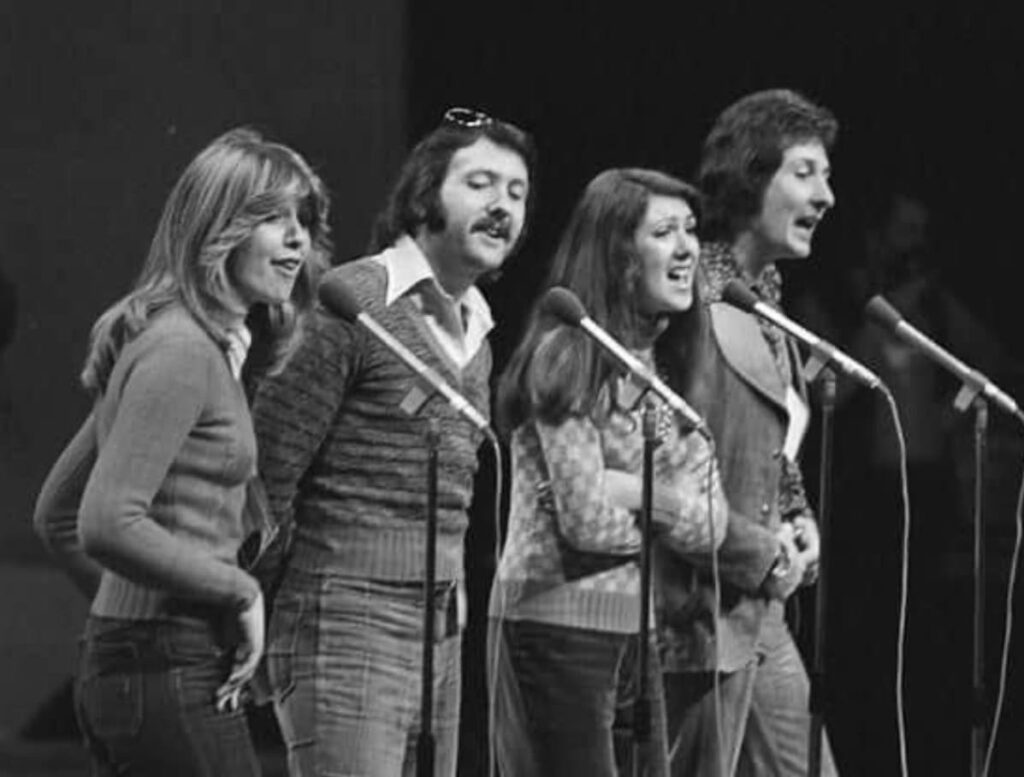
Interestingly, while the user mentions Brotherhood of Man, it is worth clarifying that “Silly Love Songs” was not recorded by them but by Paul McCartney & Wings. However, the mid-1970s pop landscape did see both acts flourishing in similar chart territories. Brotherhood of Man, the British vocal group best known for winning the Eurovision Song Contest 1976 with “Save Your Kisses for Me,” shared the era’s appetite for bright harmonies and accessible melodies. That same year, both acts contributed to a broader pop revival that embraced sweetness unapologetically.
Looking back now, decades later, “Silly Love Songs” feels less like a rebuttal and more like a reaffirmation. Its warmth carries us back to transistor radios on kitchen counters, to vinyl spinning softly in living rooms, to a time when melody felt like companionship. The bassline pulses like a steady heartbeat—reminding us that beneath every critique, beneath every passing trend, there remains something profoundly human in a simple declaration of love.
In hindsight, McCartney’s answer to his critics was not argumentative; it was melodic. He proved that a so-called “silly” love song could top charts, define a year, and endure for generations. And perhaps that is the quiet triumph of this piece: it stands as evidence that sincerity, when wrapped in craft and conviction, never goes out of style.
More than four decades on, the song continues to echo not as a novelty, but as reassurance—that in a complicated world, there is still room for uncomplicated affection. And maybe, just maybe, that is not silly at all.