
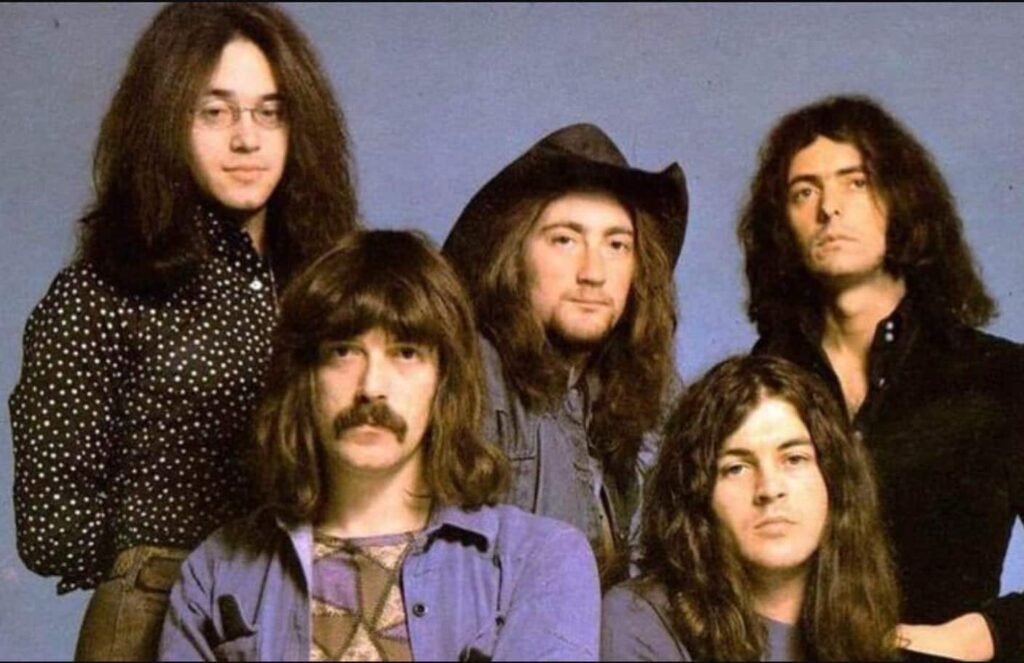
A Relentless Ode to Speed, Freedom, and the Untamed Spirit of Rock
When Deep Purple released “Highway Star” in 1972 as the opening track of their landmark album Machine Head, they were not merely presenting another hard rock number—they were igniting an engine that would roar through the decades. Although never issued as a major standalone single in the United Kingdom or United States at the time of release, the song’s impact was felt most powerfully through album sales and live performances. Machine Head reached No. 1 on the UK Albums Chart and No. 7 on the US Billboard 200, becoming one of the defining hard rock albums of the early 1970s. Over time, “Highway Star” would become one of the most celebrated live staples in the band’s repertoire and a cornerstone of what would later be called heavy metal.
The story behind “Highway Star” is one of those rare moments where spontaneity collides with destiny. In 1971, while traveling by bus to a concert in Portsmouth, England, a journalist asked the band how they wrote songs. Guitarist Ritchie Blackmore began improvising a sequence of chords on the spot, and vocalist Ian Gillan started ad-libbing lyrics about speed and cars. Within minutes, the framework of “Highway Star” was born. There is something fitting about a song about velocity being conceived in motion. It carries the romance of the open road and the sense that inspiration sometimes strikes when you are already halfway to somewhere else.
From its very first seconds, with Ian Paice’s driving drums and Blackmore’s relentless guitar riff, the song feels like acceleration itself. It does not ease the listener in; it launches forward. Roger Glover’s bass underpins the momentum, while Jon Lord’s organ lines—classically inspired yet fiercely modern—add a grand, almost baroque drama to the composition. The instrumental duel between Blackmore’s neoclassical guitar solo and Lord’s organ solo remains one of the most thrilling passages in rock history. Blackmore’s solo, structured almost like a Bach-influenced concerto, showed that heavy rock could be both technically sophisticated and viscerally electrifying.
Lyrically, “Highway Star” is deceptively simple. It speaks of a man who loves his car, who lives for speed, who identifies with the machine beneath him. Yet beneath the chrome and gasoline lies something more symbolic. The highway becomes a metaphor for autonomy, for breaking free from constraint, for embracing risk and momentum rather than stagnation. In the early 1970s—an era marked by cultural shifts, political uncertainty, and generational tension—the image of racing down an endless road resonated deeply. It was not merely about cars. It was about self-determination.
The track’s enduring reputation was cemented by its live renditions, particularly on the 1972 concert album Made in Japan, widely regarded as one of the greatest live albums ever recorded. The version of “Highway Star” on that record captured Deep Purple at their most explosive. Gillan’s vocals soar with reckless confidence, stretching into piercing high notes that feel both triumphant and defiant. Blackmore’s guitar sounds less like an instrument and more like a force of nature. For many listeners, that live version became definitive—proof that this was not just a studio creation, but a living, breathing beast of a song.
Critically, “Highway Star” has often been cited as one of the earliest fully formed examples of heavy metal. Its combination of speed, precision, aggressive riffing, and virtuosic soloing laid groundwork that countless bands would follow. Publications and critics have repeatedly included it in lists of the greatest hard rock songs ever recorded. Yet statistics and rankings only tell part of the story. What truly endures is the feeling it evokes.
For those who first heard “Highway Star” crackling through vinyl speakers in the early 1970s, it was more than background music—it was an anthem of motion in a world that sometimes felt stalled. The roar of the guitar echoed the rumble of engines on late-night roads. The organ solo felt like a cathedral hymn rewritten for electric amplifiers. And Gillan’s voice—urgent, bold, unapologetic—became the sound of youthful daring captured in permanent form.
Decades later, when that opening riff begins, time seems to fold in on itself. The highway stretches endlessly ahead once more. The air is filled with anticipation. And for four blazing minutes, “Highway Star” reminds us that the spirit of rock is not about standing still—it is about moving forward, fearless and free.