
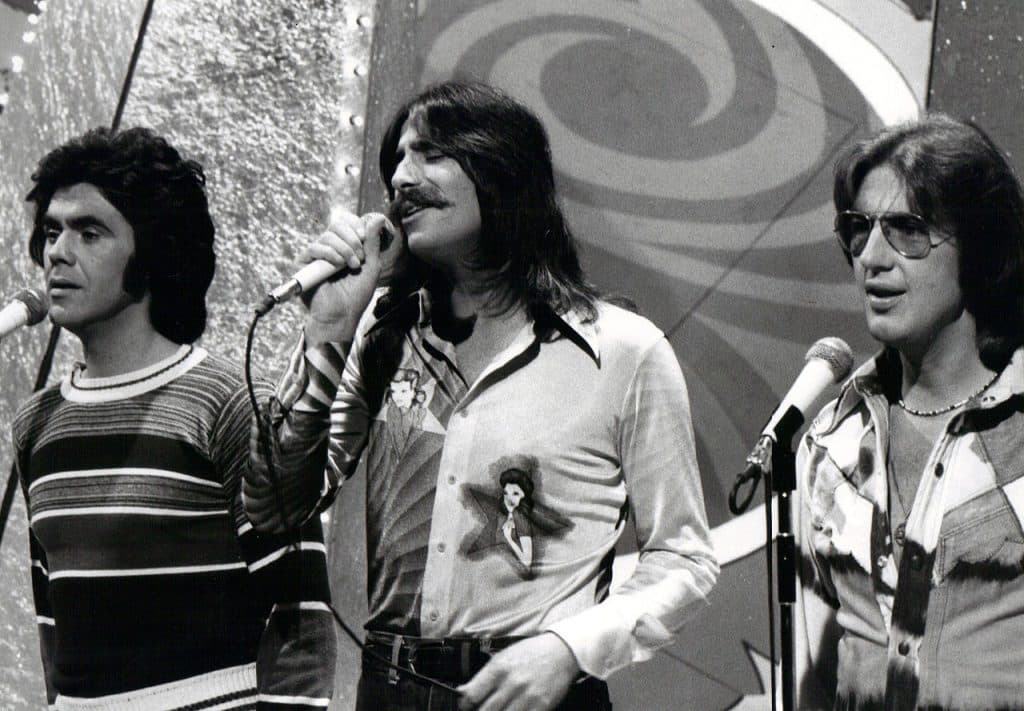
A Sacred Hymn Reimagined Through the Soulful Voice of Chuck Negron
Few songs carry the spiritual gravity and centuries-old resonance of “O Come All Ye Faithful.” When interpreted by Chuck Negron, the former lead vocalist of Three Dog Night, the hymn becomes more than a Christmas standard—it becomes a deeply personal testament, filtered through a voice that once defined the golden era of American rock.
Before discussing the emotional weight of Negron’s version, it is important to understand the history of the hymn itself. “O Come All Ye Faithful”—originally “Adeste Fideles”—dates back to the 18th century, most commonly attributed to English hymnist John Francis Wade around 1743. It is one of the most enduring carols in Western liturgical music. The hymn has never been tied to a conventional pop chart ranking in its original form, but it has appeared on countless Christmas albums, many of which have charted seasonally on the Billboard Christmas Albums chart over the decades. Its melody and lyrical invitation—“O come, let us adore Him”—have echoed through cathedrals, family living rooms, and concert halls for generations.
When Chuck Negron recorded “O Come All Ye Faithful” as part of his holiday repertoire, he brought with him a voice that carried history. As one of the three lead vocalists of Three Dog Night, Negron helped propel the band to extraordinary commercial success between 1969 and 1975. The group achieved 21 consecutive Top 40 hits on the Billboard Hot 100, including three No. 1 singles: “Mama Told Me (Not to Come)”, “Joy to the World”, and “Black and White.” That achievement alone places Negron in a rare echelon of American rock history.
But what makes his interpretation of “O Come All Ye Faithful” particularly moving is not chart placement—it is context. Negron’s life has been marked by both extraordinary triumph and painful descent. At the height of fame, he struggled with severe heroin addiction, a battle that nearly cost him everything. After years of hardship, incarceration, and recovery, Negron rebuilt his life with faith at its center. In that light, the hymn becomes more than tradition; it becomes testimony.
Listening closely to his rendition, one hears not the brash power of a rock frontman, but the tempered strength of someone who has walked through darkness. His tenor, once known for soaring pop hooks, now carries a reflective warmth. There is a subtle vulnerability in his phrasing—especially in the lines “Sing, choirs of angels” and “Word of the Father, now in flesh appearing.” These words feel less ceremonial and more intimate.
The arrangement itself typically honors the hymn’s classical structure. Unlike the high-production, orchestral Christmas recordings common in later decades, Negron’s approach leans toward sincerity rather than spectacle. It feels less like a commercial holiday single and more like a personal offering. That distinction matters.
For those who remember the era of Three Dog Night, hearing Negron sing a sacred carol creates an emotional bridge between two worlds: the vibrant, radio-driven optimism of early 1970s rock and the quieter, reflective spirituality that often comes later in life. The man who once energized stadium crowds with “Joy to the World” now channels reverence rather than exuberance. Yet the connection is undeniable—both songs, in their own way, are celebrations.
The meaning of “O Come All Ye Faithful” lies in its call to gather, to adore, to recognize something larger than ourselves. In Negron’s voice, that call carries the weight of experience. It suggests redemption, humility, and gratitude. One senses that the invitation to “come” is not merely directed outward—but inward as well.
Christmas music often risks becoming background noise—familiar, almost automatic. But when a voice with history sings an ancient hymn, the effect can be unexpectedly profound. Chuck Negron’s interpretation reminds us that sacred songs endure not simply because they are traditional, but because each generation reshapes them through lived experience.
And perhaps that is why this performance resonates. It is not about chart numbers or commercial success. It is about a seasoned voice meeting a timeless melody—and in that meeting, offering something honest, reflective, and quietly powerful.