
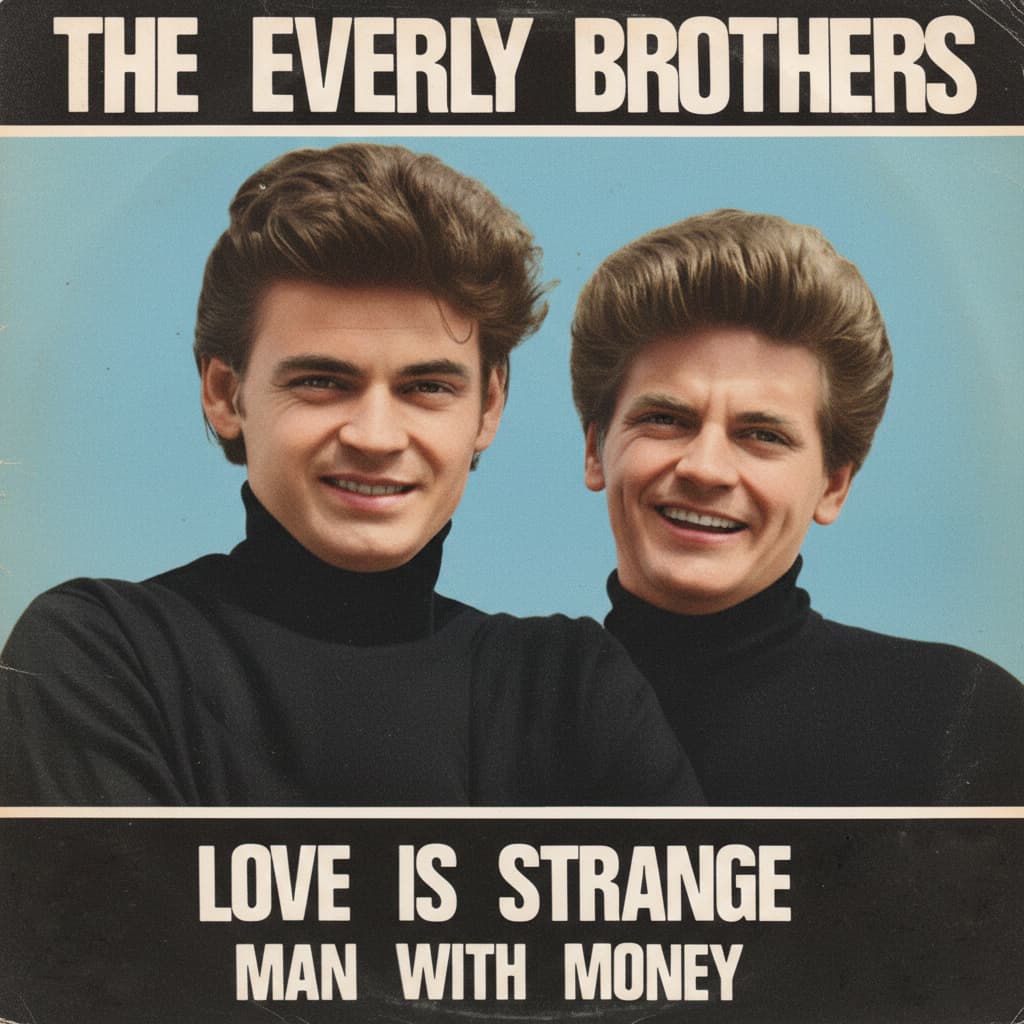
A rhythmic dialogue of shared glances and harmonic mastery, capturing the playful yet profound mystery of a heart finally finding its match.
Music has a curious way of acting as a time machine. Sometimes, it isn’t the grand, sweeping orchestral ballads that pull us back to the golden afternoons of the 1960s, but rather a simple, repetitive groove—a rhythmic pulse that feels like a heartbeat. When The Everly Brothers released their rendition of “Love Is Strange” in 1965, they weren’t just covering a song; they were revisiting a cornerstone of Rock & Roll history and draping it in their signature velvet harmonies.
Released as a standout single from their evocative album Beat ‘n’ Soul, this track represented a pivotal moment for Don and Phil Everly. While the song did not mirror the astronomical heights of their late-50s chart-toppers, it climbed to No. 11 on the UK Singles Chart and bubbled under the Billboard Hot 100 in the United States. For those who lived through the British Invasion and the shifting tides of the mid-60s, this recording remains a sophisticated bridge between the raw energy of early R&B and the polished, thoughtful “Close Harmony” style that defined the duo’s legacy.
The Story Behind the Groove
The origins of “Love Is Strange” are steeped in the lore of the 1950s. Originally written by the legendary Bo Diddley (often credited under his wife’s name, Ethel Smith) and made famous by the R&B duo Mickey & Sylvia in 1956, the song was a masterclass in flirtation. When The Everly Brothers stepped into the studio in 1965 to record it for Beat ‘n’ Soul, the world was changing. The Beatles were dominating the airwaves, and the simplicity of early Rock was evolving into something more textured.
Don and Phil chose to treat the song with a unique blend of reverence and innovation. While the original version relied on a gritty, calypso-inflected guitar riff, the Everlys’ version softened the edges. They took that iconic “spoken word” bridge the playful dialogue between two lovers and infused it with a sense of genuine camaraderie. Listening to it now, one can almost see the brothers standing before the microphone, exchanging knowing smiles as they navigated the rhythmic ” Sylvia!” call-and-response, adapting it into their own fraternal language.
A Reflection on the “Strangeness” of Love
The lyrical depth of “Love Is Strange” lies in its deceptive simplicity. It captures that universal, often perplexing realization that love is not a logical equation, but a whimsical, unpredictable force. The repetition of the lines “Love is strange / Lot of people take it for a game” serves as a gentle critique of the cynical, reminding us that for those who truly find “their baby,” the world shifts its axis.
For a listener who has walked the long path of life, these lyrics resonate differently than they did in youth. In 1965, it was a song to dance to at a social; today, it is a meditation on the enduring nature of companionship. The “strangeness” the song speaks of is no longer an abstract concept, but a lived experience the odd, beautiful coincidence of meeting someone who stays, the quirks that become beloved over decades, and the quiet rhythm of a life shared.
The Harmonic Craft of Beat ‘n’ Soul
The album Beat ‘n’ Soul was an ambitious project, seeing the brothers lean into a more “blue-eyed soul” sound. In “Love Is Strange,” their voices do not just sit on top of the music; they are woven into it. Their harmony is so tight, so “close,” that it becomes a single, shimmering instrument. This was the magic of The Everly Brothers: the ability to take a song rooted in the blues and elevate it into a piece of pop-rock art without losing its soul.
As we look back, this track stands as a testament to their versatility. It reminds us of a time when music was tactile the crackle of the needle, the weight of the vinyl sleeve, and the way a melody could hang in the air of a living room like incense. “Love Is Strange” remains a bittersweet reminder that while the charts may fade and the years may pass, a perfect harmony is timeless. It is a piece of our collective history that continues to whisper: love is indeed strange, and thank goodness for that.