
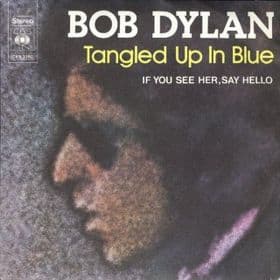
A Song of Love, Loss, and Memory Where Time Refuses to Stand Still
When Bob Dylan released “Tangled Up in Blue” in January 1975, it arrived not merely as a new single, but as a statement of artistic reckoning. Opening Blood on the Tracks, his fifteenth studio album, the song immediately set the emotional and narrative tone for what would become one of the most discussed and revered records in popular music history. Upon its release as a single, “Tangled Up in Blue” reached No. 31 on the Billboard Hot 100, a modest chart position by commercial standards, yet its cultural and artistic impact has only deepened with time.
Placed deliberately as the album’s first track, the song functions as a doorway into Dylan’s inner world at a moment of personal and creative upheaval. By 1974, Dylan was no longer the youthful prophet of the 1960s, nor the elusive country gentleman of the early 1970s. He was a man grappling with fractured relationships, shifting identity, and the passage of time. Blood on the Tracks, often associated with the unraveling of his marriage to Sara Dylan, is not a diary in the literal sense. Dylan himself resisted autobiographical readings. Yet the emotional truth embedded in “Tangled Up in Blue” feels unmistakably lived-in.
Musically, the song is deceptively simple. Acoustic guitar, steady rhythm, and Dylan’s conversational vocal delivery draw the listener inward rather than outward. There is no grand chorus demanding attention. Instead, the song unfolds like memory itself, fragmentary, nonlinear, and intimate. Dylan moves effortlessly between first and third person, between past and present, creating a sense that time itself is unstable. This narrative fluidity was radical in popular songwriting at the time and remains influential decades later.
The story within “Tangled Up in Blue” is not a single plot, but a collage of moments. Lovers meet and separate. Lives diverge. Cities change. Jobs are taken and abandoned. Lines such as the opening scene of heading out east to work on a fishing boat or the closing image of standing in the doorway with the woman still calling his name feel less like lyrics and more like remembered photographs. Each verse offers a glimpse into emotional states rather than fixed events. That ambiguity allows the song to age gracefully, meeting listeners wherever they are in life.
The phrase tangled up in blue itself carries profound symbolic weight. Blue has long been associated with melancholy, longing, and reflection in American music. To be tangled up suggests entanglement in memory, regret, love, and unresolved feeling. Dylan never defines it explicitly, which is precisely its power. The song invites interpretation rather than instruction. It acknowledges that life rarely offers clean endings or clear explanations.
Historically, “Tangled Up in Blue” also marks a turning point in Dylan’s songwriting approach. After years of surreal imagery and electric confrontation, he returned to narrative clarity without sacrificing complexity. This balance helped Blood on the Tracks earn its reputation as one of the greatest albums ever recorded, frequently appearing near the top of critical rankings worldwide. Over the years, Dylan has continued to perform the song in radically different arrangements, sometimes altering lyrics, sometimes reshaping melodies, as if the song itself were alive and evolving. Few compositions in popular music possess such flexibility without losing their emotional core.
For listeners who have lived through love gained and lost, roads taken and abandoned, “Tangled Up in Blue” resonates with particular depth. It does not offer comfort in the traditional sense. Instead, it offers recognition. It understands that memory is imperfect, that love leaves traces long after its form has changed, and that identity is something continually rewritten.
Nearly fifty years after its release, Bob Dylan’s “Tangled Up in Blue” endures not because it belongs to a specific era, but because it speaks to the universal human experience of looking back while still moving forward. It reminds us that life is not a straight line, but a series of crossings and recrossings, all bound together by emotion, memory, and time. In that sense, the song remains as vital today as it was in 1975, still quietly unraveling its meaning with every listen.
 Oldies Songs