
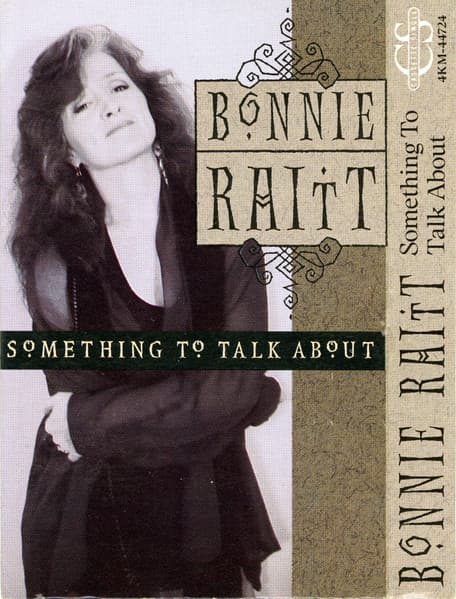
A song about love, rumor, and quiet devotion that turns everyday feeling into lasting truth
When Bonnie Raitt released Something To Talk About in 1991, it arrived not as a grand declaration but as a knowing smile. Placed prominently on her breakthrough album Luck of the Draw, the song quickly became one of the most recognizable moments of her long career. In commercial terms, it marked a high point. The single peaked at No. 5 on the Billboard Hot 100 and climbed to No. 1 on the Adult Contemporary chart, confirming that Raitt’s voice now spoke not only to loyal blues listeners but to a broad, mature audience who recognized themselves in her songs. The track later earned Raitt a Grammy Award for Best Female Pop Vocal Performance, a quiet but decisive acknowledgment of her artistry at midlife rather than youth.
The song itself was written by Shirley Eikhard, a Canadian songwriter whose work often balanced plainspoken language with emotional intelligence. When Raitt encountered the demo, she immediately recognized its strength. This was not a song about dramatic heartbreak or reckless passion. Instead, it focused on something far more familiar and far more enduring: the way love exists in the small spaces between people, shaped by rumor, routine, and the desire to be truly seen. Raitt’s decision to record it was instinctive, and her interpretation would transform the song into a defining statement.
At its core, Something To Talk About addresses the tension between public perception and private truth. The narrator observes the whispers and sideways glances that follow a couple through town, yet rather than deny them, she leans into the idea. If people are going to talk, let there be something real behind the talk. The brilliance of the song lies in its restraint. There is no melodrama, no attempt to persuade. Instead, there is confidence born of lived experience. This is love that does not need to announce itself loudly because it already knows its worth.
Musically, the song reflects Raitt’s gift for blending genres without ever sounding calculated. The arrangement draws from pop, roots rock, and subtle blues phrasing, anchored by a relaxed groove that mirrors the song’s emotional posture. Raitt’s guitar work is understated, serving the lyric rather than competing with it. Her voice, slightly weathered and unmistakably human, carries the weight of years. By 1991, Bonnie Raitt had already lived enough life for every word to sound earned. That authenticity is what allowed the song to resonate so deeply with listeners who had their own histories of love, compromise, and resilience.
The success of Luck of the Draw represented a second act that few artists achieve with such grace. Rather than chasing trends, Raitt embraced songs that reflected maturity, accountability, and emotional clarity. Something To Talk About stood at the center of that vision. It spoke to people who had moved beyond fantasy and understood that real connection is built slowly, sometimes quietly, often under the watchful eyes of others.
For many listeners, the song became a mirror. It reminded them of relationships that endured gossip, distance, or misunderstanding. It suggested that love does not always arrive with fireworks, but with a steady hand reaching for another in full view of the world. Decades later, Something To Talk About still sounds remarkably current, perhaps because its subject never ages. As long as people fall in love and others look on with curiosity, there will always be something to talk about.
 Oldies Songs